
Paper logs, spreadsheets, and disconnected systems make it easy to miss a detail — a follow-up call that never got logged, a medication dose recorded late, a screening referral that fell through the cracks. Those gaps create real compliance risk for nurses and districts alike.
This guide breaks down what belongs in a student health record, the standards that govern it, and how digital tools like MyCabinet help nurses document with less friction and fewer errors.
Key Takeaways
- Student health records must be accurate, timely, objective, and complete to protect students and staff
- Record visit notes, medication logs, screenings, immunizations, and parent communication as core health-record categories
- FERPA governs school health records; HIPAA rarely applies directly in the K-12 setting
- Digital, structured documentation closes the gaps that paper charts and spreadsheets leave behind
What Counts as a Student Health Record
Under FERPA, an education record is anything directly related to a student and maintained by the school or its agent. The U.S. Department of Education explicitly lists K-12 health records among them, in any format: paper, digital, video, or email.
For school nurses, that means the following all count as part of the student health record:
- Clinic visit notes and assessments
- Medication administration logs
- Screening results (vision, hearing, and others per state schedule)
- Immunization records
- Care plans: IHPs, 504 plans, and emergency action plans
- Incident reports and parent-signed forms
Health records aren't separate from education records. They fall under the same FERPA umbrella when the school or a school-affiliated provider maintains them. That distinction matters when a parent requests access or a student transfers.
Consistent recordkeeping matters most at transition points. When a student switches schools or sees an outside provider, a clean, structured record is often the only thing bridging the gap in their care history.
Core Elements to Record in Every Student Health Record
Every clinic encounter should capture four things: reason for visit, assessment, intervention, and outcome. Skip any one of these and the record tells an incomplete story.
Those four elements show up across the record types school nurses handle most often.
Objective, Fact-Based Observations
Write what you saw and measured, not what you assumed. Document vital signs, symptoms, and behavior in concrete terms.
- ❌ "Student seemed okay after resting"
- ✅ "Temperature 98.6°F, no visible distress, walked independently, returned to class at 10:42 a.m."

Medication Administration Records
Every medication pass needs a full audit trail. Per Colorado Department of Education guidance, records should include a written provider order, parent consent, and a per-student, per-medication log capturing:
- Drug name and dosage
- Administration time and route
- Student response or any unusual reaction
- Name or initials of the administering staff member
Errors (wrong dose, wrong time, missed dose, or refusal) need their own documented incident review, not a quiet correction.

Chronic Condition Care Plans
Asthma, diabetes, seizure disorders, and severe allergies require Individualized Healthcare Plans (IHPs) and emergency action plans.
Montana's health department guidance describes IHPs as living documents covering assessment, interventions, delegation, and evaluation. Review them at least annually, or whenever a student's status changes.
Screening Documentation
Vision, hearing, and other mandated screenings need a clear documentation trail:
- Date and screening tool used
- Result
- Any referral or follow-up action
North Carolina's School Health Program Manual is explicit: screenings without documented follow-up remain incomplete.
Structured visit types and predefined templates, like those in a nurse-centered EHR, cut down on missed fields. The system prompts for each required element instead of relying on memory.
Documentation Standards and Compliance Requirements
There's no single federal "10 standards" checklist, but a defensible school health record consistently reflects these qualities:
- Accuracy — reflects what actually happened
- Timeliness — recorded at or near the point of care
- Objectivity — facts, not impressions
- Completeness — no missing fields or follow-up gaps
- Legibility — readable by any authorized reviewer
- Authentication — signed or attributed to the staff member
- Confidentiality — accessible only to authorized users
- Consistency — same format across encounters
- Relevance — pertains directly to student care
- Retrievability — can be found quickly when needed

FERPA and State Retention Rules
FERPA guarantees parents access to records within 45 days of a request and blocks destruction of a record while a request is pending. It does not set a universal retention period. That comes from state schedules. For example:
| State | Retention Rule |
|---|---|
| Texas | Withdrawal + 7 years, or student's 21st birthday |
| Washington | 8 years after last health service |
| New York (immunizations) | 6 years, or 3 years past age 18 |
Check your state's specific schedule rather than assuming a national standard applies.
Where HIPAA Fits
HIPAA generally doesn't apply to schools directly. The 2019 joint HHS/Education Department guidance confirms that student health records maintained by or for a FERPA-covered school are treated as education records, not HIPAA-protected health information. That classification holds even when a contracted provider maintains them.
Audit trails still matter. Timestamps and user authentication protect nurses and districts when a record's accuracy is questioned later.
The Three Types of Documentation Nurses Should Know
Most school health documentation falls into three formats, each suited to different needs.
- Narrative documentation: free-text notes in the nurse's own words. Best for complex or unusual encounters; harder to standardize or search.
- Structured/templated documentation: checkboxes, dropdowns, and predefined visit types. Speeds routine clinic visits and reduces missed fields.
- Flowsheet/log-based documentation: tabular records for repeated data such as medication administration or screening logs.
Most school health platforms blend structured fields with narrative space, so nurses can move fast on routine entries and still explain exceptions that don't fit a dropdown.
Common Documentation Mistakes and How to Avoid Them
Three habits create the most risk in student health records:
- Vague language: "Student seemed fine" fails under review. Use observable detail: "No fever, ambulated without assistance, returned to class independently."
- Delayed entries: Charting hours later, after memory fades, invites errors and audit red flags. Record at or near the point of care.
- Incomplete parent communication logs: A missed outreach note is a liability gap if a parent later claims they were never notified. Log date, method, and content for every contact.
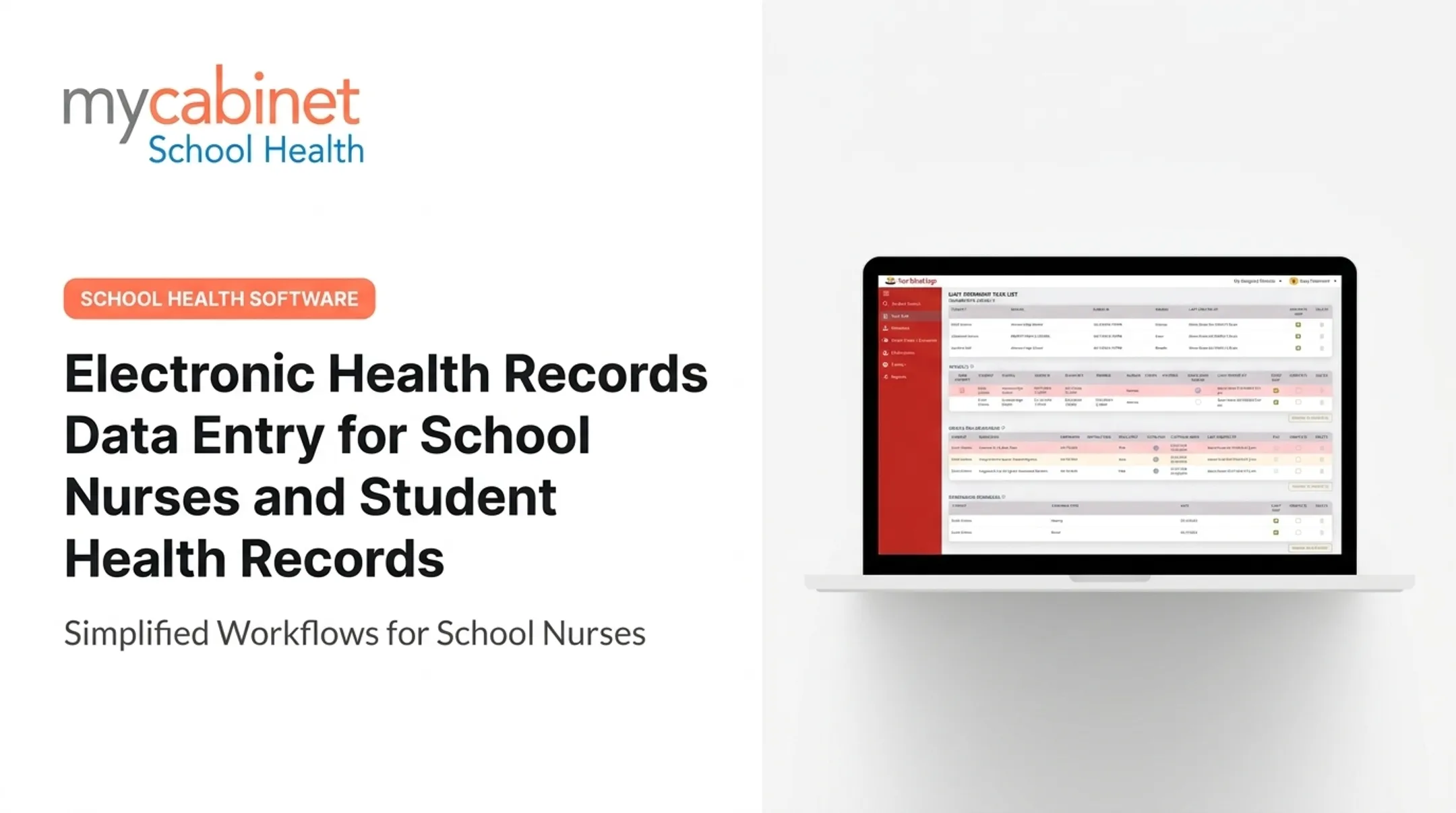
Digital task-based tools help close these gaps automatically. MyCabinet's intelligent task list, for instance, surfaces:
- Incomplete visits needing follow-up
- Scheduled rechecks
- Medications nearing expiration
Nurses do not have to track these follow-ups from memory. The system flags them so nothing slips during a busy clinic day.
How Digital Platforms Improve School Health Documentation
A purpose-built school health EHR connects the pieces that paper systems keep separate. MyCabinet structures visit documentation, medication tracking, and parent communication in one centralized student record. Visit history, medications, allergies, care plans, and notes live together instead of across binders and spreadsheets.
Digital form collection replaces the printer-scanner-email chain entirely:
- Schools notify parents that a form needs completion
- Parents upload documents through the Parent App or Parent Web Portal
- Nurses review and approve submissions in the Nurse Portal
- Approved documents attach directly to the student's health record
Role-based access keeps records FERPA-aligned by design. Parents see only their own child's information. Nurses access what they need for care. Administrators get oversight dashboards with audit trails and activity logs, without exposing more than each role requires.

A connected system cuts the manual follow-up, phone tag, and lost forms that pull nurses away from care.
Frequently Asked Questions
What are care documents?
Care documents are the records generated during student care encounters: visit notes, treatment plans, medication logs, and communication records documenting what was observed and done.
What are the three types of documentation?
Narrative (free-text notes), structured/templated (checkboxes and dropdowns), and flowsheet/log-based (tabular records like medication logs). Most school health systems combine all three.
What are the standards for documentation in health care records?
Common criteria include accuracy, timeliness, objectivity, completeness, legibility, authentication, confidentiality, consistency, relevance, and retrievability. This is a practical synthesis rather than one official federal list.
How long should school nurses retain student health records?
Retention varies by state and district policy, often 6 to 8 years past a triggering event like graduation or last service. Immunization records may follow separate rules, so check your state's records retention schedule directly.
Do school nurses need to document every clinic visit, even minor ones?
Yes. Every visit needs a record for legal protection, continuity of care, and pattern identification. Even a simple headache visit can matter later if it becomes part of a larger health trend.