
Modern school health work touches attendance, chronic disease management, medication safety, mental health, and family trust. And it all runs on one thing: accurate, accessible student health records.
When those records live in filing cabinets, spreadsheets, or a nurse's memory, care slows down. Forms get lost. Medication expirations go unnoticed until a student needs an inhaler that expired last month. This article breaks down what school health actually covers, what belongs in a student health record, how records should move through daily workflows, and how districts can protect sensitive information while doing it.
Key Takeaways
- Coordinated school health ties nursing care, prevention, mental and physical well-being, and family communication into one system.
- Complete, current records let nurses manage visits, medications, screenings, and emergencies without repeated data hunts.
- Defined permissions, audit trails, and documented retention practices are non-negotiable for FERPA and HIPAA compliance.
- Digital record systems cut administrative burden when they mirror real nurse workflows rather than act as document storage alone.
What School Health Programs Aim to Achieve
School health isn't a single service. It's a coordinated set of policies, education, and environmental supports built to protect students' physical, mental, emotional, and social well-being.
The CDC's Whole School, Whole Community, Whole Child (WSCC) model frames this well. It's a student-centered framework that explicitly links health with academic achievement, built around ten interconnected components — from physical education and nutrition to health services, counseling, and family engagement.

Why Health and Learning Are Connected
Untreated conditions don't stay contained to a student's health chart. A child with unmanaged asthma misses class for ER visits. A student with an unaddressed mental health need struggles to focus. Missing a dose of ADHD medication changes a whole school day.
Research backs this up. A 2023 study on targeted school-nurse interventions found that overall absenteeism didn't shift much, but absence rates among students with chronic health conditions dropped significantly when nurses actively managed their care (Stone et al., Journal of School Nursing, 2023).
Coordinated school health isn't a magic fix for attendance broadly. It's a targeted lever for the students who need it most.
Shared Responsibility, Not a Solo Job
School health depends on collaboration:
- School nurses manage clinical documentation, medication administration, and emergency response
- Administrators oversee compliance, reporting, and district-wide policy
- Teachers and counselors watch for changes that may need a referral, and follow approved accommodation plans
- Families submit forms, update information, and respond to outreach
- Community providers coordinate on chronic-condition management outside school hours
That collaboration still has a clear boundary. Routine school nursing is not the same as a school-based health center.
A school-based health center is typically an on-campus clinic run by an external or community provider, offering services like physicals or vaccinations. School nursing is the day-to-day health support embedded in the school's own staff and systems. The two can coexist, but they aren't interchangeable.
What Belongs in a Student Health Record?
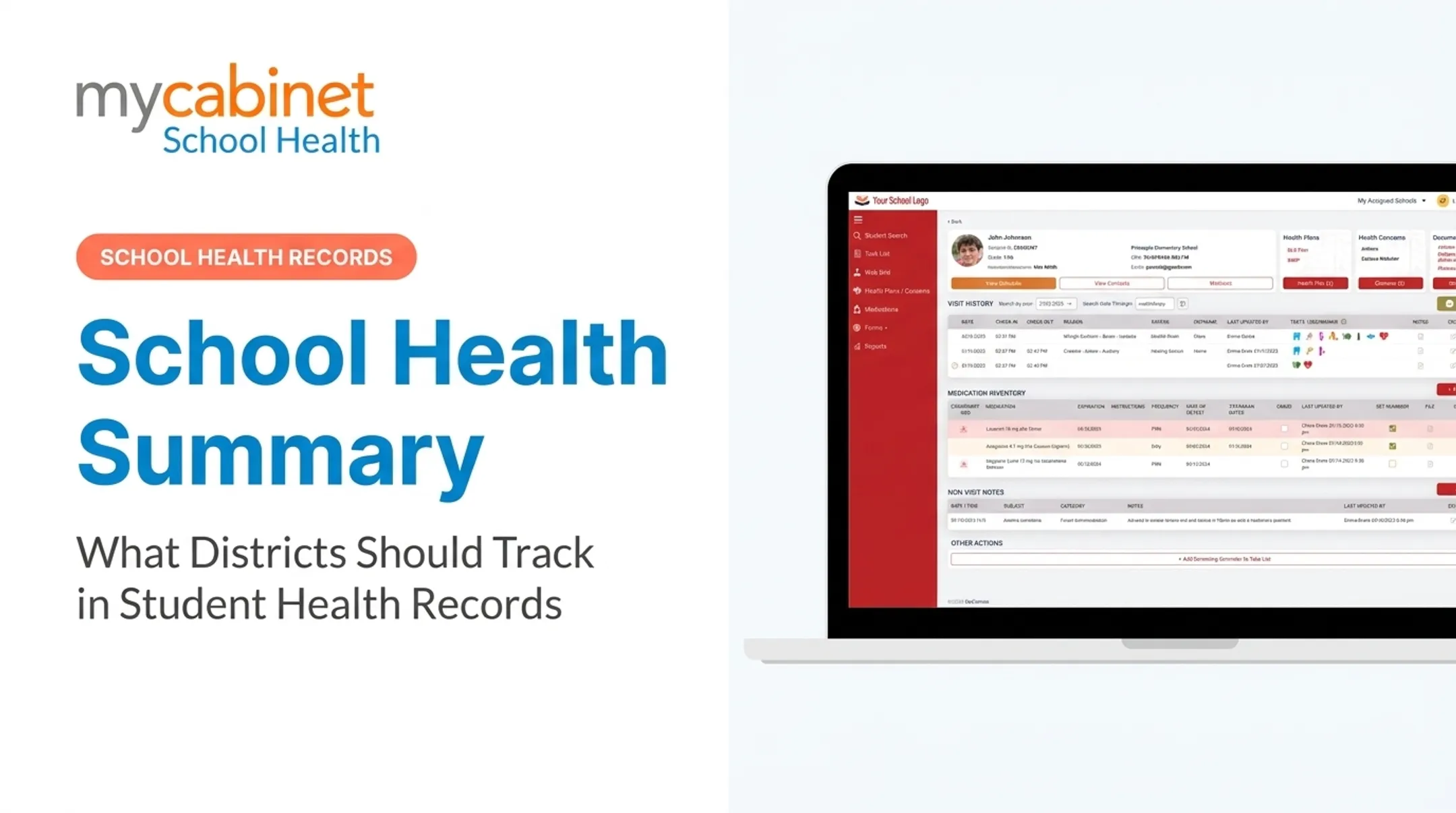
A student health record is the reference point a nurse relies on to make a safe decision in under two minutes, during a routine visit or a fast-moving emergency.
The National Association of School Nurses (NASN) sets a clear documentation bar: records should be timely, accurate, legible, complete, retrievable, and securely protected (NASN, 2024).
Core Demographic and Emergency Information
This is the foundation nurses reach for first:
- Authorized emergency contacts and relationship details
- Allergies and disclosed diagnoses or conditions
- Health alerts requiring immediate attention
- Parent/guardian authorization for emergency treatment
Data minimization matters here. Collect what's operationally necessary, follow district policy on what qualifies as sensitive, and avoid gathering information "just in case."
Clinical and Preventive Documentation
- Nurse visit notes and non-visit notes
- Immunization records and required screenings (vision, hearing, scoliosis)
- Health assessments, 504 Plans, and Individualized Healthcare Plans (IHCPs)
- Care plans, accommodations, and documented follow-up actions
Medication-Related Records
Medication documentation deserves its own category because the stakes are higher and the paperwork is heavier:
- Authorization forms signed by prescriber or parent
- Medication details — name, dosage, frequency, instructions
- Administration logs documenting each dose given (or refused)
- Expiration tracking with storage and disposal notes
- Outreach records when a refill or renewal is needed
This is where a platform like MyCabinet School Health earns its place in the workflow. Its parent app view shows active medications stored at school alongside expiration dates, so a nurse isn't discovering an expired EpiPen the day a student needs it.

Forms and Family-Submitted Documentation
A practical workflow looks like this: a parent uploads a required form digitally, then a nurse reviews it for completeness and either approves it or requests a correction. The accepted document attaches directly to the student's profile. No printing. No inbox archaeology.
Quick checklist for record categories:
| Category | Examples |
|---|---|
| Required | Emergency contacts, allergies, immunization records |
| Operational | Visit history, screening results, medication logs |
| Sensitive | Mental health notes, chronic diagnoses, Medicaid data |
Separating these categories helps schools apply the right access rules to each.
How Student Health Records Should Be Managed in Daily School Workflows
Good record-keeping covers a full lifecycle: collect, verify, review, document, follow up, update, and eventually retain or transfer according to policy.
Structure Reduces Chaos, Not Nuance
Standardized visit types and fields make records consistent across nurses and school sites. But structure shouldn't crowd out clinical judgment. A nurse still needs open space for context-specific notes: what actually happened, what was observed, what was said.
Task Lists Beat Sticky Notes
The single biggest workflow failure in school health is information sitting unactioned in an inbox, a paper folder, or someone's memory. Work queues that surface time-sensitive items solve this:
- Incomplete visits needing follow-up
- Scheduled rechecks
- Medications approaching expiration
- Screenings due or overdue
- Missing or unapproved forms
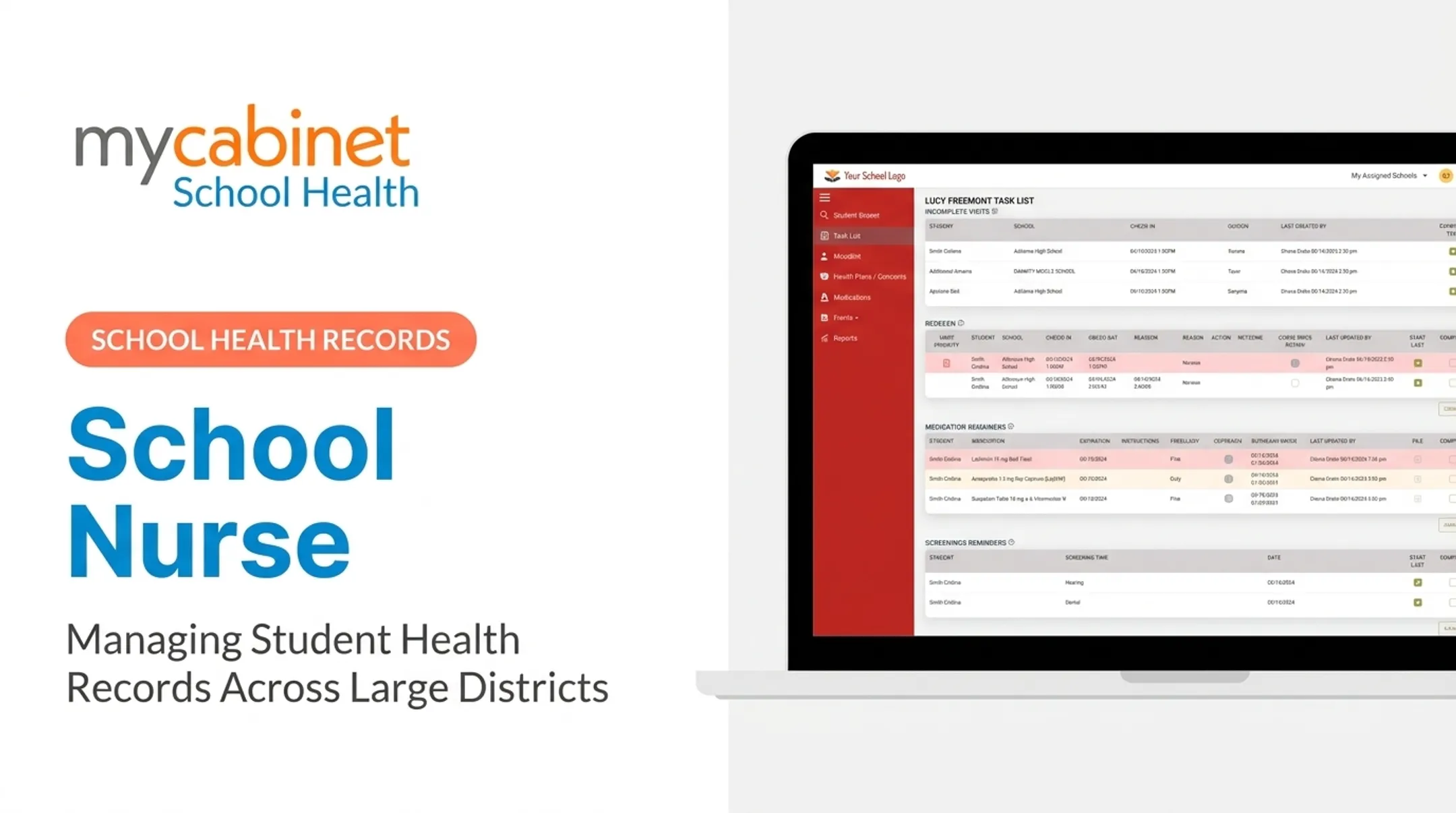
MyCabinet School Health's Nurse Portal is built around exactly this kind of task-first structure. Rather than a passive record archive, it surfaces incomplete visits, recheck reminders, and medication alerts on a dashboard, with checkboxes and completion tracking, so nothing quietly expires in a drawer.
Medication Oversight Is an Active Process
Medication management requires more than storage and dispensing:
- Confirming orders are current and properly authorized
- Monitoring expiration dates before they lapse
- Documenting every administration, including refusals
- Logging outreach attempts (date, method, notes) when a renewal is needed
- Escalating unresolved issues per district procedure
A Realistic Emergency Scenario
Picture a student with a known peanut allergy having a reaction during lunch. A substitute is covering the health office.
With a well-managed record system, that substitute can pull up the emergency action plan, allergy details, and epinephrine location in seconds. No call to the regular nurse is required. Authorized personnel get exactly what's needed, and nothing beyond it.

Document Changes, Don't Erase History
When information changes, add a new entry with a timestamp and user identification rather than overwriting the old one. Audit trails exist for this reason: they show who changed what, and when, which matters for both continuity of care and compliance reviews.
How Records Support Students, Families, and School Teams
Health records only matter when a school can act on what it already knows.
Fewer Repeat Requests, Faster Decisions
When a nurse can open current medications, allergies, and care plans in one place, decisions move faster—and families stop getting asked for the same document three times a year.
The CDC notes that more than 40% of U.S. school-aged children have at least one chronic health condition (CDC, 2024). In-school management is often what keeps those students safely in class.
Nurses who lack easy access to attendance and health data name that gap as a top barrier to reducing chronic absenteeism, according to a qualitative study of school nurse perspectives (Rankine et al., 2021).
Controlled Communication, Not Chat Overload
Families need updates, not a flood of messages. Useful communication looks like:
- Requests for missing or expiring forms
- Medication expiration reminders
- Visit notifications after a clinic stop
- A clear record of outreach attempts
MyCabinet School Health handles this with one-way notifications for clinic visits and medication alerts rather than open messaging threads, so outreach stays purposeful.
Access Should Match the Need
Teachers and staff don't need full health records. They need what's relevant to keep a student safe and supported, such as an allergy alert or an accommodation plan, without visibility into unrelated diagnoses or notes.
Continuity Across Transitions
Students move between schools, grade levels, and sometimes districts. Every transition is a risk point for lost information. Before relying on a transferred record, verify it is current and complete—not just present.
When systems are connected across a district, a student's profile can update automatically after enrollment changes. Even then, sync can take days or weeks depending on the district's process.
Privacy, Security, and Compliance Considerations
This is where school health gets legally layered, and the layers don't always overlap the way people assume.
Which Rules Apply Depends on Context
FERPA typically governs education records maintained by a school or by someone acting on the school's behalf, including a school nurse. According to HHS guidance, those records are generally protected under FERPA, not HIPAA, even if care happens off school grounds.

HIPAA can apply instead when an outside provider, one not employed by or contracted to the school, delivers services and is a HIPAA-covered entity.
State student privacy laws, health department rules, and district policy add another layer on top of both. The applicable framework depends on the school, the provider, the record type, and the specific activity. There's no single blanket answer, so treat this as a "verify per situation" area rather than a fixed rule.
Practical Safeguards Worth Implementing
- Role-based access with least-privilege permissions
- Strong authentication and data encryption
- Secure backups and device controls
- Regular staff training on privacy procedures
- Documented incident response plans
- Periodic access reviews
Logs showing who viewed, added, changed, approved, or shared a record aren't bureaucratic overhead. They're what let a district answer "what happened here" during an investigation or a routine compliance check.
Follow state, district, and records-management requirements for how long to keep records and how to dispose of them. There's no single universal retention period; it varies by jurisdiction and record type, so this is a policy-lookup task, not a guess.
Communication Channels Need Rules Too
Not everything belongs in a text message or email. Sensitive health details shouldn't travel through unsecured channels.
Parent portals, apps, and notification systems need defined permissions specifying what can be shared and how. MyCabinet School Health's app, for example, is intentionally one-way for clinic and medication alerts. Parents who need to reach the nurse directly contact the clinic, which avoids exposing sensitive detail in an open chat stream.
MyCabinet School Health is FERPA compliant, HIPAA compliant, and AICPA SOC 2 certified. That's useful context as one data point, but schools should still run their own legal, security, and procurement review before adopting any system.
Implementation Checklist for Better Student Health Record Management
Improving record management doesn't require ripping everything out at once. Start with an honest audit.
Step 1: Audit Current Workflow
Look for:
- Paper forms duplicating digital ones
- Manual re-entry of the same data
- Unclear handoffs between staff
- Medication tracking gaps
- Slow retrieval of essential information during time-sensitive moments
Step 2: Define Ownership
For each record type, answer:
- Who collects it?
- Who reviews and approves it?
- Who may access it?
- When must it be updated?
- How is missing information escalated?
Step 3: Standardize, But Stay Flexible
Standardize visit categories, medication documentation, screening records, and communication templates. Leave room for student-specific notes; not every case fits a template.
Step 4: Choose Technology Deliberately
Evaluate options on:
- Nurse usability (not just admin-side features)
- Interoperability with student information systems
- Parent and family experience
- Permission granularity and auditability
- Vendor security documentation
Step 5: Pilot, Train, Measure
Test with a small group of schools first. Collect nurse feedback before scaling. Track measures like form completion rates, retrieval time, unresolved tasks, and parent response rates. Establish your own baseline before comparing results.
Step 6: Review Regularly
Revisit the process periodically with nurses, administrators, families, and district compliance leaders. Workflows and regulations both shift over time.

Once ownership, standards, and metrics are in place, many districts evaluate connected platforms that support the workflow—not just store files.
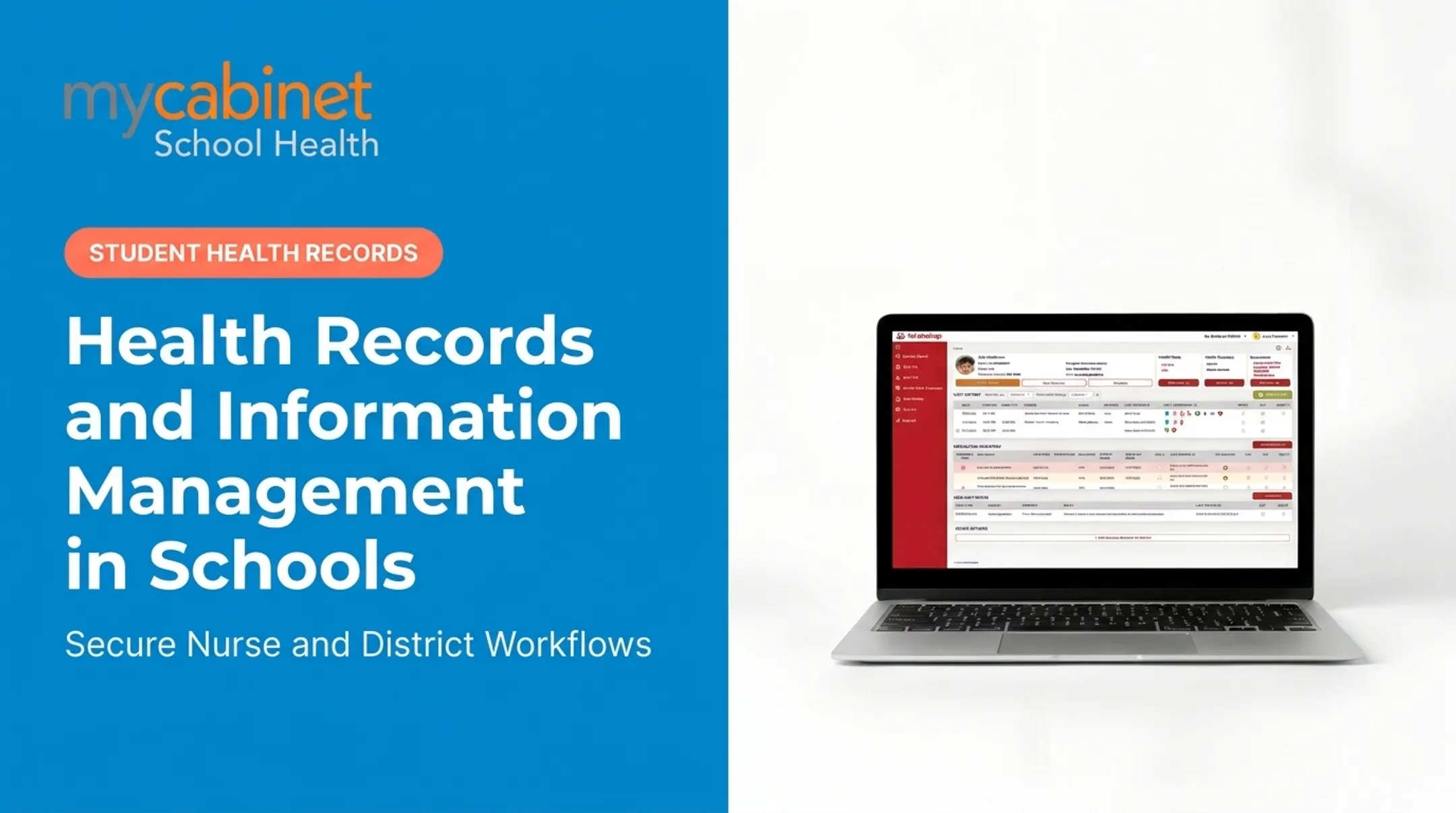
MyCabinet School Health pairs a Nurse Portal with a Parent App and Parent Web Portal, centered on digital forms, controlled notifications, and standardized health documentation rather than a static archive.
Frequently Asked Questions
What are the responsibilities of school health services?
School health services generally cover prevention, health assessments, emergency response, medication support, health education, care coordination, and family communication. Specific responsibilities vary by jurisdiction and district policy.
What is the role of a teacher in a school health program?
Teachers help maintain a supportive environment, notice changes that may need referral, and follow approved health or accommodation plans. They don't diagnose or provide nursing care, and they protect student privacy along the way.
What is the difference between a nurse and a school nurse?
Both are licensed nursing professionals; a school nurse practices in the school setting rather than a hospital or clinic. Their day-to-day focus is prevention, care coordination, health education, and emergency response shaped by school policy and student needs.
What is the most important goal of a coordinated school health program?
The central goal is helping students achieve better health, safety, well-being, attendance, and readiness to learn through coordinated support across the school community.
What information should be included in a student health record?
Essential information includes emergency contacts, allergies, conditions, medications, authorizations, visit notes, screenings, care plans, forms, and follow-up documentation. Keep records current and limited to what staff need for care and compliance.
How can schools protect student health records?
Schools should use role-based access, secure systems and communication channels, staff training, audit logs, and data minimization. Compliance with FERPA, applicable health privacy rules, state law, and district policy is non-negotiable.