
More than 40% of U.S. school-age children have at least one diagnosed chronic condition, according to CDC data cited in recent school health research. Asthma alone affects nearly 4.8 million children under 18. Generic protocols don't work for this population — each student needs a plan built around their specific triggers, medications, and daily realities.
The problem: many schools still juggle paper files, spreadsheets, and sticky notes to track it all. That fragmentation puts both student safety and compliance at risk.
This guide covers what individualized care plans (IHPs) actually are, how they differ from an IEP or 504 plan, their legal standing, and how to build one that holds up under scrutiny.
Key Takeaways
- An Individualized Care Plan (IHP) captures a student's health needs, goals, and the school-based interventions staff must deliver
- IHPs support day-to-day clinical management but carry different legal weight than an IEP or 504 plan
- A complete IHP covers health history, daily needs, measurable goals, action steps, and emergency procedures
- Digital school health platforms improve documentation accuracy and reduce compliance gaps versus paper systems
What Is an Individualized Care Plan for Students?
An IHP is a nursing document created by the school nurse for students managing chronic illness, allergies, disabilities, or complex medical needs. It translates a physician's orders into specific, actionable steps school staff can follow safely.
It is the operational bridge between a doctor's diagnosis and what actually happens in a classroom, cafeteria, or gym.
Individualized Care Plan vs. Related Documents
Schools often confuse the IHP with related student documents that serve different purposes:
| Document | Owner | Purpose |
|---|---|---|
| IHP | School nurse | Nursing assessment, goals, and school-day care |
| IEP | Special education team | IDEA-governed education plan with measurable academic goals |
| 504 Plan | School administration | Nondiscrimination accommodations under Section 504 |
| Emergency Care Plan (ECP) | School nurse | Step-by-step response for untrained staff during an emergency |

These aren't interchangeable. A student can have an IHP without an IEP or 504 plan, and vice versa. FERPA governs how these education records are accessed and shared, generally requiring written consent before disclosure, with an exception when a student's health or safety is at risk.
Is an IHP a Legal Document?
An IHP doesn't carry the same statutory enforceability as an IEP, and no federal law mandates a single national IHP format.
It is still a critical clinical and liability-protecting record. The National Association of School Nurses holds nurses accountable for documentation that is timely, accurate, complete, and securely protected. When care is questioned, the IHP is often the first record reviewed.
What makes an IHP defensible:
- Dated entries for every interaction
- Parent or guardian sign-off on the current version
- A clear audit trail showing who accessed or changed the plan
Core Components of a Student Individualized Care Plan
A solid IHP isn't a form you fill out once. It's a living document with six essential parts.
1. Student and medical background Diagnosis, current medications, known allergies, past treatments, and baseline health status. This is the foundation everything else builds on.
2. Specific needs and daily considerations What support does this student need today, in class, at lunch, during PE? Examples:
- Medication administration timing
- Mobility assistance
- Dietary restrictions or substitutions
3. Goals and desired outcomes Measurable, student-specific objectives. "Self-administers rescue inhaler with supervision by 4th grade" is a goal. "Manage asthma better" is not.
4. Action steps and responsibilities Who does what, how often, and how it gets logged. Vague responsibility is where errors creep in. A 2000 survey of school nurses found 48.5% of nurses reported a medication administration error, with missed doses the most common failure.
5. Emergency and escalation procedures Step-by-step protocol for seizures, allergic reactions, or blood sugar crashes, including when to call parents versus 911.
6. Review and update schedule Creation date, review intervals, and required re-approval after any health change.

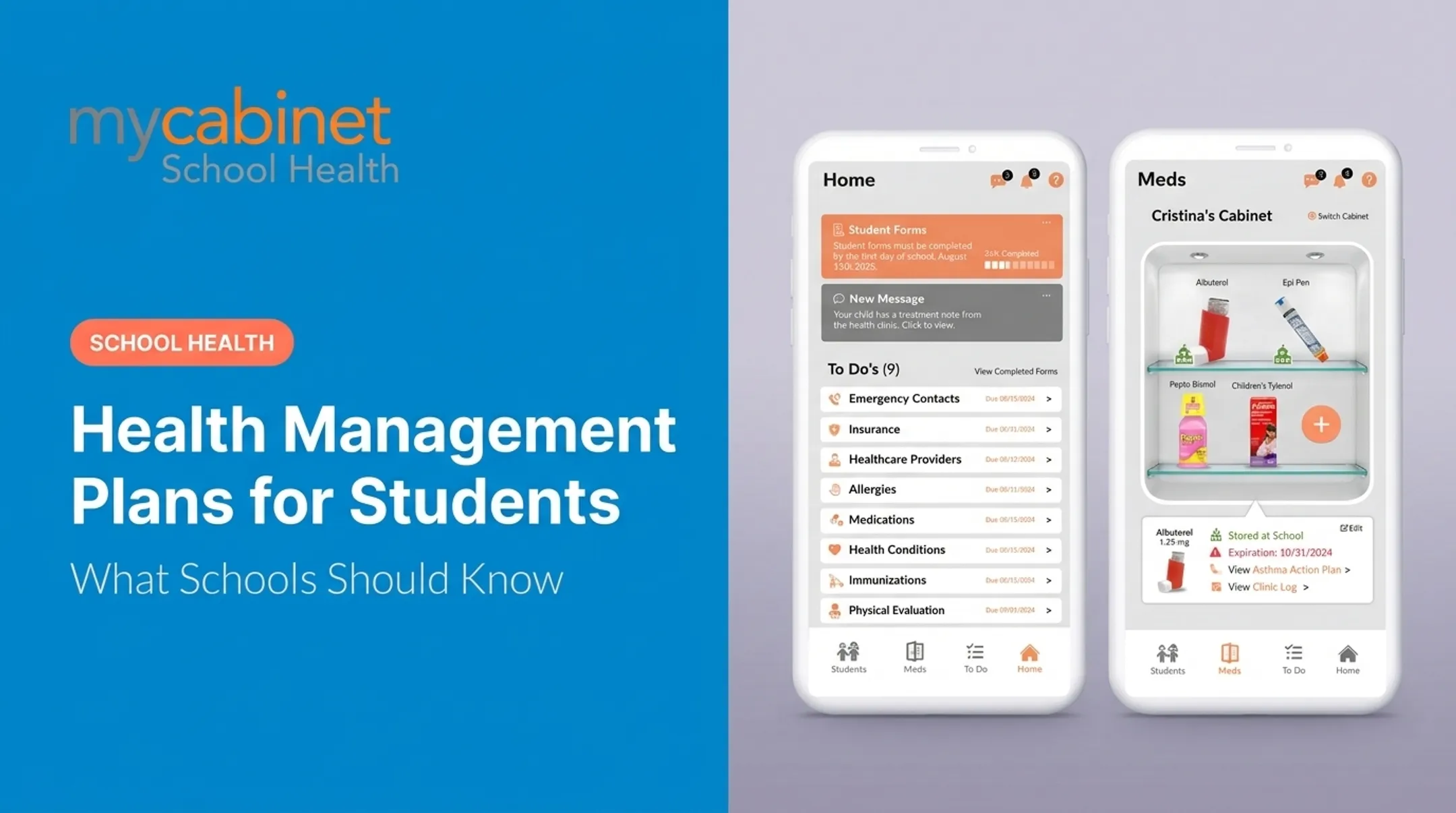
These components only help if the right details are findable in seconds. On a MyCabinet School Health student profile, chronic conditions like asthma or seizure disorder sit alongside emergency contacts and current medications, so nurses aren't hunting through binders during a crisis.
How to Develop an Individualized Care Plan
A workable IHP is built in a clear sequence. Follow these steps:
- Gather clinical documentation — Collect physician orders, parent input, and prior school records so the full health picture is in one place.
- Involve the student and family — Match goals to age and ability. A 14-year-old managing insulin needs different targets than a kindergartner starting treatment.
- Translate medical orders into school actions — Define frequency, responsible staff, and what daily support looks like on campus.
- Build in emergency protocols — Assign specific roles to teachers, coaches, and front-office staff before an incident happens.
- Set a review cadence — Require nurse and parent sign-off whenever the plan changes.

A centralized digital system cuts much of the manual tracking burden. MyCabinet’s structured visit documentation and task lists help nurses monitor plan reviews, catch medication expirations, and log parent outreach without depending on a spreadsheet only one person can update.
Example Individualized Care Plans by Condition
Condition-specific plans keep day-to-day response clear for every staff member who may need them:
- Asthma: Document known triggers (cold air, exercise, pollen), the rescue inhaler protocol with dosage and timing, and any activity accommodations for PE or recess.
- Type 1 diabetes: Include the blood glucose monitoring schedule, insulin administration steps per provider orders, and a clear hypoglycemia response: symptoms to watch for, glucose source to administer, and when to escalate.
- Severe food allergy: Outline the avoidance plan, exact location of the epinephrine auto-injector, administration steps, and cafeteria coordination so substitute staff aren't guessing.
In a MyCabinet student record, a plan for a student like "Shawn" can link his asthma action plan to tracked medications such as albuterol. The nurse sees the full picture in one place instead of cross-referencing three systems.

Keeping Care Plans Current and Compliant
An outdated IHP is worse than no plan at all. It creates false confidence.
Common risks with stale plans:
- Medications past expiration still listed as active
- Substitute nurses following outdated instructions
- Audit gaps when a plan hasn't been reviewed in over a year
The 2020 GAO report on school health documentation flagged incomplete records, delayed parent notification, and hard-to-reconstruct audit trails as direct liability risks for schools.
Role-based access helps close this gap. Only staff who need to see a plan should see it, and any change should leave a trace.
MyCabinet School Health uses one-way notifications, not open chat threads, to alert parents about clinic visits and medication expirations. Families stay informed without a new communication channel to monitor.
The platform also organizes incomplete visits, rechecks, and expiring plans into task lists automatically. Nothing sits forgotten in a filing cabinet or a nurse's memory.

Frequently Asked Questions
What is an individualized care plan?
In schools, it's a nurse-created document outlining a student's health needs, care goals, and the specific interventions required during the school day.
What are the main components of an individualized care plan?
Typical components include health background, daily needs, measurable goals, action steps with assigned responsibility, emergency procedures, and a review schedule.
How do you develop an individualized care plan for a student?
Start with clinical documentation from providers and families, set measurable goals with student input, translate orders into specific school actions, and build in a regular review schedule.
Is an IHP a legal document?
Not in the same way an IEP is. But it's a critical clinical record, and poor documentation can create real liability if a student's care is ever questioned.
Can you provide an example of an individualized care plan?
A student with asthma might have a plan listing known triggers, rescue inhaler protocol, and PE accommodations, cross-referenced with the school's medication log.
What is an example of a self-care plan?
As students mature, IHPs can build in self-management goals—like checking blood sugar or using an inhaler independently—with staff supervision stepped down over time.