
That documentation isn't paperwork for its own sake. It's the safety net that protects students, backs up nurses in disputes, and keeps parents in the loop when they can't be in the room.
This guide walks through the legal requirements, what belongs in every entry, the mistakes that trip up even experienced staff, and how digital platforms are changing the way schools track medication.
Key Takeaways
- Documentation protects student safety, supports FERPA and state nursing practice act compliance, and keeps parents informed
- Every entry needs the rights of medication administration plus outcome notes—not just a checkbox
- Timeliness and consistency across staff matter as much as accuracy
- Digital platforms cut errors and paperwork vs. paper logs
Why Documentation Matters in School Health Settings
A single school nurse often covers multiple buildings and hundreds of students. Documentation becomes the only continuity link between clinic visits, substitute coverage, and the parents who need to know what happened.
Records also serve as legal protection. If a parent disputes a dosage or a student has a reaction, the medication administration record (MAR) is often the deciding piece of evidence for both the nurse and the district.
State nursing practice acts and school health regulations set the bar. A nationwide review in the Journal of School Nursing surveyed 6,298 school nurses across all 50 states. Medication-administration policies were reported at:
- District level: 84.8%
- State level: 43.5%
- School level: 12.3%
Policy coverage isn't uniform, so clear documentation habits matter even more.
The stakes are real. A study of North Carolina's 115 public school districts found an average of 78 medication errors requiring medical intervention reported each year, and 27% of districts developed corrective action plans in a given year.
That same research found 76% of student medications were given by unlicensed assistive personnel, not nurses. Documentation still has to hold up when the person giving the dose isn't a nurse.

What to Include When Documenting Medication Administration
A complete entry does more than confirm a dose was given. Minnesota Department of Health guidance outlines the minimum fields every MAR should capture:
- Student identifying information: full name, date of birth, and grade to prevent mix-ups during busy clinic hours
- Medication name, dosage, route, and time: checked against the parent/physician authorization on file
- Administering staff name or initials: recorded immediately, not before the dose and not at day's end
- Refusals, missed doses, or observed reactions: with parent notification logged
- Expiration checks and inventory counts: especially for controlled substances
- Any deviation from the standard order: early or late dose, self-administration, or other exceptions, with a short explanation
Authorization matters as much as the entry itself. Colorado's Department of Education, for example, requires both a written healthcare-provider order and written parent consent before medication can be given at school.
District forms often go further. Cobb County School District's medication form requires the prescriber's signature, parent/guardian signature, and instructions that match the prescription label exactly.
The Six Rights (Plus Documentation) Framework
Most nurses already know the "five rights" of medication administration from clinical training. Minnesota's school health guidance adds a sixth, specific to the school setting.
- Right student — confirmed before anything is opened
- Right medication — matched against the authorization form
- Right dose — verified against the order and student record
- Right route — confirmed before administration
- Right time — given within the ordered window
- Right documentation — recorded immediately, accurately, and legibly

That sixth right exists because school clinics rarely have a second nurse to double-check work. In a hospital, a colleague often catches errors before they happen.
In a school, documentation is frequently the only safety check. Skipping it creates more than a paperwork gap. It raises liability for the nurse and the district when something goes wrong and no record explains what happened.
Common Documentation Mistakes and How to Avoid Them
An audit of 154 medications in school health offices, published in the Journal of School Nursing, found discrepancies tied to transcription errors, missing physician orders, timing issues, and incomplete documentation. These failure points show up most often. Each has a straightforward fix:
- Document each dose immediately after administration, not in an end-of-day batch from memory
- Record the exact time and clinical reason for every PRN ("as needed") dose
- Standardize one documentation system across buildings instead of mixing paper logs, spreadsheets, and unarchived emails
- Check expiration dates before each dose so expired medication never reaches a student
Minnesota's guidance is direct about what counts as an error: wrong student, wrong medication, wrong dose, missed dose, wrong time, wrong route, or wrong documentation. Any of the first five require both a student-record entry and a formal incident report. Tight point-of-care documentation closes that sixth gap and stops most of the others from slipping through.

How Digital Tools Are Modernizing Medication Documentation in Schools
Many districts still run on paper MARs, faxed authorization forms, and manual spreadsheets. That setup leaves administrators and parents with zero real-time visibility into whether a dose was given, missed, or refused.
The National Association of School Nurses' 2024 position statement makes the standard clear: school health records need to be timely, accurate, legible, complete, retrievable, and securely protected. NASN specifically identifies electronic health records as supporting that standard, provided the system is built around the nursing process rather than repurposed from a generic student information system.
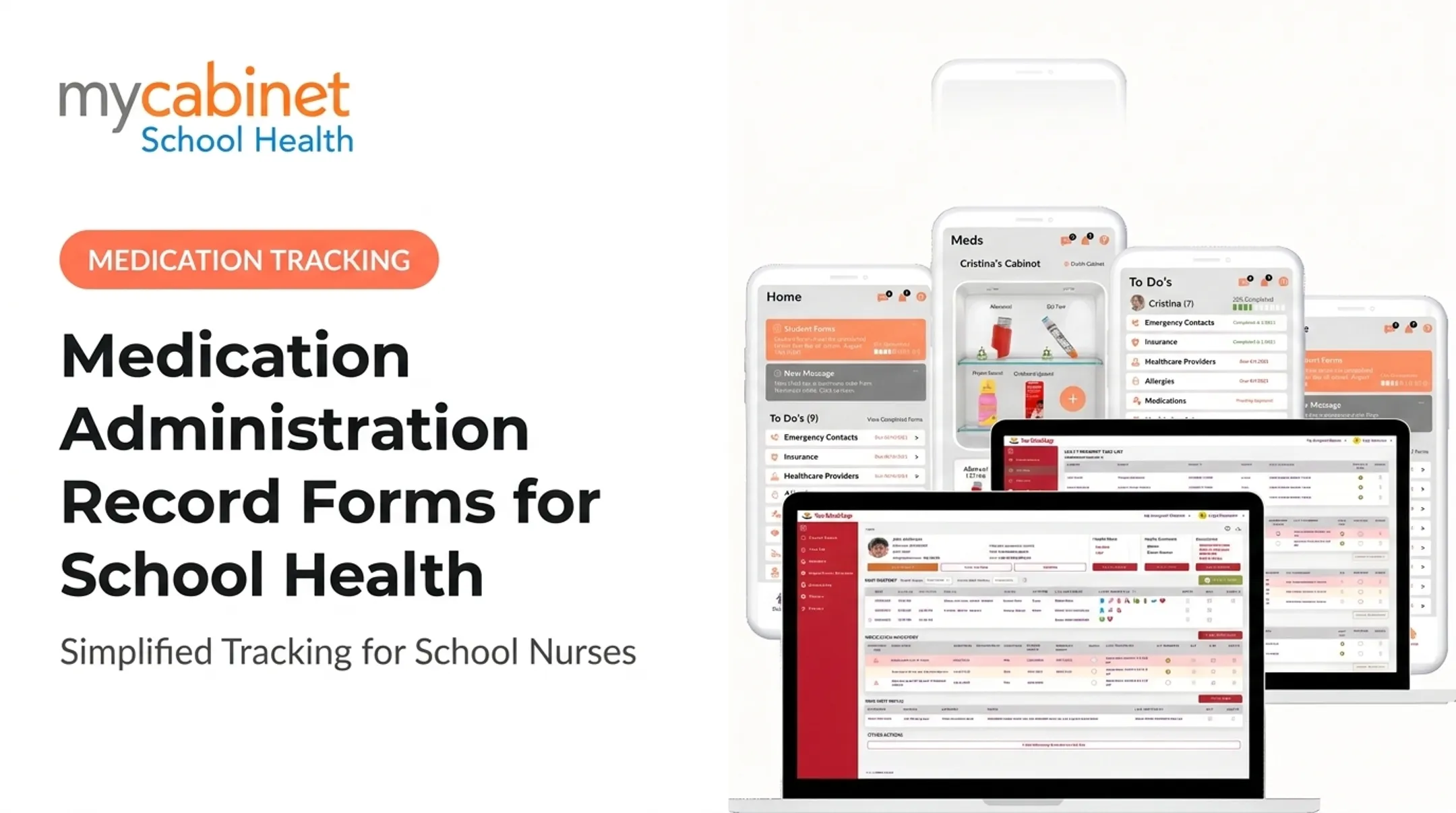
That's the gap a platform like MyCabinet School Health is built to close. Instead of a static log, work is organized into intelligent task lists so nothing gets missed during a chaotic clinic period:
- Medication tasks, expirations, and dosage/frequency tracking
- Structured visit documentation with predefined visit types
- Audit trails that support FERPA-aligned recordkeeping
- Less manual paperwork for nurses and administrators

The Parent Portal and app add another layer. Controlled, one-way notifications alert families when school-stored medication is nearing expiration, with the approximate date and time to replace it. Nurses stay focused on clinical work instead of managing an unrestricted messaging channel.
Cobb County School District has been moving in this direction. At a 2025 school board meeting, Superintendent Chris Ragsdale noted that digitizing paperwork made documentation easier and gave both parents and the district better visibility into medication administration. That shift moves districts away from the fragmented paper-and-email tracking many still rely on.
Best Practices Checklist for Compliant Medication Documentation
Compliant medication documentation comes down to a handful of habits, applied consistently:
- Standardize your MAR template — digital or paper, used the same way in every building
- Document immediately — never in advance, never after a delay
- Train every staff member — include substitutes on district-specific protocols and error-reporting steps
- Audit logs periodically — catch gaps internally before a compliance review finds them for you
None of these require new hires or a bigger budget. They require consistency — and consistency is where paper systems break down across buildings and shift changes.
Frequently Asked Questions
When documenting medication administration, what should be included?
Student identifying information, medication name/dose/time/route, the administering staff member's name, and any observations, refusals, or reactions. See the full checklist above for details.
What are the legal requirements for medication documentation in schools?
Requirements vary by state nursing practice act and district policy, but nearly all require signed parental and physician authorization plus timely, accurate logging of every dose given.
How soon after giving medication should a school nurse document it?
Immediately. Waiting until the end of the day increases the risk of errors, omissions, and inaccurate timing that can't be reliably reconstructed later.
What happens if a student refuses medication at school?
The refusal must be documented, the parent notified, and district protocol followed. Refusals count as medication errors under most state guidance and require the same reporting as a missed dose.
Can school staff other than nurses administer and document medication?
Yes, in many states, trained and delegated unlicensed personnel can administer medication under a nurse's supervision. The nurse remains accountable, and documentation is still required for every dose.
How can schools reduce medication documentation errors?
Standardized templates, consistent staff training, and digital EHR platforms with task lists and audit trails all reduce the gaps that lead to errors, particularly across substitutes and multiple buildings.