
Schools and childcare centers must track and report immunization compliance for every enrolled child, often under tight state timelines. Miss the window, and students can face exclusion from class while nurses scramble to chase down paperwork.
Many nurses still rely on paper records, fax-based exchanges with pediatrician offices, and manual spreadsheet tracking. That combination creates last-minute exclusion notices, frustrated parents, and hours of administrative work that pulls nurses away from student care.
This guide covers the legal requirements behind immunization reporting, the challenges nurses face daily, how exemptions work, and how digital tools like MyCabinet School Health simplify the entire process.
Key Takeaways
- Immunization reporting is a legal requirement under state health codes, not a school preference
- Manual tracking raises compliance risk and piles extra work onto school nurses
- Digital tools cut errors and give nurses and families real-time visibility
- Exemption rules vary by state and require careful, ongoing documentation
- Childcare centers often follow different reporting windows than K-12 schools
What Is Immunization Reporting and Why Is It Required?
Immunization reporting is the process of collecting, verifying, and submitting student vaccination records to satisfy state and local health department mandates. Schools treat it as a condition of enrollment, not optional paperwork.
There's no single federal law dictating school vaccine requirements. Instead, state law establishes vaccination requirements for public schools, private schools, and childcare facilities, according to the CDC. Ohio, for example, requires protection against 10 vaccine-preventable diseases under state law before a child can attend school.
Most states also require schools to report data into a state Immunization Information System (IIS), which combines records from multiple providers into one official source used for school and childcare entry.
Missing or incomplete reporting has direct consequences:
- Students can be excluded from class until records or a valid exemption are on file
- Districts can lose funding — California may dock average daily attendance payments when schools improperly admit noncompliant students
- State health departments audit conditional-admission and overdue rates, raising compliance exposure

Childcare vs. K-12 Reporting Timelines
Those same mandates often run on different calendars for childcare and K-12. Washington State, for instance, requires childcare providers to report annually between November 1 and December 1, while K-12 immunization status is reported separately through the school system.
Who Is Responsible for Immunization Reporting?
- School nurses, health aides, or administrative staff typically manage collection, verification, and submission of records
- Parents are responsible for supplying proof of vaccination or valid exemption documentation before or shortly after enrollment
Common Challenges Schools and Nurses Face
Ask any school nurse what eats up their morning, and immunization compliance usually tops the list.
Manual cross-checking: Comparing paper immunization cards against state-required vaccine schedules by hand is slow and error-prone, especially with hundreds or thousands of students enrolled.
Missing-record outreach: A national survey of 1,435 kindergarten school nurses found that parent outreach for undervaccinated students relies heavily on phone calls (96%), postal mail (67%), newsletters (61%), and email (59%) — a patchwork of methods that takes real time to coordinate.
That same survey found 85% of nurses already use electronic immunization documentation in some form, yet only 32% use a statewide IIS directly. That gap means a lot of manual double-entry still happens between systems.
Other recurring pain points:
- Tracking errors when records live across spreadsheets for hundreds of students
- Missed booster deadlines (such as 7th-grade doses) that turn into compliance violations
- No single view of which students are nearing exclusion status
Understanding Immunization Exemptions and Documentation
Exemption rules get complicated fast, because they differ so much state by state.
Three exemption categories exist, but availability varies:
- Medical exemptions — available in all 50 states and DC
- Religious exemptions — allowed in 47 jurisdictions
- Personal-belief/philosophical exemptions — allowed in only 18 jurisdictions, including Arizona, Ohio, Texas, and Washington

Documentation standards differ by state, too. California requires a medical exemption signed by a California-licensed MD or DO. The form must name the condition, the exact vaccines exempted, and whether the exemption is temporary or permanent. Temporary exemptions can't exceed 12 months.
Other states take a different path. Colorado, for example, accepts either an online education module or a medical provider's signature for non-medical exemptions.
New York doesn't allow any non-medical exemptions for school attendance — only medical ones are accepted.
Schools need to track exemption expirations just as closely as vaccination due dates. A temporary medical exemption that quietly lapses can leave a student out of compliance until an audit or state report surfaces the gap.
How Digital Immunization Tracking Improves Reporting Accuracy
Centralizing immunization data changes the daily reality for a school health office. Instead of hunting through folders, faxes, and spreadsheet tabs, nurses work from one digital record per student. That single source of truth is what keeps compliance data consistent when reports are due.
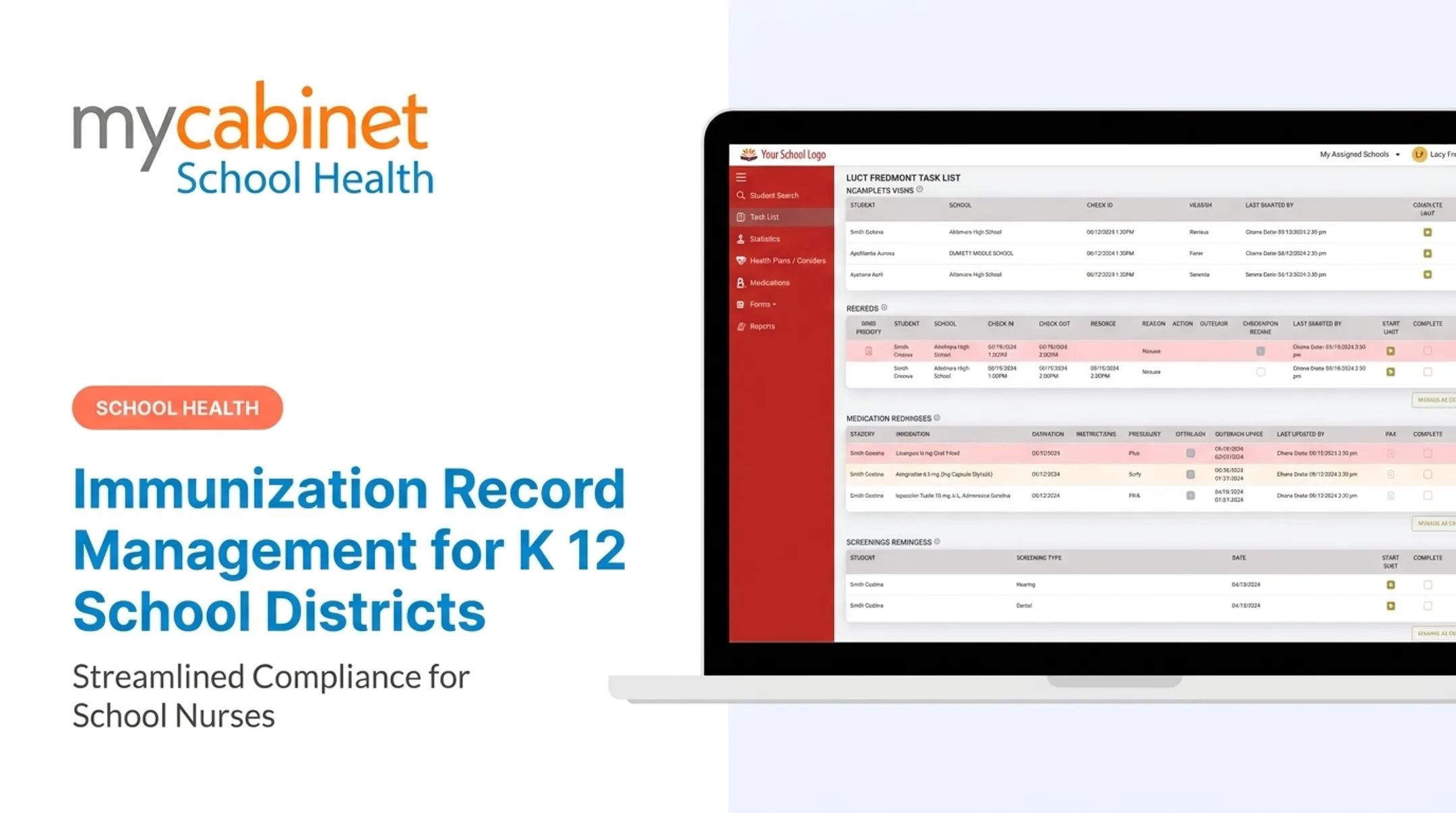
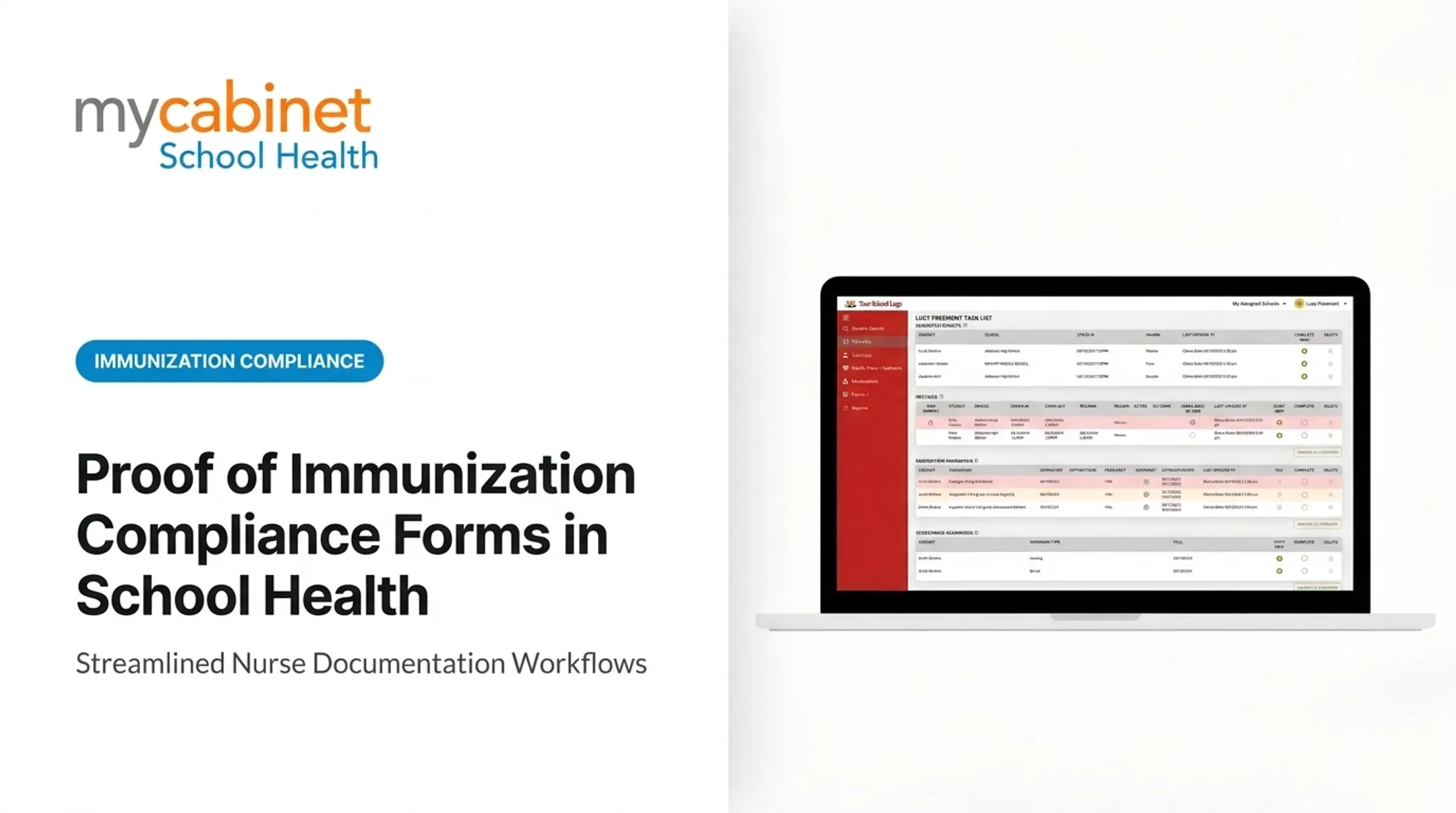
Rather than manually reviewing every student file, nurses can work from automated task lists that surface incomplete visits, rechecks, medication expirations, and screening reminders, all flagged visually so nothing gets buried. Closing those gaps earlier means fewer missing fields when immunization reports are pulled.
With MyCabinet School Health's Parent App and Web Portal, parents upload immunization records directly. A nurse then reviews the submission, approves it, and the document attaches straight to the student's health record. No scanning, faxing, or separate email thread to track, so the official record stays complete and current.

Accurate reporting also depends on controlled access. Permissions are role-based and built for FERPA-aligned recordkeeping:
- Parents see only their own child's information
- Nurses and approved staff see only what's needed for care
- MyCabinet's technical team only accesses systems for maintenance, under strict controls
Structured visit types, completion tracking, and logged outreach notes (date, method, and details) all support an audit trail without requiring a separate spreadsheet.
The same system supports follow-up without creating new inbox work. MyCabinet's Parent App sends one-way notifications for clinic visits and medication expirations, so families stay informed without unrestricted messaging that would slow nurses down.
As Cobb County School District Superintendent Chris Ragsdale put it during a 2025 school board meeting, the platform "digitized and makes documentation easier," giving parents visibility into their child's care while cutting down on manual paperwork.
Best Practices for Staying Compliant with State Deadlines
State IIS reporting rules aren't standardized nationally, so schools need their own system for staying ahead of deadlines.
- Build a compliance calendar around your specific state's IIS deadlines and grace periods. Colorado's childcare reporting window runs October 15 to January 15; Minnesota's is due December 1.
- Audit records at key transition points — the start of each school year, kindergarten entry, and 7th-grade booster requirements are common gaps.
- Communicate early, not at the deadline. Reaching out to parents during enrollment, rather than after a compliance flag appears, avoids last-minute exclusion notices that stress everyone involved.
Grace periods vary by state as well:
- New York: 14 days from school start for the first dose of each required vaccine
- Washington: 30 calendar days
- Texas: Provisional enrollment for up to 30 days, with review required every 30 days after

Frequently Asked Questions
How can I access my immunization records?
Parents can typically request records from their child's pediatrician, their state's immunization registry, or through a school's digital parent portal if the school uses a connected health platform.
What happens if a student is not compliant with immunization requirements by the deadline?
Schools may issue exclusion notices restricting attendance until proper documentation or a valid exemption is provided. Grace periods vary by state.
Are immunization requirements the same in every state?
No. Requirements, exemption types, and reporting timelines vary significantly by state, so schools must follow their specific state health department guidelines.
Do childcare centers have different immunization reporting rules than K-12 schools?
Timelines and required vaccines can differ slightly between childcare and K-12 settings, though the underlying compliance principles are similar.
How often do schools need to report immunization data to the state?
Most states require annual reporting, though some use a state immunization information system that supports more frequent or real-time updates.
Can digital platforms help reduce immunization compliance errors?
Yes. Automated task tracking and digital document collection significantly reduce the manual errors common with paper-based and spreadsheet systems, giving nurses more time for direct student care.