
The stakes are real. 5.6% of students receive medication at school on a typical day, according to a 2018 national survey of school nurses, with ADHD medications topping the list. Meanwhile, CDC guidance recommends no more than 750 students per nurse — a ratio many districts don't meet.
This guide covers what a Medication Administration Record (MAR) actually is, exactly what school nurses need to document, and how to keep records compliant with FERPA and HIPAA expectations unique to school settings.
Key Takeaways
- Every administration needs student identity, medication, dose, time, route, and outcome on the school MAR
- Documentation is the most-skipped of the 6 Rights when those rights move into school health practice
- Digital MARs reduce illegible entries and give parents real-time visibility paper logs cannot match
- Accurate documentation protects nurses legally and keeps care consistent between school and home
What Is a Medication Administration Record in a School Setting?
A Medication Administration Record (MAR) is the official, ongoing log of every dose of medication given to a student during school hours. It's not the same as a general health office log, which might track visits for scraped knees or headaches. The MAR exists specifically to document medication events.
Colorado's Department of Education guidance describes it as an individualized daily record covering medications administered, special circumstances, and any unusual reactions. It becomes a permanent record. Separate logs are typically kept per student and per medication.
How School MARs Differ From Clinical MARs
Hospital MARs assume a physician is on-site reviewing orders in real time. School MARs work differently:
- Parental authorization drives everything. No physician order exists in many cases. A parent-signed authorization form often suffices, depending on the state.
- Self-carry policies complicate tracking. Students with inhalers or EpiPens may carry their own medication, meaning the nurse documents oversight rather than direct administration.
- Communication flows to families, not physicians. When something goes wrong or a dose is missed, the nurse notifies parents, not a treating doctor.
North Carolina's School Health Program Manual requires written parent or guardian authorization plus a licensed prescriber order. That order should include the child's name, birthdate, medication, dose, route, timing, duration, and possible adverse effects.

Those authorization details are what make the MAR defensible later. Why this matters legally: MARs serve as primary evidence during state health audits, school board reviews, or litigation. If a parent alleges a missed dose or an adverse reaction went unreported, the MAR is often the first document requested.
Many districts still rely on paper binders or spreadsheets. That means illegible handwriting, records that go missing during a shift change, and delayed parent notification when something goes wrong.
What Information Must Be Documented in a School MAR
Every entry in a school MAR needs to answer the same basic question: could someone reconstruct exactly what happened, to whom, and when, just by reading this record?
Student identifying information:
- Full name, date of birth, and grade
- Known allergies or relevant medical conditions
Medication details:
- Medication name, dosage, and form (tablet, liquid, inhaler)
- Prescribing provider or the parent authorization on file
Administration specifics:
- Exact time given
- Route (oral, inhaled, injected)
- Initials or signature of the nurse or staff member who administered it
Authorization and consent trail:
- Parent/guardian consent form
- Physician order, if required by state law
- Expiration date of the authorization

Documenting the Exceptions
Refusals, missed doses, and adverse reactions need the same level of detail as routine administrations, and often more. North Carolina's medication administration manual lists reportable variances such as missed dose, wrong student, wrong medication, wrong dose, wrong time, wrong route, and failure to document. Every one of these requires:
- A note explaining what happened
- Follow-up actions taken
- Confirmation that parents were notified
A 2024 study of North Carolina public school districts found that medication errors and corrective-action plans increased as nurses covered more schools. That finding ties medication safety directly to nurse workload.
The 6 Rights of Medication Administration Applied to School Nursing
Children's Hospital of Philadelphia outlines the six rights of medication administration as right patient, medication, indication, dose, time, and route. In school nursing, right documentation often replaces or joins "right indication" as a standalone right—North Carolina's medication administration manual names it explicitly.
Here's how those rights play out in a school hallway instead of a hospital ward:
- Right Student — A nurse covering multiple grades may not know every student, and similar names among siblings or classmates make mix-ups easy. Verify identity before every dose.
- Right Medication — Match the drug name to the parent-provided label and the authorization form on file.
- Right Dose — Confirm strength and amount against both the label and the order. OTC and compounded meds are higher risk when labels don't match prescription paperwork exactly.
- Right Route — Confirm the ordered route (oral, inhaler, injection, or topical) matches what you are about to give.
- Right Time — Bell schedules, field trips, and after-school programs all shift timing. A dose due at 12:15 does not wait for a fire drill.
- Right Documentation — Auditors flag this gap most often. A dose given correctly but never logged still counts as a failure on review.
Skipping documentation is not just a paperwork problem. It removes the only evidence that the other five rights were followed at all.

Common Documentation Challenges School Nurses Face
Even nurses who know the rules cold run into structural problems that paperwork alone can't fix.
- High student-to-nurse ratios. With the CDC recommending one nurse per 750 students, many nurses are stretched across buildings, leaving little time to document thoroughly between visits.
- Expiration tracking. Medication authorizations and the medications themselves expire, often at different times, and renewing them each school year is easy to lose track of in a spreadsheet.
- Fax-and-email workflows. When a parent needs to update a medication, delays pile up if the process depends on faxed forms sitting in an inbox.
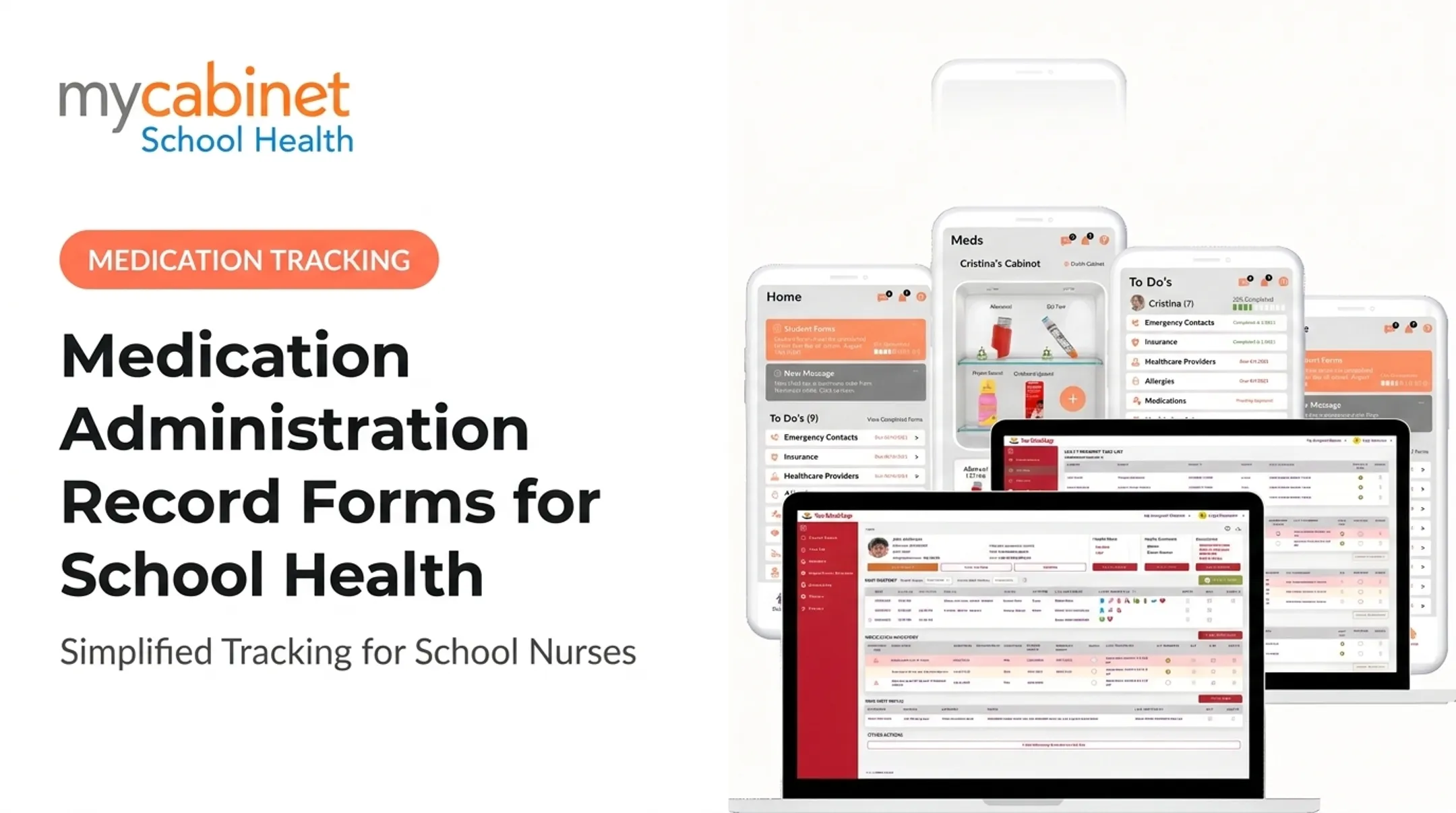
Purpose-built platforms close these gaps in daily workflow. MyCabinet School Health organizes medication reminders, incomplete visits, and expirations into a single nurse-facing task list, so nurses aren't hunting through binders or separate spreadsheets to figure out what's due.
Medication information lives inside the student's health record alongside inventory tracking. The system flags medications approaching expiration, reducing the chance that an expired inhaler sits unnoticed in the clinic drawer.

Best Practices for Accurate and Compliant MAR Documentation
Good documentation habits look less like a checklist and more like a rhythm nurses build into their day.
- Document immediately, not later. Recording a dose right after administering it, rather than batching entries at the end of the day, prevents details from blurring together or being forgotten entirely.
- Use structured fields, not free text. Predefined fields for medication name, dose, time, and route reduce ambiguity compared to open notes that different reviewers might interpret differently.
- Maintain a clear audit trail. Records should show who administered the dose, who reviewed it, and who approved any changes.
- Standardize how you log refusals and side effects. Every refusal, missed dose, or side effect needs a consistent process, including the exact steps for notifying parents.
- Reconcile authorizations regularly. Archive expired authorizations and check MAR entries against current health forms on file, rather than assuming last year's paperwork still applies.
MyCabinet supports several of these habits directly:
- Structured visit flows with predefined visit types keep documentation consistent across nurses and shifts
- Audit trails show who administered, reviewed, and changed each entry over time
- Medication outreach logs capture parent contact date and method on the student record
- One-way parent notifications flag medication expirations without adding admin work
Digital vs. Paper MAR Systems for Schools
Paper logs have obvious limits: illegible handwriting, no real-time alerts, and a scramble to locate the right binder when an auditor asks for records from six months ago. Colorado and Minnesota both permit paper MARs as long as entries use permanent ink, but permission isn't the same as practicality.
Electronic systems close these gaps:
| Feature | Paper MAR | Digital MAR |
|---|---|---|
| Legibility | Varies by handwriting | Always typed and clear |
| Expiration alerts | Manual tracking required | Automated reminders |
| Audit readiness | Search through binders | Retrievable in seconds |
| Parent visibility | Phone calls, notes home | In-app notifications |
The National Association of School Nurses' 2024 position statement calls electronic health records the most efficient and secure method for managing student health information, citing better workflow support, error prevention, and faster record retrieval.

Security matters just as much as convenience. FERPA generally requires signed, dated consent before disclosing personally identifiable education records, and schools must limit staff access to only those with a legitimate educational interest.
Platforms like MyCabinet build this in through role-based access:
- Parents see only their own child's information
- Nurses see only what's needed for care
- Technical staff access data solely for system maintenance under strict controls
Everything runs in a SOC 2 Type II audited environment aligned with HIPAA and FERPA.
Frequently Asked Questions
How do you document medication administration in nursing?
Verify the student's identity, confirm the medication and dose against the authorization on file, then administer it. Record the time, route, and any observations in the MAR immediately—waiting increases the risk of errors or omissions.
What is included in a Medication Administration Record?
A complete MAR includes student identifying information, medication name and dosage, administration time and route, and the initials or signature of the staff member who gave it. Authorization details and notes on refusals or reactions complete the record.
Can you provide an example of a Medication Administration Record?
A simple MAR layout includes columns for student name, medication, dose, scheduled time slots, and staff initials for each administration. Digital platforms typically generate these records automatically from the student's health profile, reducing manual entry.
What happens if a school nurse forgets to document a medication dose?
Most districts require a late entry or addendum noting the actual time of administration and the reason for the delay. Timely documentation matters because a missing entry can look identical to a missed dose during an audit or investigation.
Do school nurses need parent consent to log medications in a MAR?
Yes. Parent or guardian authorization is typically required before any medication is administered or logged. Many states also require a licensed prescriber's order on file—without that trail, the administration itself may not be compliant.