
That means schools aren't just educating students. They're managing a daily medication operation, often without a full-time nurse in the building.
The stakes are real. Wrong student, wrong dose, wrong time, missed documentation entirely — these aren't hypothetical risks. They're documented, recurring problems in school health offices across the country. And unlike a hospital pharmacy, most schools are running this operation with a single nurse covering multiple buildings, or a classroom aide who received training last semester.
This guide covers the legal landscape, who's actually allowed to give medication, what training is required, and how schools are using technology to close the gaps that paper systems leave open.
Key Takeaways
- Medication administration in schools falls under state law, FERPA, and district policy — there's no single federal standard
- School nurses lead administration; trained staff and self-administering students cover gaps when nurses are scarce
- Most errors stem from poor documentation and unclear protocols
- Digital platforms reduce paperwork and improve safety through task tracking and real-time visibility
Understanding Medication Administration in Schools
Medication administration in schools means giving prescribed or over-the-counter medication to a student during school hours or school-sponsored activities, under proper authorization. Rising rates of chronic conditions among school-age children have made that work more complex.
National data shows how common these needs are:
- Asthma: 6.7% of children under 18 had current asthma in 2023, per the CDC
- ADHD: 11.7% of children ages 3-17 had a current diagnosis in 2024, according to CDC data
- Epilepsy: roughly 456,000 children age 17 and younger have active epilepsy, per the CDC
- Food allergy: 5.8% of children ages 0-17 have a diagnosed food allergy, according to CDC data

Each condition brings its own medication protocol, and each protocol brings legal obligations.
The Legal Framework
Schools operate under a patchwork of rules, not one federal law:
- State nurse practice acts govern who can administer medication and how delegation works
- Physician authorization is required before any prescription medication enters a school
- Parental consent forms must accompany that authorization
- FERPA treats health records as education records, requiring written consent before disclosure — except in genuine health or safety emergencies
Where Errors Happen
Without clear protocols, schools see the same mistakes repeat: wrong student receives a dose, wrong amount is given, timing is off, or, most often, nothing gets documented at all. Missed doses have long been the dominant error type; an older national survey of school nurses put them near 80% of reported incidents, and the same failure points still show up when protocols are weak.
One detail schools often overlook: these rules don't stop at the classroom door. Field trips, sports practices, and after-school programs need the same authorization and documentation standards as the school day.
Who Can Administer Medication in Schools?
School nurses are the primary professionals trained, licensed, and held legally accountable for student medication. But the workforce doesn't match the need.
A 2024 National School Nurse Workforce Study found roughly 78,869 school-nurse full-time positions nationwide, and less than half of respondents reported having RN supervision in place. NASN's 2025 workload statement reports that one-third of students lack daily, full-day access to a school nurse.
That gap gets filled by:
- Licensed practical/vocational nurses (LPNs/LVNs) working under RN supervision in many states
- Unlicensed assistive personnel (UAP) trained and delegated by a school nurse
- Self-administering students with written physician and parent authorization

Delegation Varies by State
Texas offers a useful example. The Texas Board of Nursing allows an RN to delegate medication administration to unlicensed staff when the RN isn't physically present, but the RN retains the duty and must supervise appropriately. Delegating doesn't mean walking away.
For students cleared to self-administer, self-carry policies usually cover emergency medications (asthma inhalers, epinephrine auto-injectors). Controlled substances such as stimulant medications generally stay with the nurse.
Regardless of who gives the dose, documentation requirements stay the same:
- A written physician order
- Signed parental consent
- A clear record of who gave what, and when
Required Certifications and Training for Staff
There's no single national training standard. Requirements come from your state and district, though most programs follow a similar structure.
Three common training tiers:
- Basic training: proper storage, timing, handling, and administration routes
- Emergency training: responding to anaphylaxis, seizures, or opioid overdose (including naloxone)
- Condition-specific training: insulin administration, inhaler technique, seizure rescue medication
Iowa requires a free, state-mandated online course for anyone administering medication, with the completion certificate kept on file. Ohio limits prescription-medication administration to licensed health professionals or staff specifically trained by one.
Clinical skill is only half the requirement. FERPA confidentiality training is non-negotiable. Anyone handling a student's medical information (nurse, aide, or front-office staff covering a gap) needs to understand what they can share, with whom, and under what circumstances. That duty is a compliance requirement under federal privacy law.
Common Conditions Requiring Medication Administration
Most school medication needs cluster around a handful of conditions:
- Asthma — rescue inhalers, sometimes nebulizer treatments
- Diabetes — insulin, glucagon for emergencies
- Epilepsy — rescue medications for seizure clusters
- ADHD — stimulant or non-stimulant medications, often mid-day doses
- Severe allergies — epinephrine auto-injectors
- Opioid overdose — naloxone, increasingly stocked as a precaution
A 2026 national survey of school nurses found 90% of schools now stock naloxone, though only 18% reported ever administering it on campus.
Routine requests fall under the same rules. One point schools miss: over-the-counter medication isn't exempt from the paperwork. Giving a student ibuprofen for a headache still requires documented physician or parent authorization in most districts — a school policy alone doesn't cover it legally.
The Six Rights of Medication Administration
The Six Rights framework is the industry-standard safety checklist, and it maps directly to where errors happen:
| Right | What It Prevents |
|---|---|
| Right Student | Wrong-child errors |
| Right Medication | Mix-ups between look-alike or sound-alike drugs |
| Right Dose | Over- or under-dosing |
| Right Time | Missed or delayed doses |
| Right Route | Incorrect administration method |
| Right Documentation | Untracked or unverifiable administration |

Notice that documentation gets equal billing with the physical act of giving medication. That's intentional. A dose given correctly but never recorded creates the same downstream risk as a dose given incorrectly. Nobody can verify what happened, and the next caregiver is working blind.
Some researchers caution that checklists alone don't guarantee safety. A widely cited 2010 analysis found serious errors occurred even when staff believed they'd verified every "right." The framework helps, but it needs a system behind it.
How Technology Improves Medication Safety and Compliance
Paper-based tracking — spreadsheets, fax, sticky notes on a med cabinet — creates gaps almost by design. Nothing flags an expiring EpiPen automatically. Nothing alerts a nurse covering three buildings that a recheck visit is overdue. And parents usually hear about a problem only after someone remembers to call.
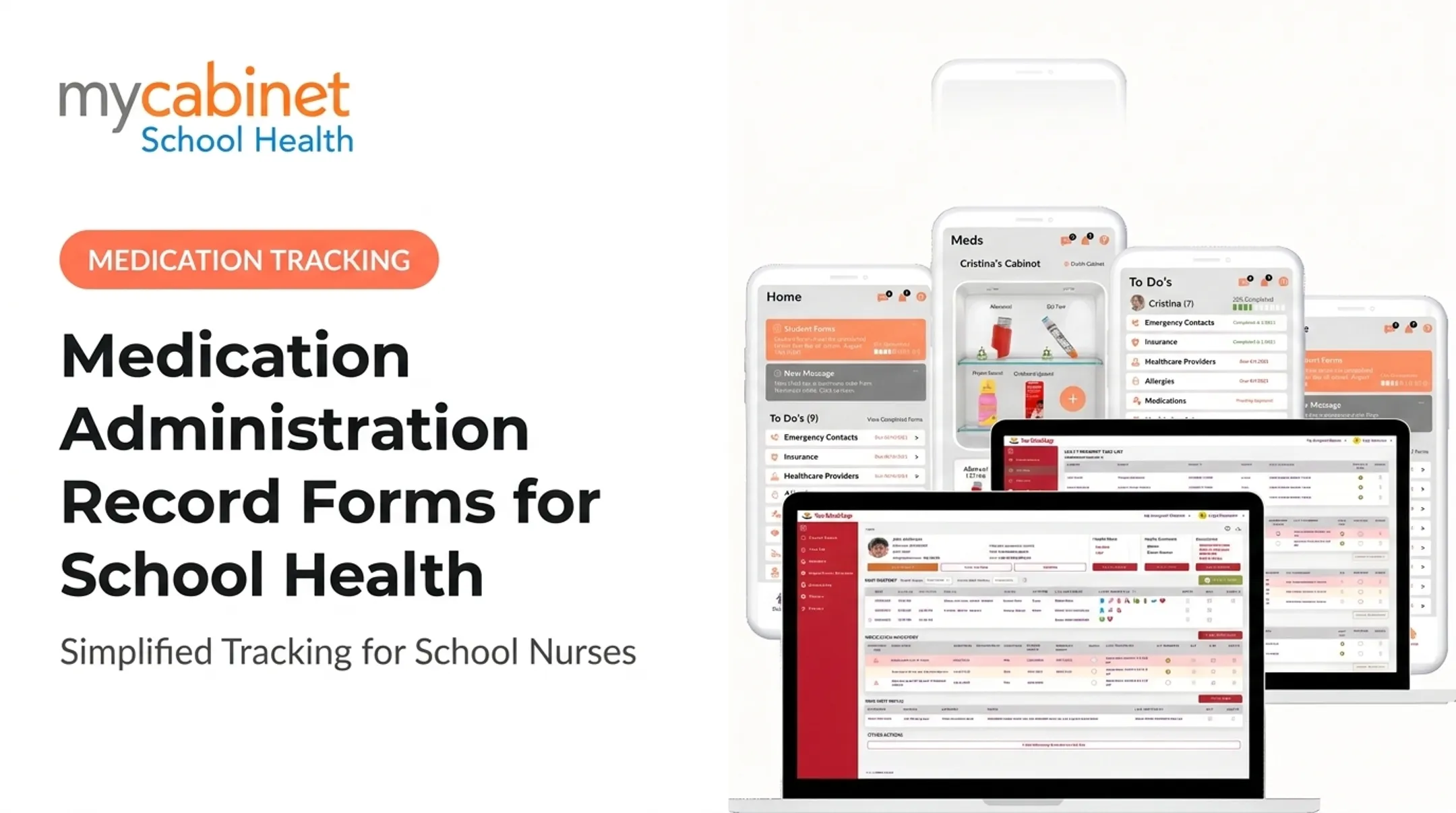
MyCabinet School Health was built to close those gaps. As a school health EHR designed around nurse workflows, it gives nurses an intelligent task list that surfaces:
- Recheck visits that need follow-up
- Medication reminders tied to dosing schedules
- Expiration alerts before a stored medication lapses
Tasks are color-coded for quick triage, so a nurse managing multiple campuses can see what's urgent at a glance instead of digging through a binder.

That same workflow view also keeps administration details from living in a separate silo.
Reducing Six-Rights Errors Directly
MyCabinet keeps dosage and frequency visible next to the student's full health profile, including allergies, health plans, and prior visits. That context, plus audit trails and structured visit documentation, supports the accountability the six rights require:
- Right student, medication, dose, time, route, and documentation
- Clear record of who administered care, to which student, and when
- Visit history that stays attached to the student profile instead of a standalone log
Cobb County Superintendent Chris Ragsdale described the impact at a 2025 school board meeting: MyCabinet "digitized and makes documentation easier," letting parents see electronically when their child was seen and given medication.
Giving Parents Visibility
The Parent App and Web Portal let families see their child's stored medications and expiration timelines directly — no more guessing whether that inhaler needs replacing. Parents get alerts as expiration approaches, with the app in front of them instead of a phone call from the nurse's office.

This is not two-way messaging. Updates to stored medication still go through the school clinic, per district policy. Even so, shared expiration visibility means fewer chase-down calls and less time spent confirming what is already on campus.
Frequently Asked Questions
What certification is needed to administer medication?
Requirements vary by state and district but typically include basic medication administration training, delegation approval from a school nurse, and sometimes CPR/first aid certification for non-licensed staff.
Who can administer medication to students?
School nurses are the primary administrators. Trained, delegated staff and self-administering students with proper physician and parent authorization are common alternatives, especially where nurse coverage is limited.
What are the six rights of medication administration?
Right student, right medication, right dose, right time, right route, and right documentation. Documentation carries equal weight to the physical administration step.
How should schools handle medication for field trips or after-school activities?
Policies and staff training must extend beyond the classroom. Field trips and after-school programs require the same authorization forms, delegation standards, and documentation as the regular school day.
What happens if a medication error occurs at school?
Most districts require immediate reporting, documentation of the incident, prompt parent notification, and a formal review process to determine corrective action.
How can schools reduce the administrative burden of medication management?
Digital health platforms like MyCabinet centralize documentation, automate task tracking, and simplify parent communication, which cuts down on the manual phone calls and paperwork that consume a nurse's day.