
Introduction
Every school day, kids show up with inhalers, ADHD medication, EpiPens, and parent notes tucked into backpacks. Behind each dose a nurse gives, there's a form that makes it legal, safe, and traceable.
Medication forms are the documents schools use to get authorization, guide safe handling, and create a reliable record of what actually happened. Without them, a nurse has no legal basis to give a dose and no way to prove what was administered later.
Getting this right matters for more than compliance. Families need confidence their child's instructions are followed, and nurses need clarity to act quickly. Districts need documentation that holds up if something goes wrong.
This article breaks down the main types of medication forms schools use, how they connect to each other, and what to check before rolling out a paper or digital process district-wide.
TL;DR
- Medication forms authorize administration, log doses, support self-carry, or cover OTC and emergency meds.
- An authorization form isn't a medication administration record. Schools generally need both.
- Requirements vary by state, district, and policy. Always confirm current rules locally.
- Collect signatures, review provider instructions, track expiration dates, and keep a secure audit trail.
What Are Medication Forms for K–12 School Health Records and Why Do They Matter?
What Medication Forms Are
Medication forms are standardized paper or electronic records used to authorize, administer, monitor, and document medication given to or managed by a student at school. They sit at the center of a workflow that typically moves through several stages:
- Parent or guardian submits a request
- Healthcare provider supplies written instructions or authorization
- School nurse reviews the paperwork for completeness
- Staff administer the medication according to those instructions
- The school renews or retires the form as circumstances change

Fields vary by form and by state, but most capture student identifiers, medication name and strength, dose, route, timing, reason for use, instructions, signatures, dates, and emergency guidance. Always verify which fields your state or district requires rather than assuming one template covers every situation.
Why This Documentation Matters
Complete, well-organized records reduce transcription errors, prevent vague instructions, and give nurses a defensible account of what happened during the school day. Incomplete forms create the opposite problem:
- Missing authorization
- Conflicting instructions
- Expired medication still sitting in a cabinet
- Doses that were never logged
The scale of this risk is real. A longitudinal study of North Carolina public school districts found an average of 78 medication errors requiring medical intervention per year across the state's 115 districts, with roughly 27% of districts reporting at least one corrective action plan.
Reporting wasn't mandatory in that study, so actual numbers were likely higher.
The National Association of School Nurses' 2024 position statement calls for student health documentation to be timely, accurate, legible, complete, and securely protected, with electronic health records upholding FERPA and HIPAA confidentiality standards where applicable.
FERPA generally covers student health records maintained by a school, including those kept by a school nurse. HIPAA typically doesn't apply when a school-based provider maintains records solely as FERPA education records — but it can apply to outside providers under certain conditions.
Don't assume one privacy rule governs every setting; check which applies to your specific arrangement.
Platforms like MyCabinet School Health support FERPA-aligned student records with role-based access and audit trails, which helps districts manage this complexity without building the compliance framework from scratch.
Types of Medication Forms
Medication documentation isn't one universal form. The right set depends on the medication, the student's needs, who's administering it, and your state or district policy.
Authorization and Medication Administration Permission Forms
This is the foundational document: it records permission for school staff to administer a prescribed or otherwise approved medication. It typically includes provider instructions, parent or guardian consent, medication details, and effective dates.
Authorization and clinical prescribing aren't the same thing. A licensed prescriber must supply the medical order: medication, dose, route, timing, and their signature. A parent or guardian separately provides consent for the school to act on that order.
Minnesota's state guidance draws this line clearly, and Maryland's state form physically separates the two sections.
Signature requirements, renewal timing, and what triggers a new form all vary. Verify current state and district rules before finalizing any template.
Medication Administration Records
The medication administration record, or MAR, is the ongoing log of what was scheduled, what was given, and any exceptions along the way. A useful MAR captures:
- Date and time of administration
- Dose and route given
- Staff member who administered it
- Student response, when relevant
- Notes on missed, refused, held, or late doses

Ohio's General Medication Administration Record includes an incident-tracking section covering wrong student, wrong dose, transcription errors, and expired or mislabeled medication.
Minnesota's guidance treats MARs as legal documents. Entries should be legible and made in unalterable ink on paper forms. Corrections should never overwrite another staff member's entry; note them separately instead.
Self-Administration and Carry Authorization Forms
Some students can carry and self-administer certain medications, most commonly rescue inhalers or epinephrine auto-injectors, subject to authorization and school policy.
Virginia's self-carry statute requires written parent consent plus a provider statement confirming the student's diagnosis, medication details, and demonstrated ability to self-administer safely. That permission is valid for one school year and needs annual renewal.
This isn't automatic for every student or every medication. Documentation should also cover:
- Storage or backup arrangements if the student can't access their medication
- Staff awareness of the plan
- Response steps if self-administration isn't possible in the moment
OTC, Emergency, and Specialized Medication Forms
Nonprescription medications aren't automatically exempt from authorization. Colorado's official guideline requires written parent or guardian consent for OTC medication just as it does for prescriptions. The AAP's 2024 policy statement recommends parental consent for OTC administration, though it doesn't require a full medical-home order in every case.
Emergency and specialized medications such as glucagon, epinephrine, and controlled substances often need extra layers:
- Clear symptom thresholds for when to act
- Delegated staff responsibilities
- Disposal or return-to-parent instructions
- Notification requirements after use
Local board policy often decides how far these requirements extend, so check district policy alongside state rules.
Medication Change, Renewal, and Expiration Documentation
Forms need updates whenever the medication, dose, route, timing, or prescriber instructions change, or simply when the school year turns over. Maryland requires a fresh form at the start of each school year and any time dosage or timing shifts; the prior form expires automatically once the school year ends.
Tracking renewal and expiration prevents staff from relying on outdated instructions or holding medication past its usable window. Manual paper processes often fail here: nothing flags the calendar until a dose is already overdue.
How to Choose the Right Medication Forms
The right form set depends on legal requirements, medication categories, student population, and staffing model, not on picking the most detailed template available.
Purpose and Workflow Coverage
Map every stage the process needs to support:
- Request and authorization
- Provider review
- Parent consent
- Receipt and storage
- Administration or self-administration
- Exception handling
- Renewal
- Final disposition
Each form should also define:
- A clear owner
- A completion point
- A required signature
- A direct link to the student's health record
Compliance and Clinical Clarity
Cross-check every template against current state law, district policy, and provider instructions. A well-designed form separates prescribed medical instructions from internal school procedures, so authorized staff can act without guessing what a provider meant.
Usability and Accessibility
A form that confuses parents or trips up a substitute nurse defeats its own purpose. Ask:
- Can a parent complete this without duplicate entry?
- Does it work in the family's preferred language?
- Can attachments and signatures be handled digitally, not just on paper?
- Is there a defined process for resolving incomplete or conflicting information?
Security, Auditability, and Long-Term Maintenance
Check how the process limits access by role, records who reviewed or changed information, and supports proper retention. This is where digital platforms tend to outperform paper stacks in a filing cabinet.
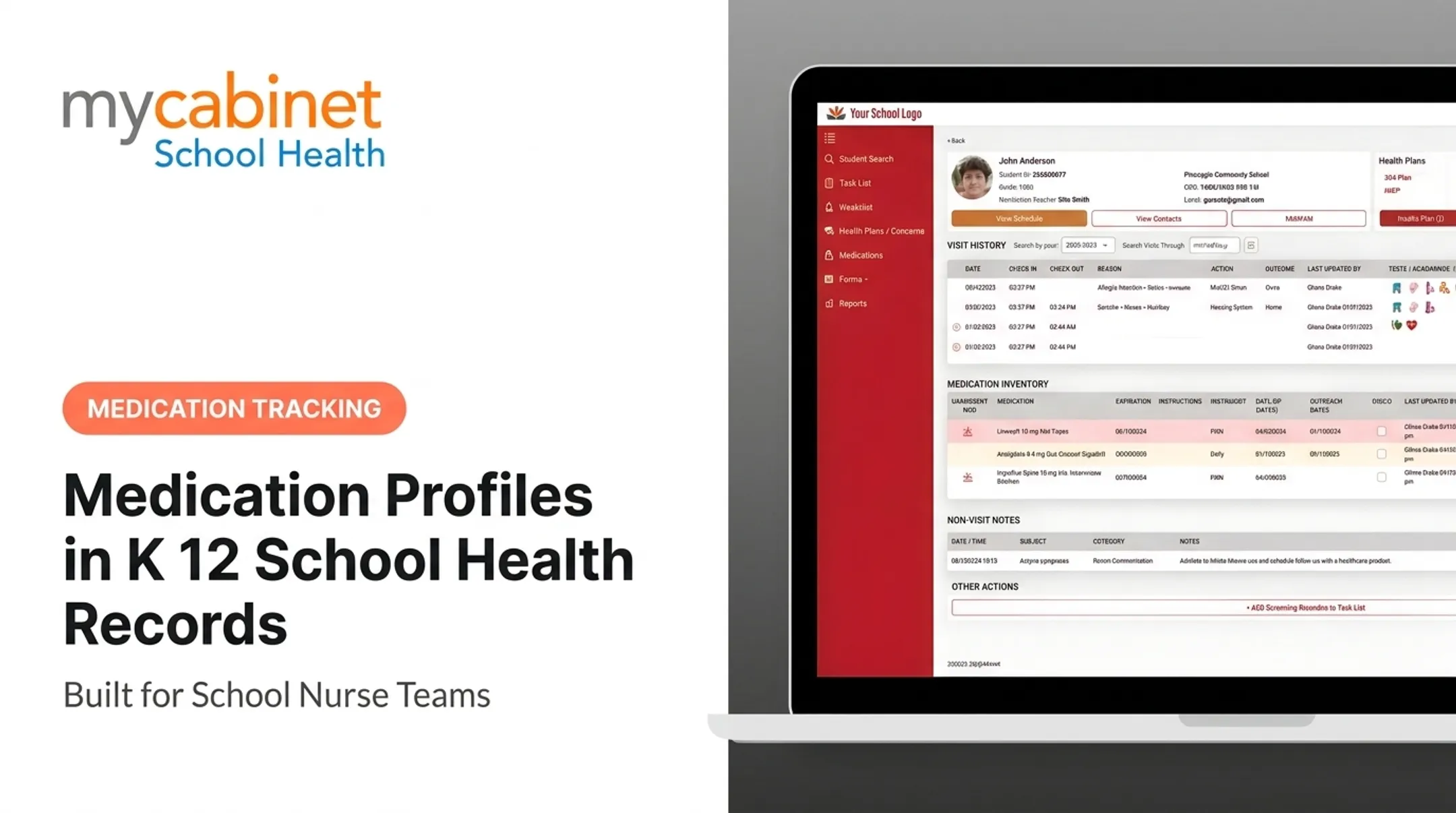
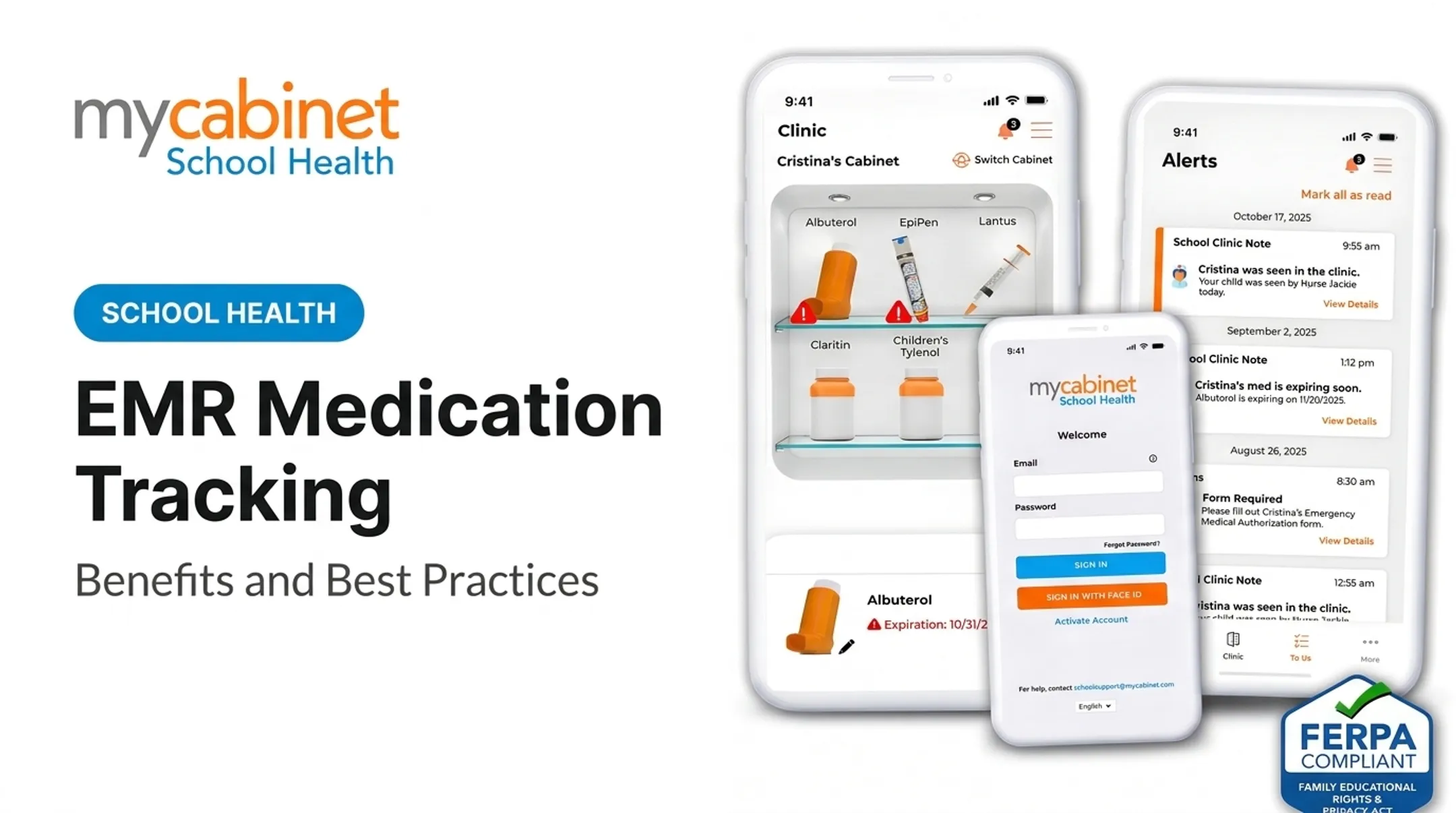
MyCabinet School Health, for example, centralizes digital form collection through its Parent App and Parent Web Portal. Parents upload documentation, nurses review and attach it to the student record, and the system tracks medication expiration dates, dosage details, and outreach notes automatically.

It is a workflow option worth considering, though it does not replace legal review of your forms against state and district requirements.
What to Check Before Finalizing a Medication Form Process
A few checks catch most problems before they become audit findings or missed doses:
- Confirm local applicability. A generic template from the internet won't necessarily satisfy your state rules, district policy, or licensed prescriber requirements.
- Verify internal consistency. Medication name, strength, dose, route, timing, effective dates, and authorizing signatures should all match before anyone signs off.
- Separate authorization from administration proof. A signed permission form doesn't prove a dose was given. Confirm you have a separate process for logging administration, refusals, and missed doses.
- Build in renewal and expiration controls. Add renewal dates and expiration alerts so mid-year medication or instruction changes don't leave nurses with lapsed or outdated authorizations.
- Test the workflow with real users. Have nurses and a handful of families run through the process to surface duplicate entry, unclear ownership, and retrieval issues before rolling it out district-wide.
Conclusion
Medication forms support the full lifecycle of school medication management. No single form covers every step. Schools need a coordinated set based on local requirements, student safety, and how usable the process is for nurses and families.
That lifecycle typically includes:
- Authorization and provider review
- Daily administration and exception documentation
- Renewal and secure recordkeeping
Start by reviewing your current process with school nurses and the relevant state or district authorities. Where manual follow-up consumes nurse time without adding oversight, a secure digital platform can close that gap when it is paired with the legal review your forms still require.
Frequently Asked Questions
How do I fill out a medication form?
A parent or guardian and an authorized healthcare provider complete different sections of the same form. Confirm required fields, signatures, and renewal rules with your school or district before submitting.
How do I document medication administration?
Record the scheduled and actual dose, date, time, route, and administering staff member as soon as possible after each dose. Note any refusal, missed dose, error, or relevant observation according to your school's policy.
What are the rules for medication administration?
Rules vary by state, district, medication type, and staff role. Follow your current authorization, storage, administration, emergency response, privacy, and documentation requirements rather than assuming a nationwide standard applies.
Can over-the-counter medication be given without authorization?
No. OTC medication still requires authorization. Verify parent or guardian, provider, state, and district rules before giving it.
What is a medication authority form?
A medication authority form gives the school permission and instructions to possess, administer, or support a student's medication. Names and required fields vary by state and district, so follow your local policy.
What are the forms of medication administration?
Common routes include oral, topical, inhaled, and injectable, as specified in the provider order. Staff authorization and training depend on the route and local policy, so confirm both before assigning administration duties.