
This scenario plays out in schools every day. Student health records and forms are the backbone of school safety, legal compliance, and nurse efficiency — yet many districts still rely on paper packets that go missing, go stale, or never make it back from home.
This post breaks down what belongs in a student health record, which forms schools actually require (including state-specific examples like Georgia's Form 3231 and New Jersey's CH-14), and how digital collection is changing the process.
Key Takeaways
- Student health records keep medical history, immunizations, allergies, medications, and emergency contacts in one place
- States set their own required forms — Georgia's immunization certificate and New Jersey's CH-14 are two well-known examples
- Digital collection and nurse-review workflows cut down on paper chasing and speed up emergency response
- FERPA covers most school-held health records, so only authorized staff should have access
What Is a Student Health Record?
A student health record is the ongoing collection of medical, immunization, and emergency information a school maintains for each enrolled student. It's different from a health form, which is a point-in-time data collection tool: think of the form as one input, and the record as the complete file built from many inputs over time.
Core components of a student health record typically include:
- Emergency contacts and preferred provider/hospital
- Immunization history
- Chronic conditions and care plans
- Current medications and allergies
- Vision, hearing, and dental screening results
- Signed consent for emergency treatment
Missing even one piece, such as an undocumented allergy, can delay emergency response when seconds matter. School nurses describe this exact scenario when paper records go missing or fall out of date.

Who Can Access These Records
Under FERPA, a student health record maintained by a school is generally treated as an education record (U.S. Department of Education, 2019 joint guidance). Access is restricted to school officials with a legitimate educational interest, and parents generally have the right to inspect records within 45 days of a request.
HIPAA typically doesn't apply to these records unless a separate, non-school healthcare provider is involved.
Essential Forms Every School Needs
Student Health History / Medical Information Form
This is the foundational intake document. It typically collects:
- Student and family contact information
- Medical history and past diagnoses
- Immunization dates
- Family health history
- Dietary or physical accommodation needs
- Emergency treatment consent
Many districts use a version with roughly two dozen or more questions to cover these categories thoroughly. Timing matters: send this form before the school year starts, and require an annual update each spring for returning students so nurses aren't working off two-year-old information.
Immunization Records and Emergency Consent Forms
Immunization documentation is legally mandated at the state level. It supports outbreak prevention and enrollment eligibility. The CDC's state vaccination requirements confirm that every state sets its own school-vaccination rules and exemption processes.
Alongside immunization records, schools also need emergency treatment consent—so staff can authorize care when a parent can't be reached—and a preferred provider or hospital designation so no one is guessing where to send a student.
Together, consent and provider designation remove the guesswork that slows care decisions during a crisis.

State-Specific Health Forms: Examples Parents and Schools Should Know
Beyond general intake forms, many states mandate their own standardized documents. Requirements vary widely by state and even by grade level, so what's required in one district may not apply next door.
Georgia's Form 3231 (Certificate of Immunization) is a common example. Key facts:
- Required for children attending Georgia schools or child-care facilities
- Must be certified by a licensed physician, APRN, PA, or an authorized Board of Health employee
- Organized around age/grade bands (K-6, 7-10, and 11+) rather than a single one-time submission
- Must be replaced within 30 days of expiration
New Jersey's CH-14 (Universal Child Health Record) serves a broader purpose:
- Combines parent-completed history with a provider exam and immunization attachment
- Includes screening results, care plans, and emergency instructions
- Endorsed by the NJ Department of Health, AAP New Jersey, and the NJ Academy of Family Physicians
- Available through a pediatrician's office, the school nurse, or the NJ Department of Health's website
Because form requirements change periodically, always confirm current versions and deadlines directly with your state department of education or local district before relying on last year's paperwork.

Best Practices for Managing Student Health Records and Forms
Good record management isn't complicated, but it does require consistency:
- Distribute forms early. Send required packets well before the school year starts so families have time to gather immunization and medical history details.
- Flag incomplete records immediately. Don't wait until the first day of school to discover a missing immunization date. Catch it during summer intake.
- Build quick-reference summaries. Nurses, coaches, and substitute staff all need fast access to allergies, medications, and emergency contacts without digging through a full file.
- Schedule annual reviews. Returning students' information changes: new medications, new allergies, updated contacts. An annual refresh keeps records accurate.
The National Association of School Nurses recommends documentation that is timely, accurate, complete, and securely protected. That standard is hard to meet with paper folders alone.
How MyCabinet Modernizes Student Health Record and Form Management
MyCabinet was built specifically around school health workflows, replacing the printing, scanning, faxing, and email chasing that eats up nurse time.
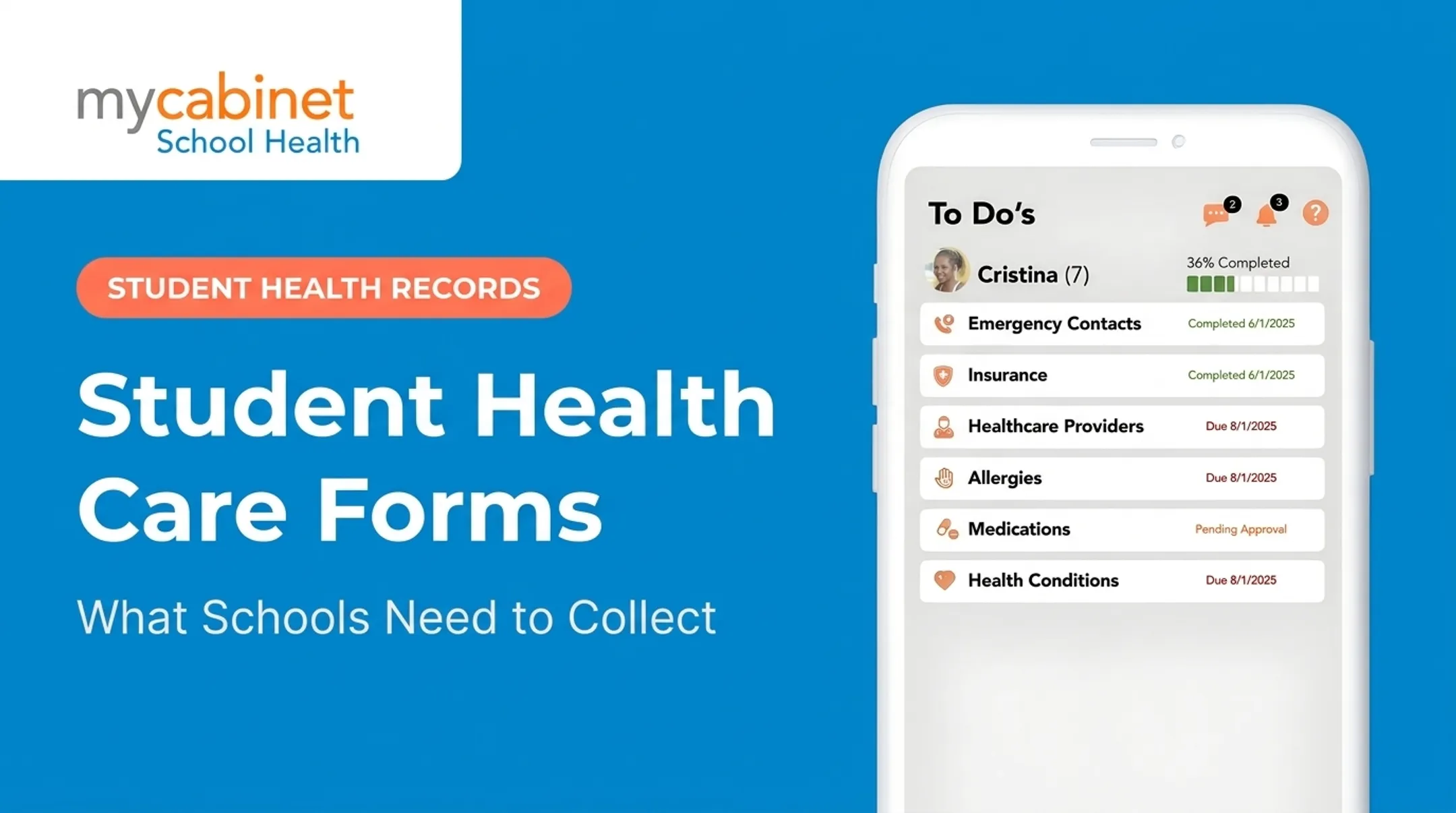
Digital form collection: Parents upload required forms, including state-mandated ones, through the Parent App or Parent Web Portal. A nurse reviews each submission, approves it, and the document attaches automatically to the student's record. No more scattered uploads or lost paperwork.
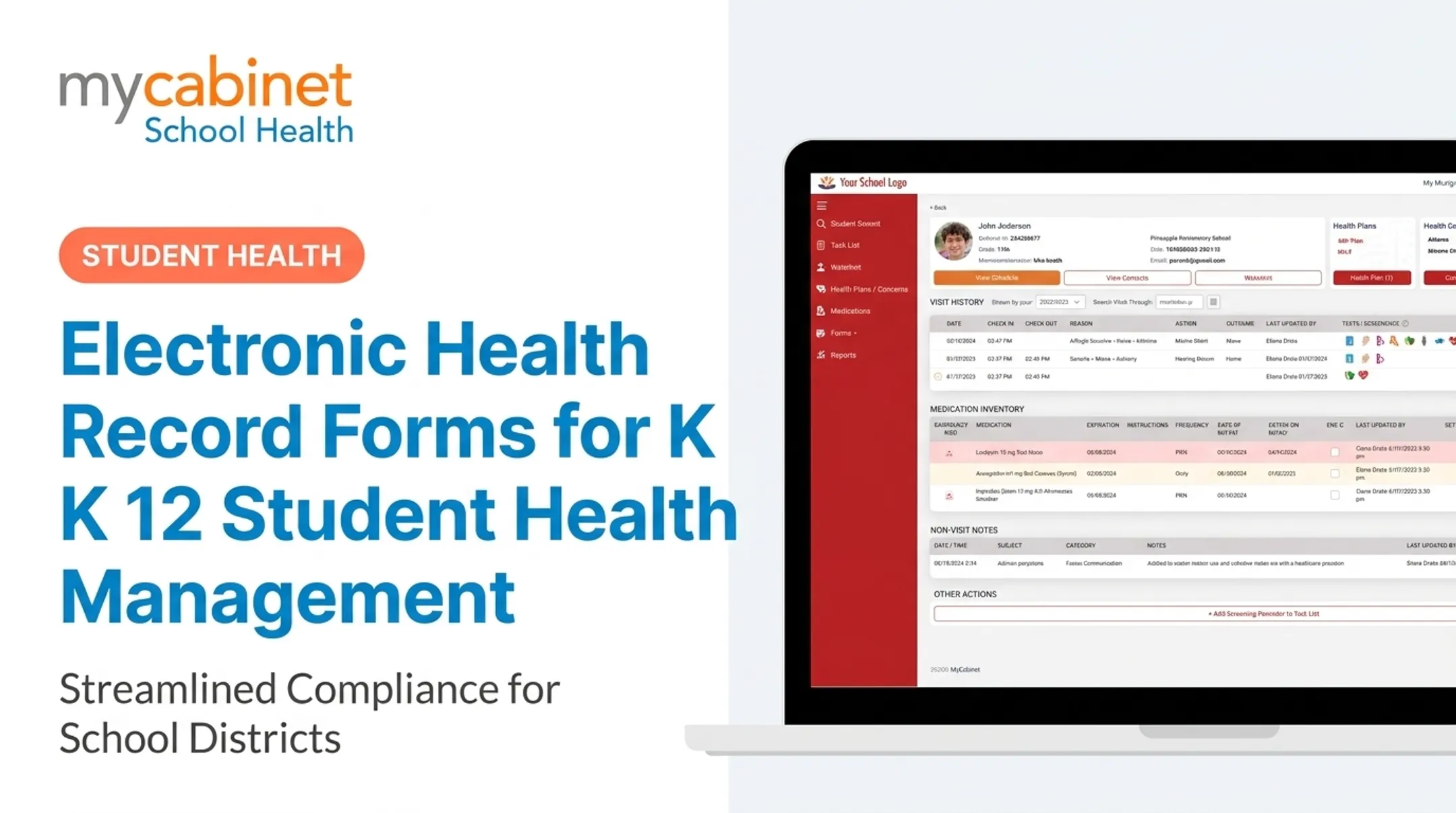
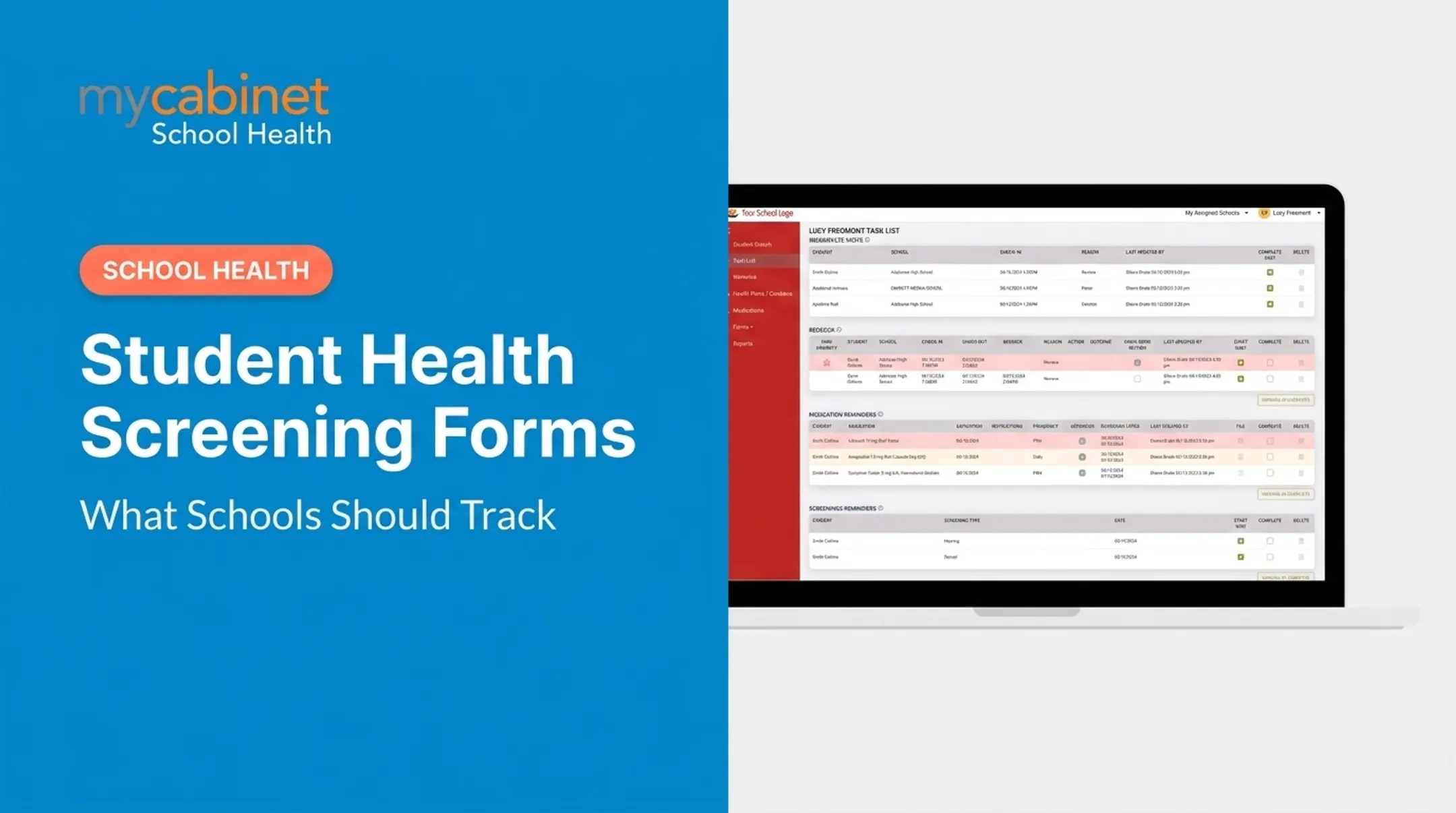
Nurse Portal task lists: Nurses see incomplete visits, rechecks, medication expirations, and screening reminders in one organized view, with color-coded flags for quick triage. Outstanding items stay visible instead of buried in a stack.

Parent visibility: Through the Parent App and Web Portal, families see:
- Recent clinic visits and why their child was seen
- Active medications stored at school
- Medication expiration reminders
Notifications are one-way, triggered by a documented clinic visit or an approaching medication expiration, so parents stay informed without an open messaging channel.
Compliance built in: MyCabinet is SOC 2 Type II audited, HIPAA compliant, and FERPA compliant, with role-based access so parents see only their own child's information and nurses see only what's needed for care.
As Cobb County School District Superintendent Chris Ragsdale put it, the platform "digitized and makes documentation easier."
Frequently Asked Questions
What is a student health record?
It's the collected medical, immunization, and emergency information a school keeps for each student. It supports safe, informed care and quick decision-making during clinic visits or emergencies.
What is a GA 3231 form?
It's Georgia's Certificate of Immunization, required for students attending Georgia schools or child-care facilities. It must be completed by a licensed provider and organized by grade band (K-6, 7-10, 11+).
Where can I find the Universal Health Form for my child in New Jersey?
Families can typically obtain the NJ CH-14 Universal Child Health Record from their pediatrician, the school nurse's office, or directly from the NJ Department of Health website.
How often should student health forms be updated?
Most schools require annual updates, especially when medications, allergies, or emergency contacts change. Waiting longer than a year leaves schools relying on outdated information.
Are school health records protected by privacy law?
Yes. FERPA governs most school-maintained health records, and access must be limited to authorized personnel. HIPAA may apply separately if an outside healthcare provider is involved.
Can parents submit health forms digitally?
Many modern school health platforms, including MyCabinet, allow secure digital upload through a parent app or web portal, with nurse review and approval replacing paper submission.