
Fragmented paper files still create problems: lost allergy alerts, faxed immunization forms nobody can find, spreadsheets tracking medication expirations, and endless phone tag with parents. These gaps don't just slow nurses down. They create compliance risk for entire districts.
This article covers what school health records management actually involves, which regulations apply, where most districts struggle, and how modern platforms are reshaping the school nurse's workday.
Key Takeaways
- Health records management covers the full lifecycle: collection, storage, access, sharing, retention, and destruction
- FERPA, not HIPAA, governs most student health data kept by school nurses
- Poor documentation raises the risk of medication errors, missed care, and district liability
- Purpose-built digital platforms cut administrative time and improve parent communication
- Automated task lists and structured workflows are the foundation of compliant health offices
What Is Health Records and Information Management in Schools?
School health information management is the set of procedures governing student health data — from the moment a family submits an immunization form to the day records are retired or destroyed. It's distinct from hospital-grade clinical EHR systems, which are built for billing and diagnostic complexity that schools don't need.
The scope typically includes:
- Immunization records and exemption documentation
- Medication logs and administration tracking
- Health office visit documentation
- Allergy alerts and individualized care plans
- Parent-submitted health forms and medical history
FERPA vs. HIPAA: Why It Matters
Many teams assume student health records automatically fall under HIPAA. In schools, that assumption is usually wrong. According to joint guidance from the U.S. Department of Education and HHS, records kept by a school nurse acting on behalf of the school are FERPA education records — not HIPAA-protected — even when care happens off campus. HIPAA generally only applies when an outside provider, such as a school-based health center billing insurance, is a covered entity.
Key stakeholders in this system:
- School nurses (day-to-day documentation)
- Administrators and compliance officers (policy oversight)
- Parents and families (form submission, record access)
- Students (record subjects, with rights once they turn 18)
Staffing context matters here too. According to NCES data, public schools averaged 630 students per FTE nurse, climbing to 1,310 students per nurse in schools with 1,000+ students. With that volume of health data in so few hands, clear procedures and reliable systems are essential.

Why Proper Health Records Management Matters in Schools
When records are scattered across paper charts and spreadsheets, real harm follows. A lost allergy note can delay a reaction response. Unclear medication documentation can lead to a missed dose. Minutes disappear when an emergency contact is outdated.
A peer-reviewed study covering all 115 public school districts in North Carolina from 2012–2018 found districts reported an average of 78 medication errors requiring medical intervention every year. Errors rose as districts grew larger and dropped when nurses were directly employed by the district, according to the study published in a national nursing journal.

Beyond safety, poor records create lasting operational risk:
- FERPA violations that can jeopardize a district's federal funding
- Liability exposure when weak documentation complicates oversight, as the GAO has noted in public systems
- Broken parent trust when families get voicemail and sticky notes instead of real-time care visibility
That last gap is exactly what districts are under pressure to close. Cobb County Superintendent Chris Ragsdale put it plainly at a 2025 school board meeting: digital tools now let parents submit paperwork electronically and see exactly when their child was seen and given medication. That transparency simply wasn't possible with paper files.
Once health records and parent access move online, vendor security becomes part of the same risk picture. Recent third-party breaches involving student information, including the widely reported PowerSchool incident, have pushed privacy attorneys to call for stronger oversight of vendors handling sensitive student health data. For schools, records quality and vendor controls now rise or fall together.
Key Regulations and Compliance Requirements
FERPA is the primary law governing student health records in most K-12 settings. Under 34 CFR 99.10, parents and eligible students have the right to inspect education records, and schools must comply within 45 days. Schools also can't destroy a record while an access request is pending.
HIPAA only reaches those same records in narrow cases.
When HIPAA does apply:
- A school-based health center bills insurance electronically
- An outside provider (not employed or contracted by the school) delivers care and qualifies as a HIPAA covered entity
Otherwise, HIPAA generally doesn't touch school nurse records.
Beyond the federal floor, state requirements vary widely:
| State | Rule |
|---|---|
| California | Unimmunized students may be excluded; parents get two weeks to provide documentation (Education Code 48216) |
| New Jersey | Certified school nurses must annually review all immunization records and submit a status report, generally by January 1 |
| Texas | Cumulative health records must be kept for 7 years past withdrawal or until age 21; immunization records for 2 years; medication logs for 3 years |
Because retention rules vary this much, districts need role-based access controls and audit trails to stay organized and to demonstrate compliance during a records audit.

Common Challenges in School Health Records Management
Even well-intentioned health offices run into the same recurring problems.
Documentation gaps:
- Paper charts and faxed forms get lost or go missing during emergencies
- Spreadsheets can't flag upcoming medication expirations or recheck visits
- Retrieving a single student's history across multiple systems takes far too long
Communication delays:
- Manual email and phone follow-up slows down medication authorization
- Parents wait days for confirmation that a form was received
- Nurses re-request the same paperwork when forms stall between home and the health office
Staffing pressure:
- With ratios sometimes exceeding 1,000 students per nurse, administrative tasks eat into time meant for student care
- Without a centralized platform, tracking students with chronic conditions means juggling disconnected files and follow-ups
- Duplicate data entry across paper, spreadsheets, and email steals hours every week
None of these are new problems. What's changed is that schools finally have tools built specifically to solve them, rather than adapting hospital software that was never designed for a health office.
Best Practices for Modern School Health Information Management
Districts leaving paper behind rebuild workflows around structure and automation, not just scanned files.
- Standardize visit types and templates. Consistent documentation across every nurse and campus makes audits far less painful.
- Digitize forms with a review layer. Parents upload immunization records and medical history; nurses review and approve before anything attaches to a student's file.
- Automate task flagging. Systems that surface incomplete visits, medication expirations, and required rechecks remove the guesswork.
- Enforce role-based access. Only staff who need student health data should see it — a core FERPA principle.
- Train staff regularly. Cover data handling, retention schedules, and destruction procedures on a set cadence.
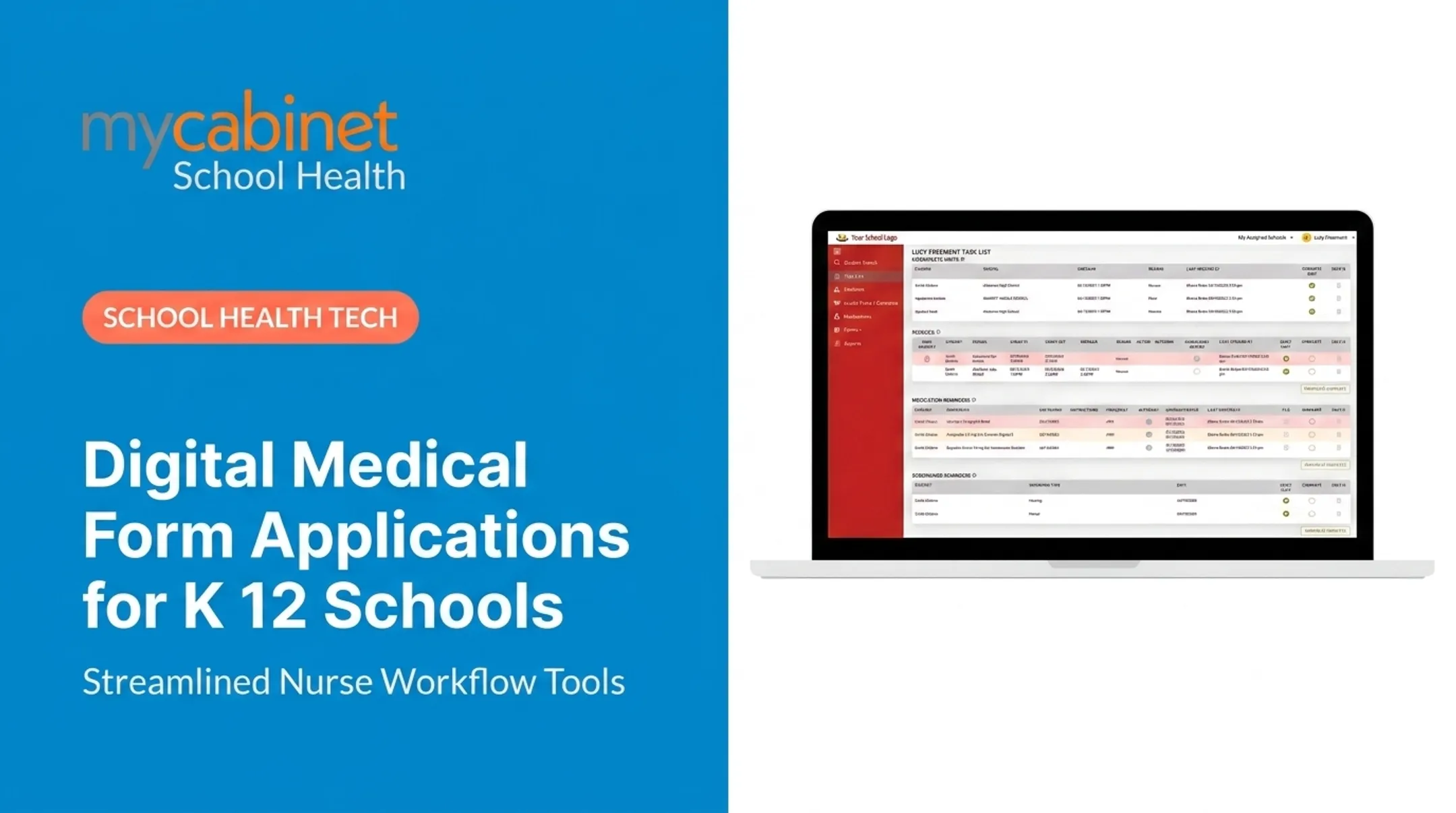
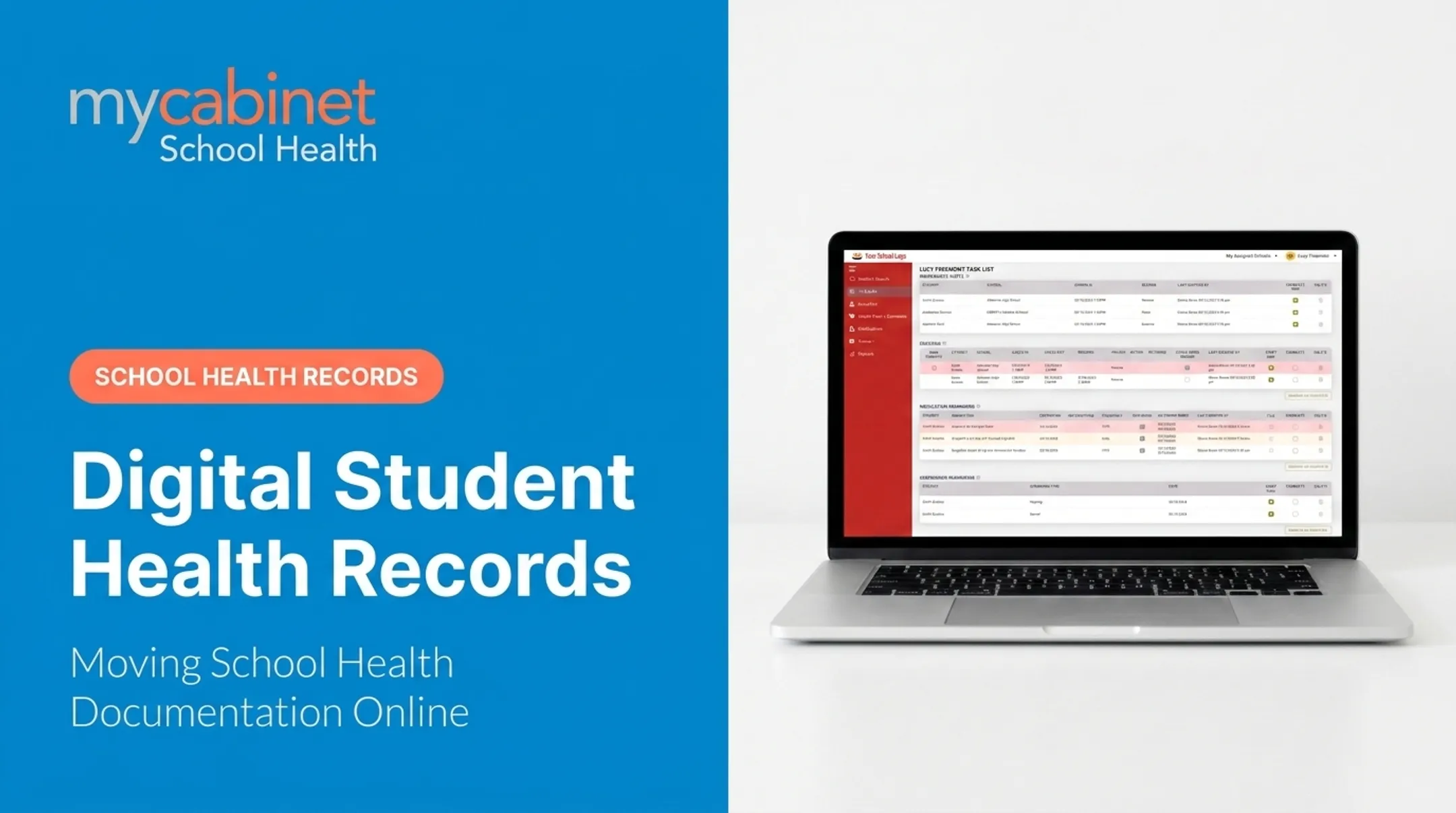
MyCabinet School Health is built around these practices. Its Nurse Portal turns visits, medications, screenings, and follow-ups into workflow-driven task lists so incomplete items do not slip through.
Parents upload required health forms directly. Nurses review and approve them in the system, and approved documents attach to the student record without a fax machine. Medication tracking adds automated expiration alerts, and every access event is logged for a clear FERPA-aligned audit trail.

Choosing the Right School Health Records Platform
Not every EHR is built for a school. Generic clinical systems often carry features schools don't need, while missing the parent-facing tools families expect.
What to look for:
- FERPA-aligned, role-based security: not just a HIPAA badge borrowed from hospital software
- Parent-facing tools: an app and web portal for controlled, one-way updates on visits and medications
- Low-friction nurse adoption: intelligent task lists and structured documentation instead of manual data entry
- Independent security audits: SOC 2 Type II certification is a strong signal
MyCabinet School Health was built around this exact structure: a Nurse Portal for day-to-day documentation, a Parent App for real-time notifications, and a Parent Web Portal for families who prefer browser access.
Parent communication is intentionally one-way (clinic visits and medication alerts, not open messaging), which keeps nurse workflows focused rather than turning into a help desk.
The platform is SOC 2 Type II certified, HIPAA and FERPA compliant, and a ClassLink Certified Partner. It also supports real-time sync into existing Student Information Systems.

Frequently Asked Questions
Can I access my own child's health records?
Under FERPA, parents and eligible students generally have the right to request access to student health records maintained by schools. Platforms with parent portals, like MyCabinet's Parent App and Web Portal, replace paper requests with direct, controlled access.
What is the difference between HIPAA and FERPA for school health records?
FERPA typically governs student health records kept by school nurses acting on the school's behalf. HIPAA mainly applies to school-based health centers that bill insurance or otherwise qualify as covered entities.
How long must schools retain student health records?
Retention timelines vary by state and record type. Texas, for example, requires cumulative health records to be kept 7 years past withdrawal or until age 21. Always check your state's education code.
Who is responsible for managing health records in a school?
School nurses handle day-to-day documentation: visits, medications, and screenings. Administrators and district compliance staff oversee broader policy, retention schedules, and audits.
What happens if a school mismanages student health records?
Consequences can include FERPA complaints, loss of federal funding eligibility, eroded parent trust, and safety incidents caused by inaccurate medication or allergy data.
How can schools improve parent communication about student health?
Digital tools with parent apps or portals give families real-time, controlled updates on clinic visits and medication status, replacing delayed phone calls and paper notes sent home in a backpack.