
Introduction
A student with diabetes needs insulin before lunch. Another carries an inhaler but can't always self-administer during a flare-up. A third has a seizure disorder that requires specific staff to know exactly what to do in the first sixty seconds.
Without a clear plan, school staff are left piecing together instructions from sticky notes, old emails, or whatever the substitute nurse remembers from last semester. That's a risk no district should carry.
More than 40% of U.S. school-aged children have at least one chronic health condition, according to the CDC, and many need daily support or emergency readiness during school hours.
An Individualized Health Plan (IHP) solves this by turning a student's medical needs into a written, actionable plan. This article covers what an IHP includes, when one's needed, how it fits with an IEP or 504 plan, and how schools keep it current.
Key Takeaways
- An IHP converts a student's health needs into clear school-day actions, roles, and expected outcomes.
- School nurses typically lead development, working with families, staff, and providers.
- It works alongside an IEP, 504 plan, or emergency action plan; it does not replace them.
- Plans require ongoing review, not a one-time signature.
What Is an Individualized Health Plan in School Health?
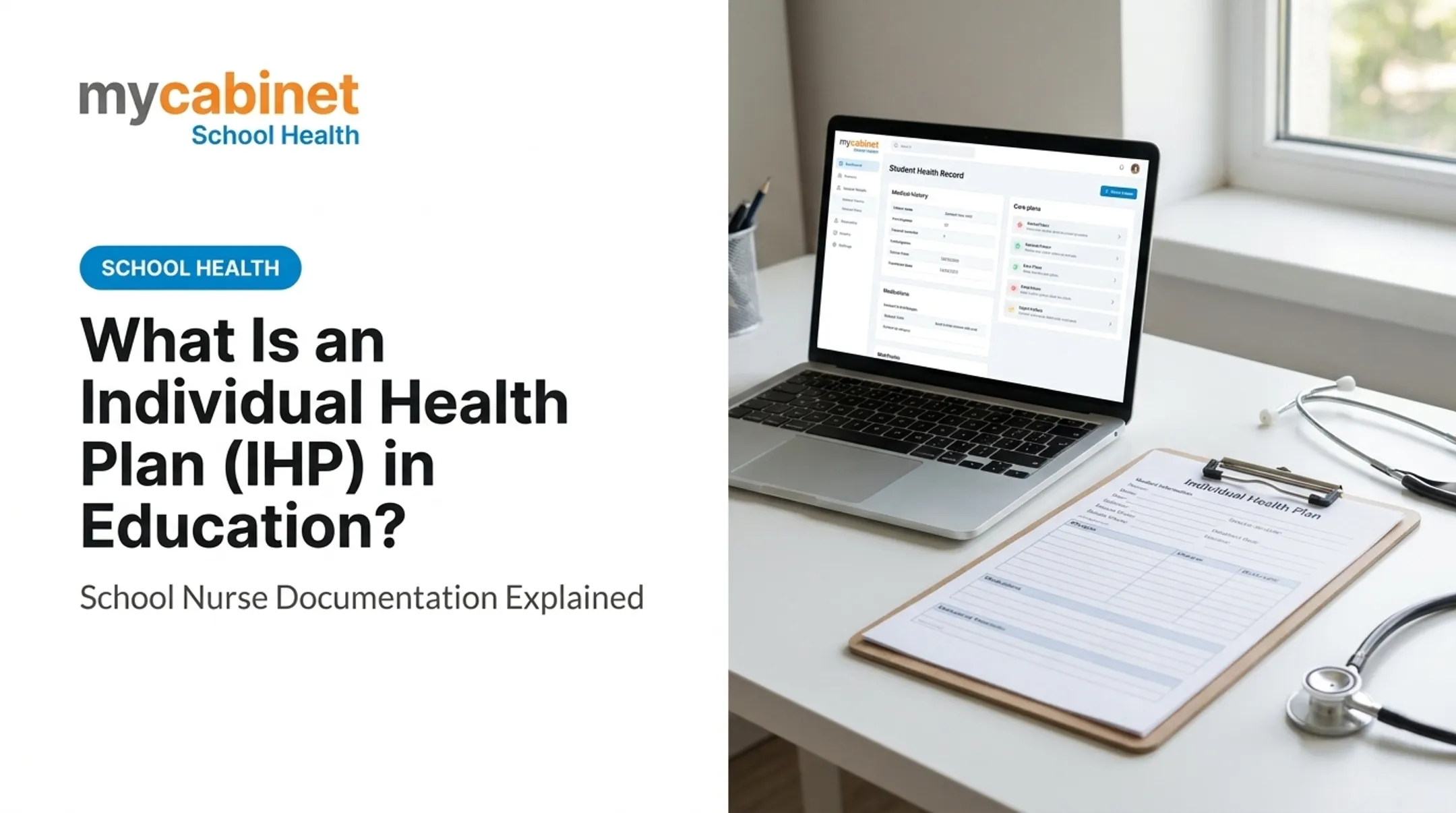
An Individualized Health Plan, sometimes called an Individualized Healthcare Plan or Individualized Health Care Plan, is a written nursing care plan built around one student's health needs at school. Unlike a generic form with a name filled in, it connects a health assessment and provider instructions to daily routines, safety measures, and how that student participates in the classroom.
The IHP's job is to answer practical questions: What care does this student need today? Who provides it? What happens if something goes wrong? NASN's 2025 position statement identifies the registered school nurse as the professional responsible for developing, implementing, and updating these plans for students with complex needs.
That said, the exact forms, signature requirements, and delegation rules vary by state and district. Some states use published templates; others leave more discretion to local nursing staff.
Distinguishing an IHP from Related Documents
Schools often juggle several student health and support documents at once, and it's easy to confuse them:
- IEP (Individualized Education Program): Addresses special education services and educational access; may reference health needs if they affect learning.
- Section 504 Plan: Provides accommodations for a disability without requiring special education services.
- Emergency Action Plan (EAP): A condensed, emergency-focused document that non-medical staff can follow quickly.
- Provider orders: The clinical authorization behind medications or treatments listed in the IHP.
North Carolina's school health program manual is explicit on this point: a plan of care or IHP is separate from an IEP or 504 plan and doesn't replace either one. These documents are meant to complement each other, not compete.
This article is general educational information. Always follow your state law, district policy, and current provider instructions.
When Might a Student Need an IHP?
Not every student with a health condition needs an IHP. The trigger is what the condition requires during the school day, not the diagnosis alone.
Consider an IHP when a student has:
- Daily medication or treatment (insulin, tube feeding, catheterization)
- A chronic or complex condition, such as asthma, epilepsy, or a cardiac condition
- Frequent visits to the health office
- Medically fragile status requiring close monitoring
- Health-related barriers to attending school or joining activities
- A condition that could escalate into an emergency without warning
Schools increasingly manage emergency medications like epinephrine, naloxone, and seizure rescue medications, and multiple daily dosing schedules are becoming more common. That is why NASN guidance treats "complex" needs—not a fixed diagnosis list—as the deciding factor.

A Quick Checklist for School Teams
Before drafting a plan, ask:
- What care is needed, specifically?
- When and where during the school day does it apply?
- Who is qualified and available to provide it?
- What could go wrong, and how would staff know?
- What training, equipment, or backup coverage does this require?
If the answers point to daily action, risk of emergency, or specialized staff training, an IHP is probably warranted—regardless of whether the student already has an IEP or 504 plan.
What Should an IHP Include?
A well-built IHP follows the nursing process: assessment, nursing diagnosis, goals, interventions, documentation, and evaluation. Texas DSHS frames it this way, and most state templates follow a similar structure.
Clinical and background information should cover:
- Relevant diagnoses, symptoms, and known triggers
- Allergies and baseline health considerations
- The student's self-management ability
- Communication needs and functional impact at school
Routine care and treatment details need to be specific enough that any trained staff member could follow them without guessing:
- Medication name, dose, timing, and administration instructions
- Storage and access procedures
- Who is responsible for administration
- Supplies needed for daily care
- Field trip and extracurricular handling
- A backup plan for when the nurse is unavailable
Safety, Emergencies, and Daily Participation
Every IHP needs a clear emergency section covering:
- Warning signs and immediate actions
- Escalation steps and emergency contacts
- Where emergency supplies are kept
An emergency action plan can extend from this section for non-medical staff, but it doesn't replace the fuller IHP.
Educational access belongs in the plan as well:
- Accommodations, positioning, or equipment needs
- Dietary restrictions and transportation logistics
- Participation in gym class, assemblies, and other school activities
Keep the paper trail complete: provider orders, parent input, staff sign-offs, version dates, and who is authorized to see the plan. South Carolina's published IHP form, for example, includes fields for review dates and separate signatures from the RN, LPN, and parent when applicable—a useful model for tracking accountability.
How Schools Manage an IHP From Intake Through Review
An IHP isn't a document you write once and file away. It's a lifecycle:
- Identify the need and notify the school nurse.
- Gather information: provider orders, medication details, emergency history, parent input, and student preferences.
- Consult healthcare providers as needed to confirm instructions.
- Assess school-day requirements: classrooms, transportation, athletics, field trips.
- Draft the plan using the nursing process.
- Review with stakeholders, including staff who'll actually carry it out.
- Train responsible staff and confirm they know where to find current instructions.
- Implement, monitor, and evaluate, then revise as needed.

The Texas Department of State Health Services (DSHS) recommends reviewing the drafted plan with relevant staff before it goes live, not after the first incident exposes a gap.
Review Triggers, Not Just a Calendar Date
Annual review is a common minimum, but it shouldn't be the only trigger. Revisit the IHP whenever there's a change in:
- Diagnosis or symptoms
- Medication or provider orders
- Equipment or staffing
- School placement or activities
- The student's ability to self-manage care
Colorado's guidance describes the IHP as dynamic, not fixed. Treat it that way in practice. A plan left untouched for two years after a medication change is a liability.
Version control matters as much as the clinical content:
- Label the current plan clearly
- Record approval and revision dates
- Restrict access by role
- Retire outdated copies so multiple versions don't circulate in different inboxes
Roles and Responsibilities in IHP Management
Clear ownership prevents the "I thought someone else had it" problem.
School nurses typically handle assessment, plan development, staff training, documentation, monitoring, and recommending revisions, within their scope of practice and state requirements.
Parents and caregivers contribute:
- Accurate health history
- Current provider documentation
- Medication and supplies
- Emergency contacts
- Timely notice when something changes
Students, teachers, administrators, and delegated staff share day-to-day duties:
- Follow the current plan
- Document care they provide
- Escalate concerns quickly
- Protect student confidentiality
Healthcare providers supply the clinical orders that anchor the whole plan.
Delegation adds another layer. In many states, a school nurse—not an administrator—decides whether a specific task can be delegated to trained, unlicensed staff for a specific student.
North Carolina's school health manual treats this as ongoing work: the nurse trains, evaluates competence, supervises, and checks outcomes, rather than delegating once and stepping away.
Using Secure Digital Workflows to Manage Student Care Plans
Paper folders, fax machines, spreadsheets, and email threads are still how a lot of schools track IHPs. It works, until a substitute nurse can't find the current version, or a parent's updated provider note sits unread in a shared inbox for a week.
A school health platform centralizes the pieces: forms, provider documents, nurse notes, medication details, follow-up tasks, and review dates in one place.
MyCabinet School Health is one example of this approach. Its nurse portal keeps care plans (including entries like a "504 Plan" or "IHCP") alongside allergies, medications, and emergency contacts in a student's digital record.
Nurses see task lists that flag incomplete visits, medication expirations, and screening reminders instead of relying on memory. Parents submit medical forms and updated documentation directly, which nurses review and approve before the files attach to the student's record.
When evaluating any digital tool for this purpose, look for:
- Role-based permissions so staff see only what they need
- Controlled parent communication rather than open-ended messaging
- Secure document handling with FERPA-aligned workflows
- HIPAA-related safeguards where applicable
- Clear retention policies and audit trails
MyCabinet's connected Nurse Portal, Parent App, and Parent Web Portal are built around this kind of controlled visibility. Software organizes the paperwork; it does not replace nursing judgment, provider orders, or district policy. Those remain the foundation of every IHP, digital or not.

Frequently Asked Questions
What does IHP stand for in healthcare?
In school health, IHP usually means Individualized Health Plan or Individualized Healthcare Plan, a student-specific nursing care document. In insurance or other clinical settings, the same acronym can mean something else, so confirm the context.
What is an individual health plan in an IEP?
An IHP is generally a separate school health or nursing document, not a section within an IEP. Health-related accommodations may still appear in an IEP when they affect educational access, and school teams should coordinate the two plans.
How often should a student's IHP be reviewed with the school nurse?
Review timing depends on district and state requirements, but most guidance points to at least annually. Review sooner whenever health status, medication, provider orders, or staffing changes.
Is an IHP a doctor?
No. An IHP is a written plan, not a person or medical professional. The school nurse develops and manages it using clinical information and provider instructions.
Is IHP a TPA?
No. In school health, IHP means Individualized Health Plan, which is unrelated to a third-party administrator (TPA). If you see the acronym in an insurance context, confirm its meaning there separately.
What are some examples of SMART goals for school nurses?
Examples include documenting IHP medication doses with 100% accuracy each month, finishing emergency action plan training for classroom staff by a set date, or cutting response time for asthma or seizure episodes. Tie each goal to measurable outcomes in the student's IHP.