
Introduction
Ask most people what a school nurse does, and they'll picture Band-Aids and ice packs. In practice, the job covers far more than first aid.
School health nurses manage chronic conditions, coordinate with outside providers, train staff on emergency response, and connect clinical care to the classroom.
More than 98% of children in the United States pass through school doors each day, and nurses are often the only consistent health professional many of them see. Managing that responsibility across a district, with different campuses, staff, and student populations, creates real complexity.
How do you keep care consistent from elementary to high school while still meeting each student's individual needs? This article breaks down the nurse's core responsibilities, how coordination works across a district, the measurable impact on student outcomes, and the systems that keep everything running without sacrificing clinical judgment or student privacy.
Key Takeaways
- School nurses deliver direct care, prevention, education, emergency response, and advocacy in a single role.
- District-wide programs work best when core practices are standardized and still flexible for each school and student.
- Consistent student care depends on nurses, families, educators, and outside providers sharing the same plan.
- Secure records and organized workflows cut paperwork and follow-up load without replacing nurse judgment.
The School Health Nurse's Role in District-Wide Student Care
A school health nurse is a clinical professional, a student advocate, an educator, and a care coordinator who runs far more than the health office. The National Association of School Nurses (NASN) defines the role as one that bridges healthcare and education, supporting both physical well-being and academic success.
Direct care covers a wide range of daily tasks:
- Student health assessments and first aid
- Chronic-condition monitoring and support
- Medication administration and tracking
- Symptom monitoring and follow-up
- Referrals to outside providers
- Emergency response, including anaphylaxis and seizure protocols
Supporting Chronic and Complex Conditions
Chronic health needs are widespread in schools. According to the CDC, more than 40% of U.S. school-aged children have at least one chronic health condition, including asthma, diabetes, severe allergies, and seizure disorders. Left unmanaged, these conditions directly affect attendance and classroom participation.
Nurses respond by building and reviewing individualized healthcare plans (IHPs), 504 accommodations, and emergency action plans alongside families, physicians, and school teams.
Tennessee's official allergy protocol, for example, spells out exact steps: administer epinephrine immediately, document the time, call 911, and give a second dose if symptoms don't improve within five minutes. That specificity keeps a plan usable when an emergency hits.

Prevention and Health Promotion
Beyond treatment, nurses lead prevention and health-promotion work across the district:
- Screenings and follow-up on immunization gaps
- Infection-prevention efforts, including handwashing campaigns and cleaning protocols
- Outbreak coordination with local health departments
- Health education, from puberty curricula to diabetes self-management coaching
How School Nurses Coordinate Care Across a District
A single nurse managing one campus is one challenge. A district managing consistency across a dozen campuses is another entirely.
District nursing leadership typically establishes shared protocols for:
- Medication administration and error reporting
- Referral pathways to outside providers
- Emergency response steps
- Documentation standards
- Communicable disease management
These protocols only work with buy-in from a wide circle of people: parents, primary care providers, specialists, counselors, special education teams, teachers, administrators, transportation staff, and community health organizations.
When a student needs a same-day assessment versus a routine follow-up versus an emergency escalation, that call rests on the nurse's professional judgment, guided by district policy rather than a rigid checklist.
Continuity During Transitions
Continuity matters most at the exact moments it's hardest to maintain: when a student transfers schools, moves up a grade, or returns after a hospitalization. Districts that keep health records tied to the student rather than the building make these transitions smoother.
Some platforms, including MyCabinet School Health, automatically shift a student's profile to their new school within the same district once enrollment updates, cutting down on the lag where care history goes missing for days or weeks.
Family Communication and Legal Boundaries
Record continuity only helps if access stays controlled. Sharing information with the right people, while protecting the rest, is a constant balancing act.
According to joint federal guidance from the U.S. Department of Education and HHS, health records maintained by a provider acting on behalf of a FERPA-covered school are treated as education records under FERPA, not HIPAA.
HIPAA typically applies only when a non-FERPA provider transmits protected health information electronically. That distinction shapes how districts train staff and structure consent. Confirm the rules with legal counsel for your specific setting rather than assuming one framework fits every scenario.
The District-Wide Impact of School Nursing
School nurses influence more than the health office. Their work shapes attendance, participation, and equity across an entire district.
Health-related barriers to learning are common. CDC research notes that students managing asthma, diabetes, food allergies, or seizure disorders often face daily management challenges that can increase absenteeism.
Nurses reduce these barriers through consistent monitoring, medication access, and quick response, keeping students in class instead of sending them home.
A Population-Health Lens
Nurses see patterns that individual teachers or administrators can't. Recurring health complaints from one building, a spike in asthma visits during allergy season, or unusually high visit volume at a single school all signal something worth investigating at the district level.
Equity Gaps Are Real
Access isn't distributed evenly. A Journal of School Nursing study analyzing over 1,340 nurses across Washington districts found that a higher share of Black students was associated with a worse student-to-nurse ratio, while rural districts had higher ratios than urban ones. These are associations, not proof of cause, but they point to where staffing and resource decisions deserve scrutiny.
Districts evaluating program impact typically look at:
- Health office visit patterns
- Medication errors or near misses
- Attendance trends tied to health visits
- Referral follow-through rates
- Family engagement with health communications
Building Consistent and Safe School Health Workflows
Consistent workflows keep student care safer and more reliable across a district. Most health interactions move through the same core steps:
- Collect forms and consent from families before the school year starts
- Review and flag conditions requiring an IHP, 504 plan, or emergency action plan
- Document each visit with consistent detail
- Track medications, including expiration dates and administration logs
- Follow up on referrals and unresolved concerns
- Notify families of relevant updates
- Retain records according to district and state requirements
Where Manual Systems Break Down
Paper forms, spreadsheets, fax machines, and scattered email threads create real risk: missing information, delayed follow-up, duplicated work, and no visibility across campuses. Districts without a centralized platform often struggle to manage students with chronic conditions because information lives in too many disconnected places.
This is the gap MyCabinet School Health was built to close. It supports clinical judgment with a workflow layer that helps nurses act faster:

- Structured visit documentation with predefined visit types
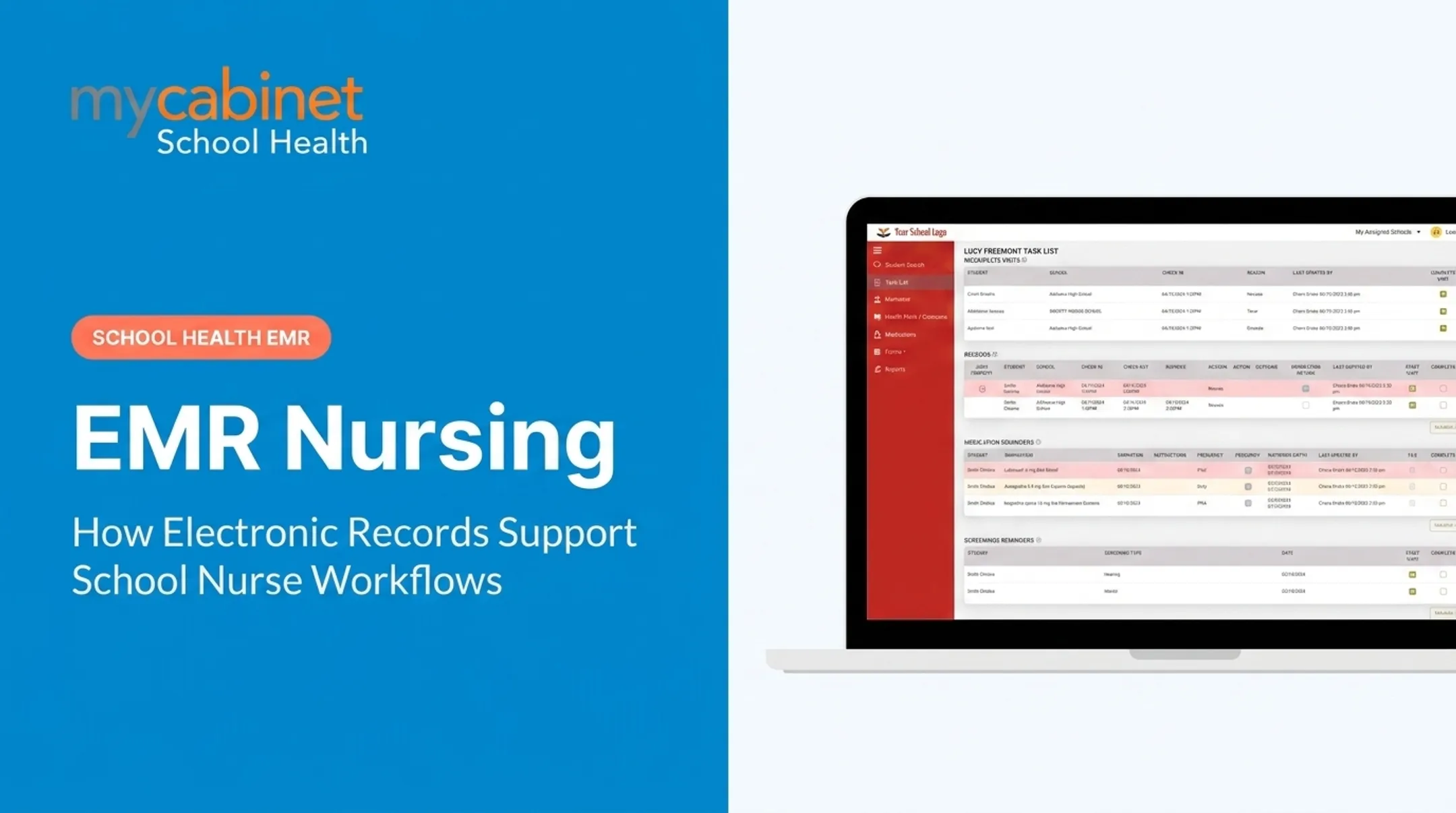
- Intelligent task lists that surface incomplete visits, rechecks, and medication reminders
- Medication expiration tracking and outreach logging
- Digital health-form collection with parent upload and nurse approval
- Role-based access that keeps parents limited to their own child's records
The platform is built with FERPA-aligned and HIPAA-compliant controls, though districts should still confirm their own compliance obligations rather than treating any single tool as a complete solution.
Measuring and Strengthening a District School Health Program
Improving a school health program starts with combining several inputs: nurse feedback, family needs assessments, workflow reviews, incident analysis, and health data trends.
Before assuming a program is working, check whether every campus has:
- Clear escalation pathways for urgent situations
- Backup coverage when a nurse is out
- Consistent medication procedures
- Adequate emergency supplies
- Shared documentation standards
- Defined referral processes and communication expectations
A Continuous-Improvement Cycle
- Assess district-wide needs and gaps using nurse feedback, incident data, and family input
- Define one measurable goal tied to a specific gap
- Implement a targeted change on a clear timeline
- Review results against the goal with shared metrics
- Gather feedback from nurses and families on what worked
- Refine the approach and repeat the cycle
That cycle shows up clearly in practice. A 2025 quality-improvement project published in the Journal of School Nursing followed an urban district that, over eight months, identified 688 students experiencing homelessness and used a standardized nurse-led health assessment to connect them with care.
Sixty-seven percent completed a partial or full assessment. Most of those students had a primary care provider on record, while roughly half lacked a dental home. The project did not claim a dramatic outcome shift. It showed what a focused, data-driven cycle can surface.

Frequently Asked Questions
What are the main responsibilities of a school nurse?
School nurses provide direct student care, manage medications and chronic conditions, and lead prevention and health education efforts. They also handle emergency response, referrals, documentation, and student advocacy across the district.
What is the main focus of care for a school nurse?
The focus is protecting and improving student health in ways that support safe participation, attendance, and learning. This includes ensuring equitable access to care regardless of a student's background or campus.
What are the goals of school health nursing?
Goals include health promotion, early intervention, and care coordination, alongside emergency preparedness and family support. The aim is reducing health barriers so students can stay in class and learn.
What qualifies you to be a school nurse?
Requirements vary by state and district but generally include registered nurse (RN) licensure, relevant clinical experience, and sometimes a school-nurse credential or endorsement. Always verify current requirements with your specific state's education or nursing board.
How many years does it take to be a school nurse?
There's no single timeline. It depends on your nursing education path, RN licensure, clinical experience, and any extra state credentialing beyond the degree.
What is a nursing endorsement?
An endorsement is a state-issued authorization, separate from RN licensure, that qualifies a nurse for a specialized role like school health. Terminology and eligibility requirements differ by state, so check with your state education department directly.