
Compliance touches state law, documentation standards, exemption categories, and hard deadlines. Miss one, and a student can be excluded from class. This guide breaks down what's actually required, where nurses commonly get tripped up, and how platforms like MyCabinet support cleaner, more defensible workflows.
Key Takeaways
- Every US state mandates immunization compliance; required vaccines and deadlines vary by state and grade
- Spreadsheet tracking raises the risk of missed deadlines and failed audits
- Medical and religious exemptions need separate documentation and often do not expire once filed
- Automated digital reminders close compliance gaps manual systems miss
- FERPA and HIPAA govern how immunization records are handled, shared, and stored
What Is Immunization Compliance?
Immunization compliance is the process schools use to verify, document, and maintain proof that students meet vaccination requirements before they can attend class. It is an ongoing administrative responsibility, not a one-time checkbox at enrollment.
One point that often surprises new nurses and administrators: there is no single federal school-entry vaccine law. Compliance is enforced state by state, based on state legislative authority, not federal mandate.
That means:
- Requirements differ across state lines, and sometimes across districts within the same state
- Non-compliant students can face exclusion from school until proper documentation is on file
- Districts and school officials can face legal or financial penalties for failing to enforce these rules properly
Who Sets These Requirements
Three sources typically shape a school's immunization rules:
- State law: the primary and most binding source, setting minimum vaccines, doses, and exemption categories
- Individual school or district policy: some institutions add requirements beyond the state minimum
- Affiliated health or clinical partners: school-based health centers or district medical advisors may add their own documentation standards
Before building any compliance workflow, confirm the specific state, school type, and grade level you're working with. Treating a national vaccine schedule as legal doctrine is one of the most common mistakes in this space.
Core Immunization Requirements Schools Must Track
Most states require a similar core group of vaccines, though exact doses and timing vary. The standard list includes:
- DTaP (diphtheria, tetanus, pertussis)
- Polio (IPV)
- MMR (measles, mumps, rubella)
- Varicella (chickenpox)
- Hepatitis B
- Tdap (typically required around 7th grade)
- Meningococcal ACWY (often required at 7th and again at 11th grade)
Dose requirements typically increase at three checkpoints: kindergarten, 7th grade, and 11th grade. These transition points act as catch-up windows before students face new exposure risks. Middle and high school environments carry different disease-transmission patterns than elementary settings.

The "New Entrant" Problem
Any student transferring schools or returning after an enrollment gap typically triggers a fresh compliance review, regardless of what was on file at their previous school. This is one of the most common sources of missed documentation, since incoming records don't always transfer cleanly or completely.
Beyond the Standard Vaccine Certificate
Compliance files often require more than a basic immunization card:
- Titer lab reports (blood tests confirming immunity when vaccination records are incomplete)
- TB skin test results (required in certain districts or for specific student populations)
- Physician-signed exemption forms (for medical exemptions specifically)
Those extra documents are where files stall, and the national numbers show how common gaps are. According to CDC's SchoolVaxView data for the 2025–2026 school year, national kindergarten vaccination coverage ranged from 92.0% for DTaP to 92.4% for MMR and polio.
That leaves roughly 1 in 13 kindergartners starting the year without complete documentation for at least one core vaccine. Exemption rates climbed to 4.2%, or about 155,000 kindergartners nationally.
Understanding Exemptions and Non-Compliance Scenarios
Two exemption categories apply nationwide, though state rules vary sharply:
- Medical exemptions — signed by a licensed provider, accepted in all 50 states and DC
- Religious or personal belief exemptions — accepted in most states, but California, Connecticut, Maine, New York, and West Virginia no longer allow non-medical exemptions
A Typical Non-Compliance Timeline
When a student's record is incomplete, most districts follow a similar escalation path:
- Initial notice sent to the parent identifying the missing documentation
- Grace period — commonly 30 days to submit records or an exemption
- Follow-up reminder if the deadline is approaching with no response
- Exclusion from attendance if the issue remains unresolved

One detail nurses often overlook: exemption documentation, once filed, usually doesn't expire. Unlike standard immunization certificates that need periodic updates as students age into new dose requirements, an approved exemption form typically stays valid for the student's entire enrollment. Keep it with the permanent health record so it remains available for audits and future grade transitions.
Common Compliance Management Mistakes (and Fixes)
Even well-run health offices fall into predictable traps. Here are the four biggest ones.
Relying on spreadsheets and paper forms. Manual tracking is where deadlines slip through the cracks. A single missed row or outdated file can mean a student attends class without valid documentation, and that's exactly what audits catch. Move records into a centralized digital system that flags missing or expiring documentation automatically.
Inconsistent parent communication. Vague or one-off reminders about missing records leave parents confused about deadlines and consequences. Multi-channel reminders (email, app notifications, and portal alerts) reduce the back-and-forth.
No clear ownership. When compliance tracking falls entirely on one overwhelmed staff member, gaps are inevitable. Build buy-in from administrators and support staff so compliance is a shared responsibility with a designated lead.
Not tracking guideline changes. State health department rules shift more often than people expect. Assign someone specifically to monitor updates and adjust your tracking system before the next school year starts, not after a violation surfaces.
A 2021 peer-reviewed study of school nurses found that the recurring challenge isn't a lack of effort but a lack of standardized process. Nurses consistently cited the need for better resources and access to statewide immunization registries to do their jobs efficiently.
How Technology Streamlines Immunization Compliance
A school health EHR platform changes the math. Instead of manually cross-referencing spreadsheets against state requirements, the system automates record collection, flags gaps, and generates reports ready for an audit.
Prioritized Task Lists
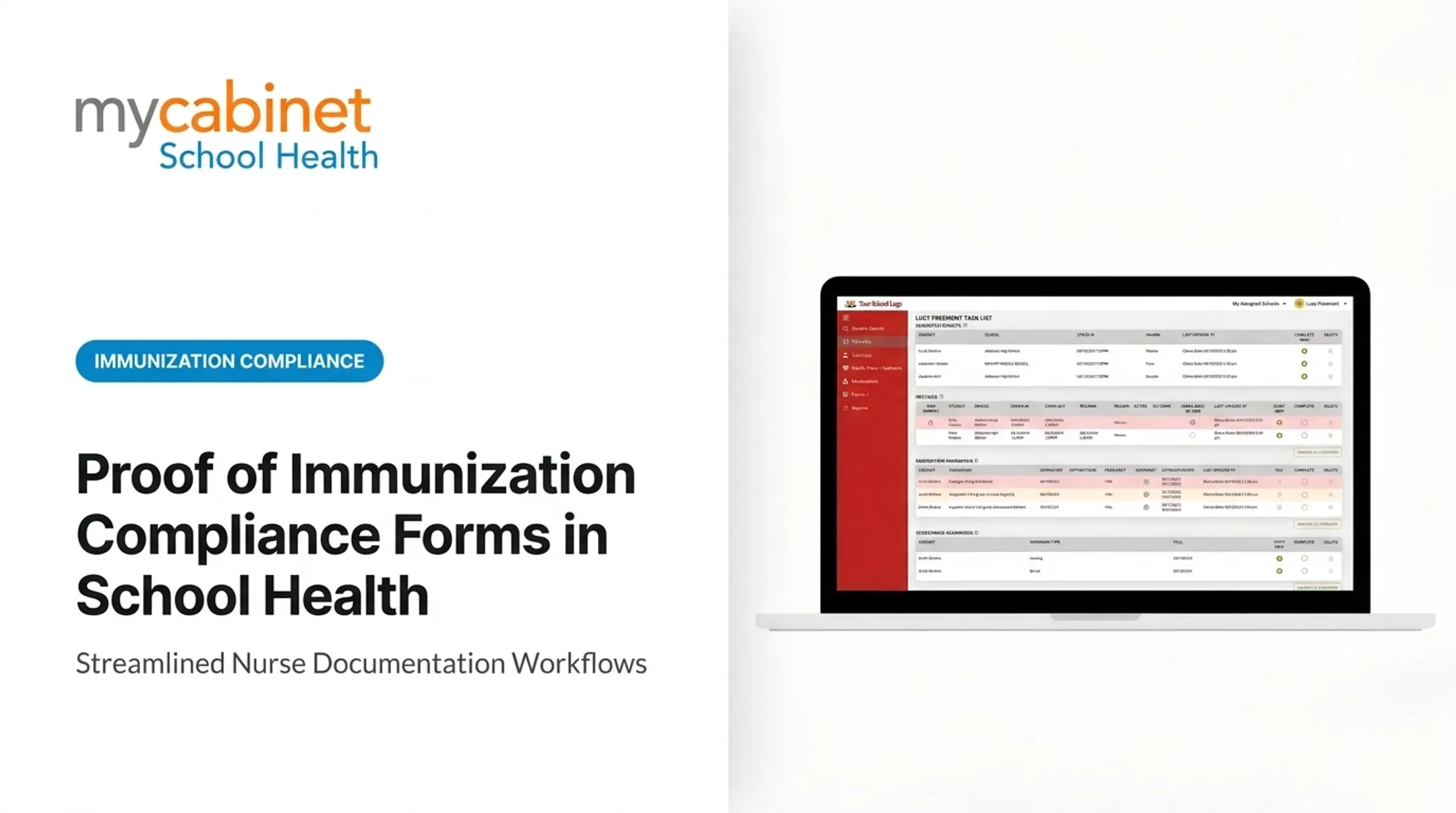
MyCabinet's Nurse Portal organizes incomplete visits, outstanding documentation, and follow-up items into a single task list. Rather than hunting through folders or spreadsheets to figure out who's missing what, nurses can see what needs attention and work through it in order.
Parent-Submitted Records
MyCabinet's connected Parent App and Parent Web Portal let families upload immunization records directly. A school nurse then reviews the submission and approves it, attaching it straight to the student's digital health record. No printing, faxing, or digging through email threads required.

Cobb County Schools Superintendent Chris Ragsdale described the shift this way after implementing MyCabinet: it digitized documentation, let parents submit paperwork electronically, and gave families visibility into their child's care. He called it "a win for the parents and a win for the district."
Privacy Built Into the Workflow
Immunization data is sensitive, and access needs to be controlled accordingly. MyCabinet applies FERPA-aligned, role-based permissions so records are visible only to parents (for their own child), school nurses and approved staff, and administrators with reporting access. The same role-based controls protect student privacy and keep the district audit-ready.
Frequently Asked Questions
What is vaccination compliance?
Vaccination compliance means a student has met their state's mandated immunization requirements for school enrollment or attendance, confirmed through documentation on file with the school.
Where do I find my vaccine certificate?
Request records from your child's pediatrician, local health department, or your state's immunization registry. Many schools now let parents upload these directly through a parent portal.
Why is MMR not given before 9 months?
Maternal antibodies in infants can interfere with vaccine effectiveness. The CDC sets the routine minimum age for the first MMR dose at 12 months because the vaccine is less effective before a child's first birthday.
Why do people born before 1957 not need MMR?
Widespread measles circulation before the vaccine era means most people born before 1957 are presumed immune. Anyone born in 1957 or later is generally recommended to have two MMR doses.