
Compliance monitoring software fixes this by automating audit prep, flagging violations before they escalate, and cutting legal exposure. The stakes are real: the global average data-breach cost hit $4.99 million in 2026, a 12% jump year-over-year, with US breaches averaging $11.5 million, according to IBM's Cost of a Data Breach Report 2026. Organizations using extensive AI and automation cut breach costs by $1.93 million and identified incidents 65 days faster.
This guide breaks down the top platforms for 2026 and how to pick the right one, including what a district should weigh differently.
Key Takeaways
- Compliance monitoring software automates tracking, evidence collection, and reporting against regulatory frameworks
- Prioritize regulatory mapping, continuous monitoring, automation depth, integrations, and audit-ready reporting
- Match your needs to GRC platforms, framework-specific automation, or industry-specific systems
- Non-compliance carries steep financial risk, so proactive monitoring belongs in your core controls stack
What is Compliance Monitoring Software?
Compliance monitoring software continuously tracks an organization's adherence to internal policies, regulations, and industry standards — for a district, that spans IT security frameworks and student health obligations alike. Rather than checking boxes once a year, it watches controls in real time.
Traditional audits vs. continuous monitoring, a distinction districts meet at state reporting deadlines:
- Point-in-time audits (SOC 2 Type I) evaluate control design at a single moment
- Period audits (SOC 2 Type II) evaluate operating effectiveness over an extended window
- Continuous monitoring assesses controls often enough to support real risk decisions, per NIST's definition
The market spans general GRC platforms for broad frameworks, security-certification tools focused on SOC 2/ISO 27001, and industry-specific systems for sectors like healthcare or K-12 education. Below are the top options in each category.
Top Compliance Monitoring Software for 2026
The platforms below are enterprise GRC tools. In a district they cover the security posture of district systems, not whether a student's immunization record is current. Read the list with that in mind and prioritize a few practical factors:
- Framework coverage and continuous monitoring depth, including whether school obligations appear at all
- Automation strength and integration breadth
- Whether reporting is truly audit-ready
Vanta
Vanta automates SOC 2, ISO 27001, and HIPAA certification through continuous control monitoring. It's built for speed. In a district that fits the technology team, not the health office.
Differentiators:
- Automated evidence collection with failed-test notifications
- 400+ integrations in its official library
- AI-assisted remediation guidance for closing gaps
| Category | Details |
|---|---|
| Best For | Startups and SMEs seeking fast certification |
| Standout Feature | Continuous control monitoring with automated evidence collection |
| Pricing | Custom/quote-based |

Drata
Drata handles continuous compliance across 30+ frameworks, including SOC 2, ISO 27001, and HIPAA, with daily-updating control statuses. Districts running many cloud systems get the most from that breadth.
Differentiators:
- Prewritten policy templates for faster setup
- Real-time compliance dashboards with drift alerts
- 300+ integrated tools plus API connectivity
Drata earned G2 Leader status in Spring 2025 across four categories, including Cloud Compliance and Security Compliance.
| Category | Details |
|---|---|
| Best For | Companies maintaining multiple certifications simultaneously |
| Standout Feature | Real-time reporting and customizable trust center |
| Pricing | Custom/quote-based |
AuditBoard (now Optro)
AuditBoard, rebranded as Optro, combines compliance, audit management, and risk tracking for enterprise-scale operations. Built for organizations larger than most districts.
Differentiators:
- AI-powered documentation and workflow tools
- Strong third-party integrations, including Jira and ServiceNow
Gartner named it a Leader in the 2025 Magic Quadrant for GRC Tools.
| Category | Details |
|---|---|
| Best For | Large, highly regulated enterprises needing audit + compliance oversight |
| Standout Feature | AI-powered workflow automation and analysis |
| Pricing | Custom/quote-based |
OneTrust
OneTrust focuses on privacy and GRC, purpose-built for GDPR, CCPA, and global data protection compliance across 55+ frameworks. For a district, the use is student data privacy beyond FERPA — mapping what each edtech vendor holds.
Differentiators:
- Automated data mapping and privacy impact assessments
- DSAR management built in
- 200+ pre-built integrations, plus a broader integrations gallery
| Category | Details |
|---|---|
| Best For | Organizations managing complex global privacy regulations |
| Standout Feature | Automated privacy impact assessments and DSAR management |
| Pricing | Custom/quote-based |
Hyperproof
Hyperproof manages multiple frameworks (160+ pre-built) with automated evidence collection through cloud integrations. That suits a district juggling several frameworks with a small technology team.
Differentiators:
- Hypersync integrations for recurring evidence pulls
- Continuous controls monitoring with risk-to-control linkage
- Strong collaboration tools for audit teams
Hyperproof earned 2025 Capterra Shortlist recognition for Compliance and Risk Management categories.
| Category | Details |
|---|---|
| Best For | Growing companies managing multiple regulatory frameworks |
| Standout Feature | Automated evidence sync via cloud integrations |
| Pricing | Custom/quote-based |

Key Features to Look for in Compliance Monitoring Software
Not every tool covers the same ground. A district should ask of each: does it cover district IT compliance, and does anything here touch student health records? Prioritize these five capabilities:
- Multi-framework mapping: HIPAA, SOC 2, ISO 27001, and GDPR support with shared controls, so you are not duplicating evidence work across frameworks
- Continuous monitoring: Daily or near-real-time control checks that catch drift before it becomes an audit finding
- Automated alerts and remediation: Failed tests trigger workflows, not just notifications
- Enterprise integrations: HRIS, ERP, and CRM connections that keep compliance data out of silos
- Audit-ready reporting: On-demand, exportable dashboards auditors can use without extra cleanup
Skip any of these and you will spend more time on manual evidence collection and audit prep later. None will produce the immunization compliance report a state asks a district for.

Why Schools Need Industry-Specific Compliance Monitoring
General GRC platforms are built for broad security frameworks. They often miss workflows specific to specialized sectors, like K-12 schools, where FERPA and student health privacy overlap in ways generic tools weren't designed for.
In a school setting, compliance isn't just IT security. It's protecting student health records, medication logs, and parent communications, all while keeping documentation consistent enough to survive an audit.
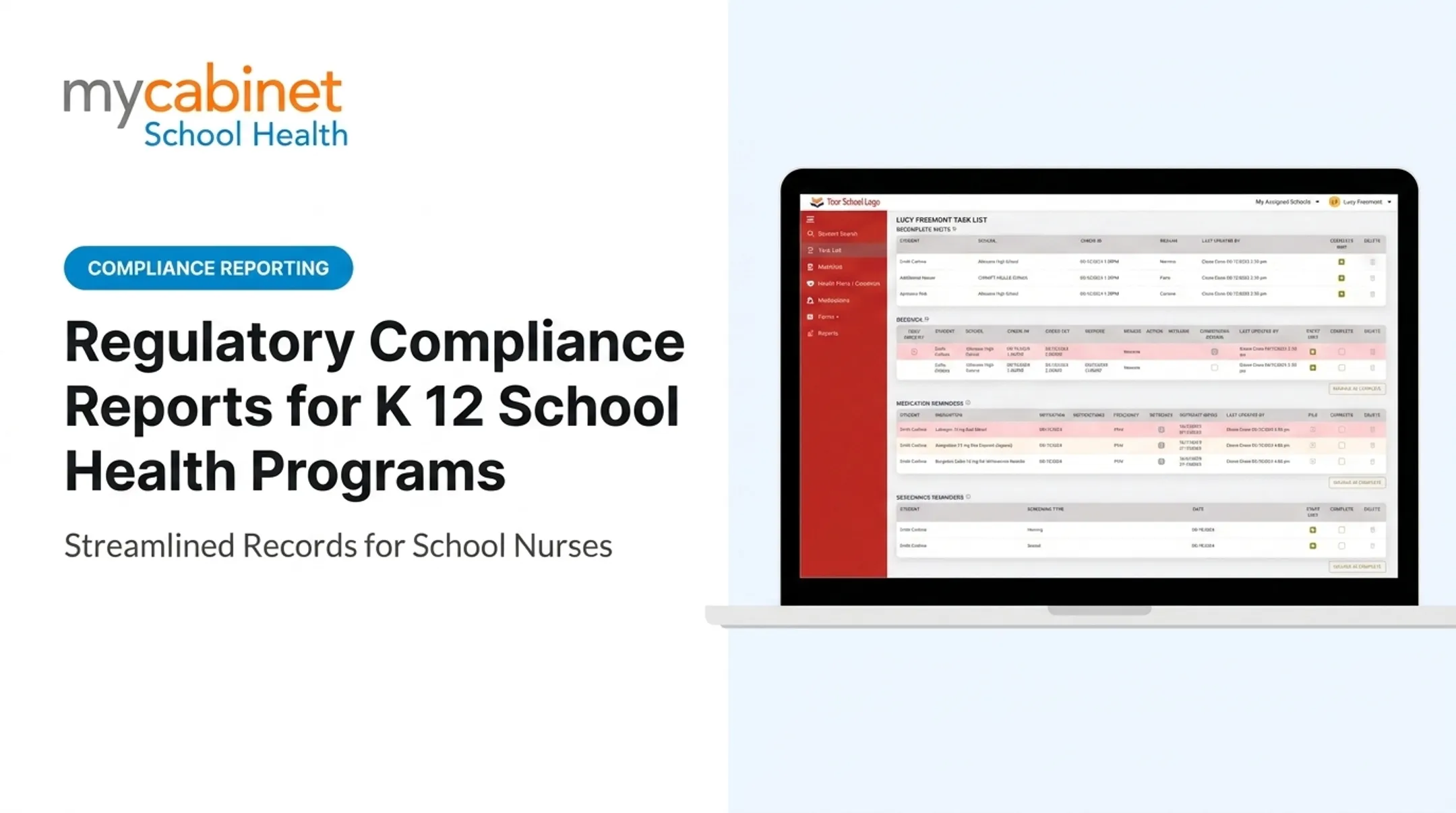
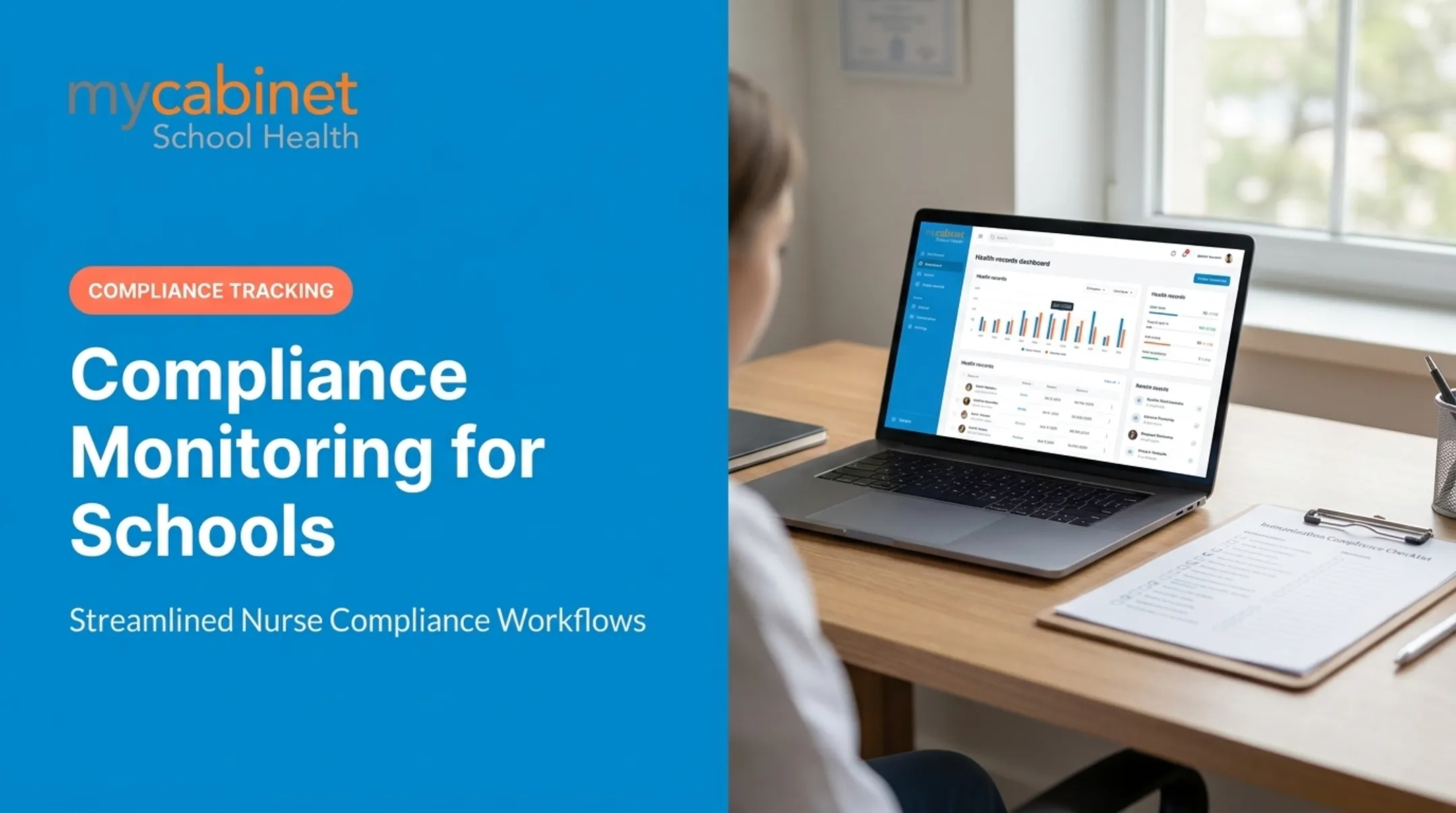
Purpose-built platforms fill the gap generic GRC tools leave open. MyCabinet School Health, HIPAA compliant, FERPA compliant, and SOC 2 Type II certified, supports school nurse compliance workflows through:
- Structured visit documentation — pre-defined visit types keep encounters consistent, even when a nurse handles dozens of visits per week
- Role-based access — parents see only their own child's information; nurses access only what's needed for care
- Audit trails — activity logs and clean documentation trails without adding extra steps for nurses
- Medication expiration tracking — automated parent alerts help schools maintain current records and demonstrate follow-up
Cobb County School District's superintendent noted at a 2025 school board meeting that the platform "digitized and makes documentation easier," specifically citing electronic paperwork submission and visibility into medication and visit records. For school health workflows, that kind of purpose-built coverage is what broader compliance platforms typically miss.

How We Chose the Best Compliance Monitoring Tools
Our evaluation weighed four factors; a district should weight the first hardest, since FERPA and state school-entry rules sit outside most GRC platforms:
- Regulatory coverage — breadth across the frameworks buyers actually need
- Automation depth — how much evidence collection and control testing runs without manual work
- Continuous monitoring — ongoing visibility versus point-in-time checks
- Reporting quality — audit-ready output stakeholders can use without rework
A common buyer mistake is choosing on brand recognition alone instead of framework fit and team size. A five-person startup chasing SOC 2 does not need the same platform as a 5,000-employee enterprise juggling ISO 27001, GDPR, and PCI DSS at once.
We cross-checked claims against verified reviews on G2, Capterra, and Gartner Peer Insights. Vendor badges are self-reported recognition, not independent proof—so we treated them as one data point among several, not a ranking shortcut.
Conclusion
Choose compliance monitoring software that fits your organization's scale, regulatory complexity, and industry—not the tool with the biggest name.
Before committing:
- Test the free trial or demo — see how the interface handles your actual frameworks
- Confirm integration compatibility — check it connects to your existing HRIS, ERP, or CRM stack
- Map framework overlap — make sure shared controls reduce duplicate evidence work
For general enterprise compliance, the platforms above cover most needs. For sector-specific work like school health, pair them with a purpose-built system such as MyCabinet School Health so nurses, forms, medications, and family records stay compliant without forcing school workflows into a generic GRC tool.
Frequently Asked Questions
How do you generate a compliance report?
Most compliance monitoring tools pull live evidence and control data into pre-built templates. These reports can be exported on demand, giving auditors current documentation without manual compilation.
What is the best compliance software?
There's no single best tool, and a district usually needs two: a GRC platform for district IT compliance and a school health platform for student records. Top platforms in 2026, including Vanta, Drata, and Hyperproof, each serve different needs depending on industry, framework requirements, and company size.
What is compliance tracking software?
It's software that monitors adherence to regulations and internal policies, automating audits, evidence collection, and reporting so teams aren't managing spreadsheets manually.
What is an example of compliance monitoring?
Continuous monitoring of access controls against SOC 2, with automated alerts when anomalies appear, is a common example. In schools, tracking medication expirations with automated parent notifications serves the same purpose.
What are the 7 pillars of compliance?
Per HHS OIG guidance, the seven pillars are written policies, compliance leadership, training, communication channels, enforcement, routine monitoring and auditing, and corrective action.