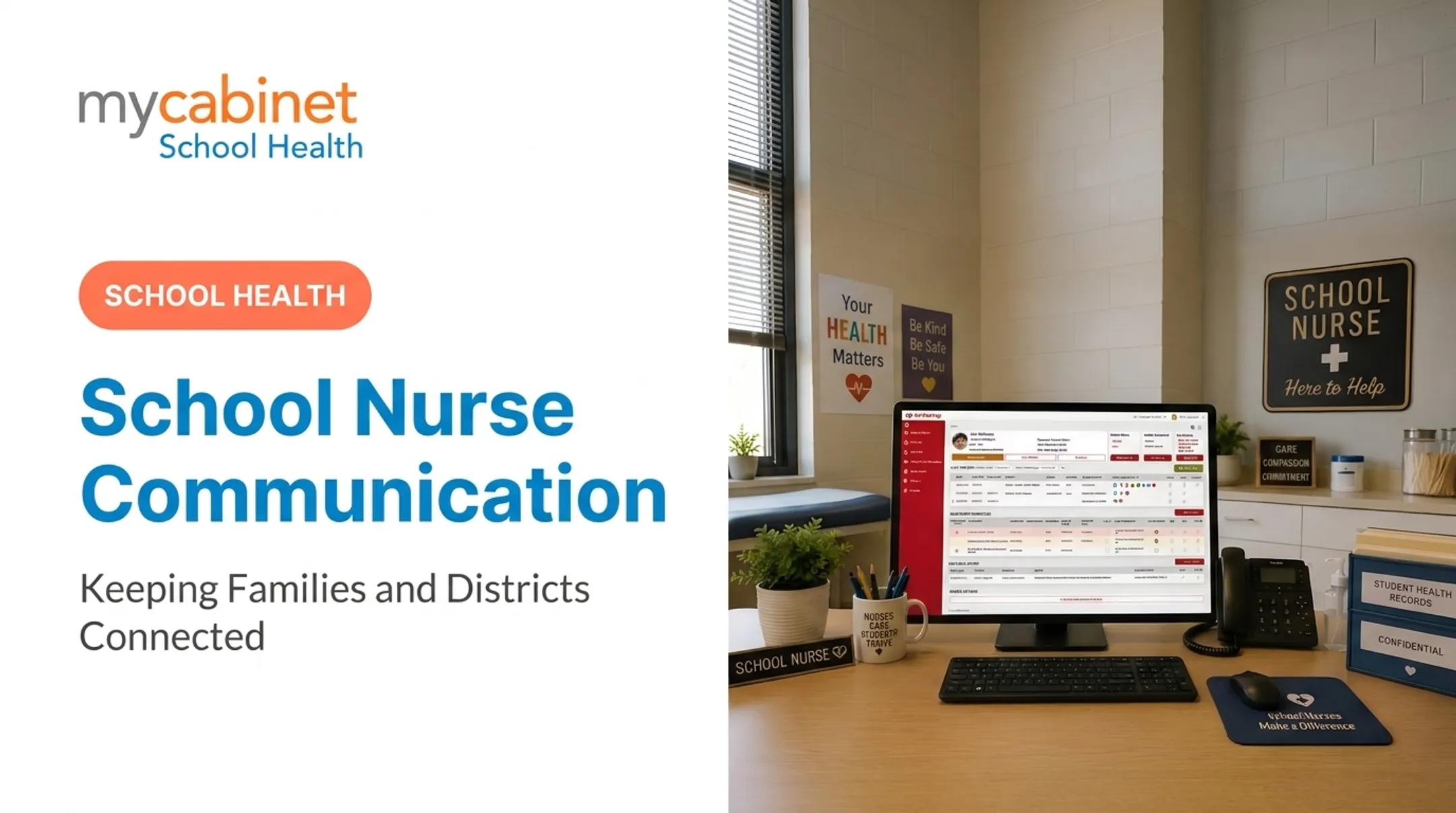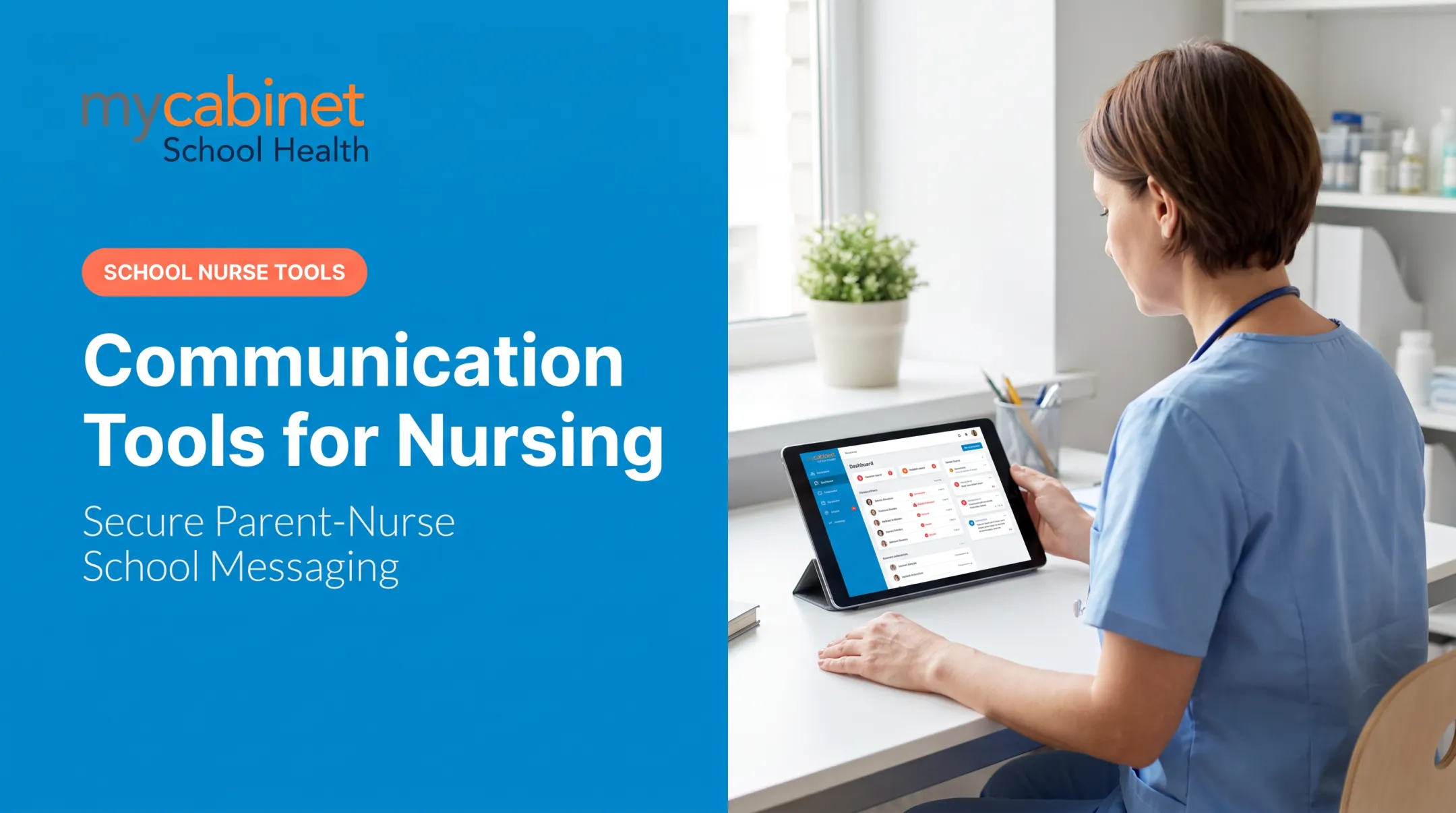

Many administrators assume FERPA alone covers school health information. In practice, families now expect HIPAA-grade privacy for any conversation involving their child's health, even when the law technically says FERPA applies. This article covers what compliant communication actually looks like, where schools commonly slip up, and how purpose-built platforms like MyCabinet School Health support nurses and families without adding administrative weight.
Key Takeaways
- School health records are usually governed by FERPA, not HIPAA, but families expect HIPAA-level security anyway
- Encrypted, access-controlled, audited communication should be the default, regardless of which law technically applies
- Consumer texting and email lack the audit trails and access controls needed for sensitive health updates
- Districts face an average of five cyber incidents per week, making secure-by-design communication a practical necessity
- Purpose-built platforms reduce nurse workload while improving parent visibility into clinic visits and medications
What Is HIPAA-Compliant Communication and Why It Matters for Schools
HIPAA-compliant communication means health information moves through encrypted channels, with access limited to authorized users and every exchange logged for review. The HIPAA Security Rule requires administrative, physical, and technical safeguards for electronic health information. Those safeguards include access controls, audit mechanisms, and transmission security (HHS Security Rule summary).
Here's the catch for schools: most K-12 districts aren't HIPAA-covered entities. Yet school nurses handle exactly the kind of sensitive information HIPAA was built to protect:
- Medication administration records
- Immunization histories
- Chronic condition management plans
- Mental and emotional health notes
Best-practice security still makes sense even without formal HIPAA coverage. Whether or not HIPAA technically applies, districts that adopt encryption, role-based access, and audit trails cut legal risk and reputational damage. A data mishap involving a student's health information creates the same parent backlash regardless of which federal law applied.

FERPA vs. HIPAA: What Applies to School Health Records?
The December 2019 joint guidance from the Department of Education and HHS lays out clear boundaries. Most K-12 student health records fall under FERPA, not HIPAA, because schools generally aren't classified as covered entities.
Health records maintained by a school nurse or contractor acting on the school's behalf are treated as education records under FERPA, even when a third party is involved (ED/HHS Joint Guidance, 2019).
When HIPAA Actually Applies
If a school-based health clinic bills Medicaid or insurance electronically for a covered transaction, that clinic can become a HIPAA-covered entity for that specific function. Even then, records maintained solely as FERPA education records typically stay outside HIPAA's Privacy Rule.
In those cases:
- FERPA and IDEA consent rules still govern disclosures
- HIPAA coverage attaches to the billing function, not the full student health file
- Districts should confirm which law applies before setting disclosure policy
The takeaway for districts: know which law governs before assuming compliance. Families expect the same standard of discretion whether HIPAA or FERPA applies.
What Forms of Communication Are HIPAA/FERPA Compliant for School Health?
Not every communication channel meets the bar for sensitive health information. Compliant channels include:
- Secure messaging platforms with encryption and role-based access for medication updates, visit summaries, and care plan changes
- Parent portals and apps with controlled, one-way notifications for clinic visit alerts and medication expiration warnings
- Digital health forms routed through in-system upload, nurse review, and approval instead of faxed or emailed PDFs
- Structured visit documentation with audit trails, replacing spreadsheets and sticky notes with a defensible access record
Standard SMS and personal email lack encryption and audit trails, so limit them to general reminders. One-way portal notifications keep families informed without the liability of open-ended chat.
Breach data shows why channel choice matters. HHS's 2024 breach report recorded 663 large-scale healthcare breaches, affecting roughly 242.9 million individuals, with hacking and IT incidents responsible for 81% of those reports (HHS OCR 2024 Breach Report). Schools aren't immune: the Department of Education reports districts face five cyber incidents per week on average.

Common Communication Challenges in School Health
Nurses juggling multiple communication channels face predictable friction points that compound over a school year.
- Fragmented tools: Paper logs, email threads, spreadsheets, and phone calls pull nurses in different directions instead of centralizing information
- Medication tracking gaps: Without automated expiration alerts, doses get missed or medications lapse without anyone noticing until it's urgent
- Parent visibility gaps: Families often learn about a clinic visit hours later, sometimes secondhand through their child
- Compliance risk: Staff texting parents from personal phones about a health issue creates an unencrypted, unlogged record outside district oversight
The Staffing Reality Behind These Gaps
Part of the problem is structural. NCES data shows only 52% of public schools had a full-time nurse as of 2015-16, though 82% had at least part-time coverage (NCES, School Nurses in U.S. Public Schools).
Charter schools fared worse, with just 52% having any nurse coverage compared to 84% of traditional public schools.
NASN cautions against relying on simple nurse-to-student ratios. Those figures miss real workload variability: medication administration, screenings, care coordination, and documentation all compete for the same hours. Fewer nurses covering more responsibilities means less time for manual communication workarounds, and more risk when those workarounds fail.

How MyCabinet School Health Supports Secure, Connected Communication
MyCabinet School Health was built around this exact intersection of nurse workflow, parent communication, and compliance pressure. The platform connects three components: a Nurse Portal, a Parent App, and a Parent Web Portal.
The Nurse Portal centralizes student records, visit documentation, medication inventories, and task lists (incomplete visits, rechecks, medication reminders) so nurses aren't reconstructing information from memory or scattered notes.
The Parent App and Web Portal deliver controlled, one-way notifications instead of open chat. Parents see:
- Clinic visit summaries
- Active medications kept at school
- Medication expiration alerts with approximate dates
- School health notices
Because messaging stays one-way, nurses avoid becoming an on-demand support line while parents still get timely, documented updates. If a parent needs to discuss something directly, they contact the clinic, keeping sensitive back-and-forth off unsecured channels.
Digital form collection follows a closed loop. Parents upload required health forms through the app or web portal, nurses review and approve them in the system, and approved documents attach directly to the student record. No faxing, no scanning, no manual follow-up emails.

This structure paid off for Cobb County School District. Superintendent Chris Ragsdale told the district's 2025 school board that the platform "digitized and makes documentation easier."
He pointed to electronic parent paperwork and parent visibility into when their child was seen and given medication, calling it "a win for the parents and a win for the district."
Behind these features, MyCabinet is HIPAA-compliant, FERPA-compliant, and SOC 2 Type II certified, with independently audited controls for role-based access, audit logs, data encryption, and incident response.
Best Practices Checklist for Compliant School Health Communication
Districts evaluating their current setup should run through this list:
- Use a purpose-built platform rather than consumer messaging apps for any health-related parent communication
- Set clear protocols defining what can be shared via app versus what requires a phone call
- Train staff regularly on data handling and communication policies, not just during onboarding
- Choose vendors with signed agreements and documented data-handling practices, plus a BAA when PHI is involved
None of this requires overhauling how nurses work. It requires replacing ad hoc habits (a text here, a spreadsheet there) with one system that logs every message and handoff automatically for audit readiness.
Frequently Asked Questions
How do I stay HIPAA compliant when texting?
Standard SMS isn't compliant because it lacks encryption and audit trails. Use a platform with access controls and logging, and secure a signed BAA with the vendor if HIPAA applies to your situation.
What forms of communication are HIPAA compliant?
Secure messaging platforms, encrypted email with reasonable safeguards, parent portals, and HIPAA-compliant video conferencing all qualify when paired with access controls and audit trails.
What is an example of HIPAA-compliant school communication?
A school health platform sending an encrypted, logged notification about a medication expiration, instead of a nurse texting a parent from a personal phone, is a practical example of compliant communication.
What are the three main rules of HIPAA?
The Privacy Rule governs use and disclosure of protected health information. The Security Rule requires safeguards for electronic health data. The Breach Notification Rule sets requirements for notifying individuals and HHS after a breach.
Does FERPA or HIPAA apply to school health records?
FERPA generally governs student health records maintained by schools, since most districts aren't HIPAA-covered entities. HIPAA can apply in specific cases, such as school clinics billing insurance electronically.