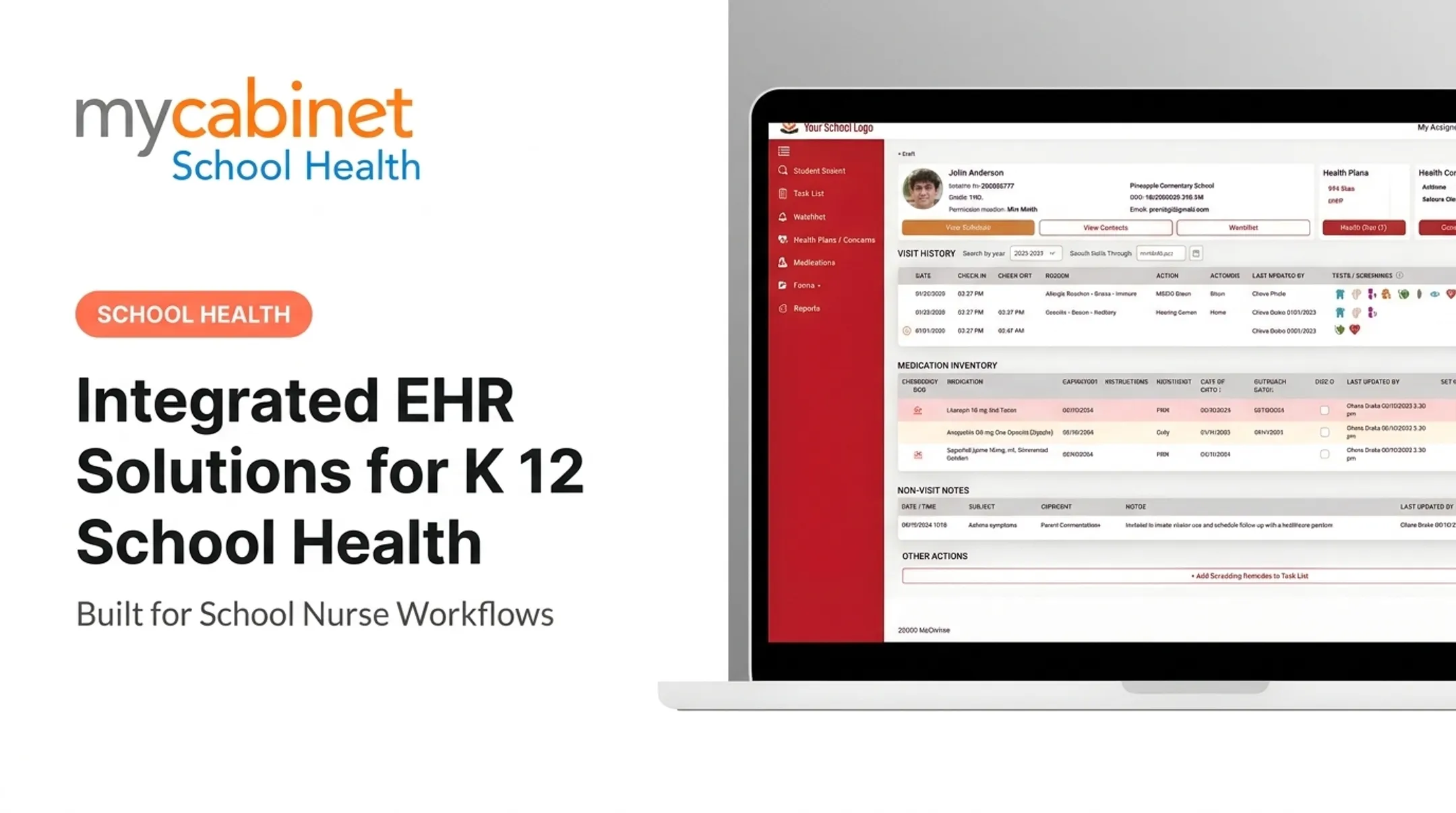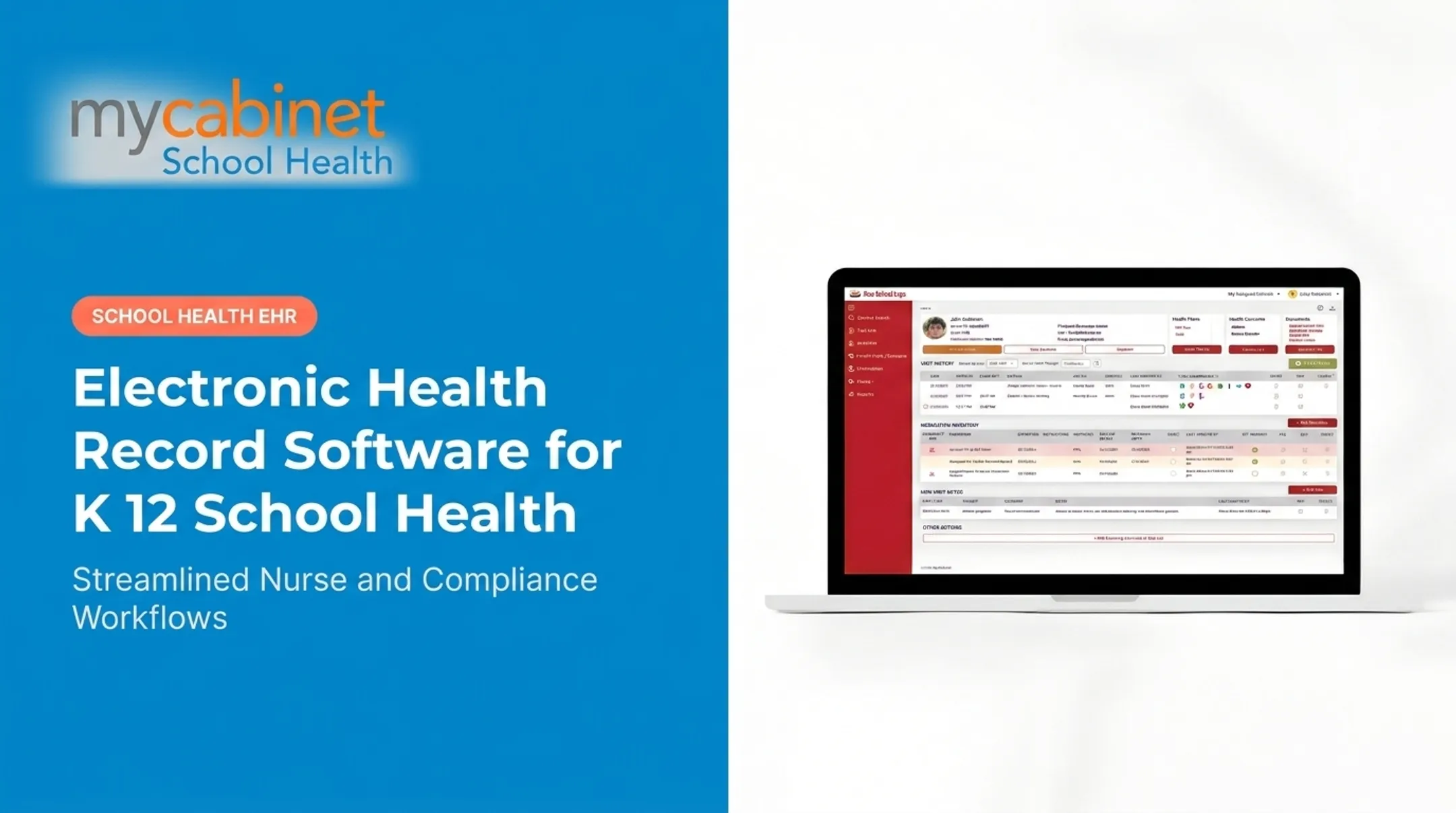

That breadth matters because school nurses rarely get to slow down. A student walks in with chest pain, a seizure, or an allergic reaction, and the nurse needs history, allergies, and emergency contacts in seconds, not minutes spent flipping through paper files. Nationwide, roughly 95,800 full-time school nurses serve close to 52.5 million children across 130,000 public and private schools, according to a 2024 CDC-affiliated study of school nurse workload — a caseload that leaves little room for disorganized records.
This article breaks down what school health EHRs capture, how nurses and administrators use that data, and what separates a school-built system from a general medical record.
Key Takeaways
- School health EHRs capture more than diagnoses—encounters, interventions, medications, screenings, forms, and communications
- Structured records help nurses retrieve student history quickly and keep care documentation consistent
- Access controls, accurate documentation, and privacy practices protect sensitive student data
- Fields captured vary by EHR design, school policy, and each student’s care needs
What Information Does an EHR Capture in School Health?
An electronic health record is a digital, longitudinal record that follows the student over time. It holds the health information authorized staff need to document, understand, and support that student's care. In school health, an EHR captures five connected categories of information working together.
Student and Health Background Information
Core profile data gives a nurse the context to act quickly:
- Student identification and contact details
- Emergency contacts and authorized family information
- Relevant health history, allergies, and chronic conditions
- Accommodations, such as a 504 Plan or Individualized Health Care Plan (IHCP)
Background details should stay limited to what school health operations actually need. A screen crowded with irrelevant history slows a nurse down exactly when speed matters most.
Visit and Encounter Documentation
Every health office visit generates its own record. Typical entries include:
- Date, reason for visit, and symptoms reported
- Assessment notes, interventions, and outcomes
- Follow-up instructions
That documentation covers playground injuries, fever complaints, routine medication administration, and scheduled rechecks.
Medications and Care Plans
Medication data typically includes:
- Drug name, dosage, frequency, and administration records
- Parent or prescriber authorization
- Expiration dates and storage requirements
For a student with asthma, that might mean an Albuterol inhaler marked as stored at school and linked directly to an asthma action plan and clinic log. The medication-to-care-plan connection stays visible instead of scattered across separate files.
Screenings, Immunizations, Forms, and Supporting Documents
This category covers:
- Vision and hearing screenings
- Immunization records and physical forms
- Consent documents and emergency action plans
- Physician instructions and uploaded attachments
Digital form collection cuts down on paper, faxing, and repeated follow-up calls to parents chasing missing signatures.
Tasks, Referrals, and Communication History
EHRs also track open work: incomplete visits, rechecks, medications nearing expiration, referrals, and parent outreach. Communication records should show what was shared, with whom, when, and through which authorized channel, without replacing the underlying clinical notes.

How School Health EHR Data Is Used
Captured data only has value if it supports the actual workflow: intake, documentation, follow-up, reporting, and family communication. Here's how that plays out in practice.
Faster, More Informed Nurse Decision-Making
Before responding to a student's needs, a nurse can pull up the following in one view:
- Allergies and conditions
- Current medications
- Prior visits
- Emergency contacts
That organization cuts the time otherwise spent digging through paper files, spreadsheets, or scattered email threads. That time matters most during an urgent visit.
Safer Medication Management
Medication records support verification, dosage and frequency visibility, expiration monitoring, and follow-up with families.
Consider a practical example: a student's EpiPen is set to expire in three weeks. A complete medication record flags the expiration, logs outreach to the parent, and gives the nurse a clear next action: request a replacement before the date passes, not after.
Continuity of Care and Follow-Up
A longitudinal record helps staff spot recurring visits, unresolved concerns, and documented referrals, even when a student sees a different staff member each time. This supports consistency across staff. School documentation still only covers school-based care. It does not replace diagnosis or treatment decisions made by a licensed healthcare provider.
Family Communication and Participation
Authorized parents or guardians can receive forms, requests, or notifications through approved channels, subject to school policy and permissions.
MyCabinet School Health, for example, connects nurse workflows to parent-facing access through a mobile app and browser-based web portal. It sends one-way notifications for clinic visits and medication expirations rather than open chat threads. Confirm parent-facing access is available before treating it as a standard feature.
Reporting, Planning, and Program Improvement
Aggregated, appropriately protected data helps schools identify recurring health needs and plan screenings or supplies. The National Association of School Nurses notes that EHR data can be monitored, extracted, and analyzed to track trends, support quality improvement, and inform evidence-based policy decisions at the school, district, or state level.

What Makes School Health EHR Data Different?
School health records are built around the student's school-day needs: nurse workflows, attendance context, medication requirements, family permissions, and coordination with teachers and administrators. That's a different orientation than a general medical EHR designed around clinical encounters in a hospital or physician's office.
A few distinctions stand out:
| Feature | School Health EHR | General Medical EHR |
|---|---|---|
| Visit focus | Episodic health-room visits, screenings, medication administration | Ongoing diagnosis and treatment |
| Communication | Parent-school notifications and form requests | Provider-to-provider referrals |
| Primary user | School nurse, often managing dozens of students daily | Physician or clinical care team |
| Governance | Typically FERPA, sometimes HIPAA depending on context | Primarily HIPAA |
The National Association of School Nurses defines a school-nursing EHR as a platform built specifically for school nursing. It uses standardized nursing language and data points alongside FERPA- and HIPAA-aligned confidentiality standards.
Structured fields, predefined visit types, audit trails, and searchable task lists matter here because a single nurse may be responsible for an entire building. The record needs to support individual student care and district-level reporting simultaneously, without exposing personal health information unnecessarily.
Privacy, Access, and Data Quality Considerations
Student health data is sensitive, and protecting it requires more than good intentions. Look for systems that include:
- Role-based access and strong authentication
- Controlled sharing and audit trails
- Secure storage and documented retention practices
HIPAA and FERPA Don't Always Apply the Same Way
According to HHS guidance on school health records, records maintained by a school or school nurse acting on behalf of a FERPA-covered institution are generally treated as education records under FERPA, not the HIPAA Privacy Rule.
An outside provider not employed by or acting on behalf of the school may fall under different rules, especially if that provider conducts HIPAA-covered electronic transactions. Schools should verify which rules apply based on who is creating and holding the record.
Beyond legal frameworks, data quality itself is a safety issue. Outdated or duplicated information creates risk. Verify these fields regularly:
- Allergies and current medications
- Emergency contact accuracy
- Signed consent forms
- Active care plans
MyCabinet School Health supports HIPAA and FERPA compliance with role-based permissions and audit trails built into the platform. Schools should still evaluate any vendor's safeguards, contracts, and implementation practices independently rather than relying on a compliance label alone.

Choosing a School Health EHR
A quick checklist before signing with any vendor:
- Workflow fit — Does it support school-specific documentation, not just generic medical charting?
- Medication tracking — Does it flag expirations, dosages, and required outreach automatically?
- Forms and screenings — Can parents submit forms digitally, with nurse review built in?
- Task visibility — Are incomplete visits, rechecks, and reminders organized in one place?
- Parent access — Is there a controlled, permission-based way for families to see relevant updates?
- District integration — Does it connect with existing student information systems?
Ask vendors directly how they handle role-based permissions, audit trails, data exports, training, support, and records retention. A good answer names concrete controls and processes, not general assurances.
MyCabinet School Health is built for K–12 schools and districts around those same checks:
- Nurse-centered visit and task workflows
- Digital form collection through the Parent App
- Medication oversight with expiration alerts
- Controlled parent updates through a mobile app and web portal
No single platform fits every staffing model, budget, or student information system. Judge vendors against your real workflow, not feature lists alone.
Frequently Asked Questions
Which of the following is the best definition of electronic health records?
An EHR is a digital record that organizes a person's health information, care encounters, medications, assessments, and related documents for authorized users. In school health, that structure is adapted specifically around student and nurse workflows.
Which type of electronic health records allows a patient to input their own information?
Patient-facing or portal-based EHR systems let individuals submit their own information. In schools, authorized parents and guardians can submit forms or updates under school review and permission settings.
What information is typically included in a school health record?
Typical records include health history, allergies, chronic conditions, visit documentation, symptoms, interventions, medications, screenings, forms, care plans, referrals, follow-up tasks, and authorized communications.
How do school nurses use electronic health record data?
Nurses use EHR data to review student health information quickly, document visits, administer and monitor medications, manage follow-up tasks, and coordinate with families when something needs attention.
Are electronic health records in schools private?
Yes. Student health information is sensitive and protected under FERPA and related school privacy rules. Access should stay limited to authorized users through role-based permissions, secure storage, and documented privacy practices.