
Introduction
A student walks into the nurse's office mid-seizure. The nurse needs the emergency care plan, current medications, and allergy history in seconds, not minutes. That urgency creates a hard tradeoff: school health records must be instantly accessible, yet every field still has to stay locked down.
Every digital record a school nurse touches—from a visit note to a medication log to a message home—is a potential target. Over 2 million students have been affected by ransomware attacks on schools and districts, according to CISA's 2023 K-12 cybersecurity report.
When health data is exposed, altered, or unavailable during an emergency, the damage is not only a privacy problem. It disrupts care, erodes family trust, and can shut down clinic operations for days.
This article covers the core EHR security controls, how FERPA and HIPAA actually apply to school health records, common school-specific risks, and a practical checklist for evaluating or improving your district's system.
Key Takeaways
- Protect K-12 health data with technical controls, privacy policy, staff training, vendor oversight, and incident response.
- Use least-privilege access, MFA, encryption, audit trails, secure backups, and controlled communication as the baseline.
- FERPA and HIPAA obligations depend on the specific record and who holds it, not on the software alone.
- A strong school health EHR supports secure nurse workflows, accurate documentation, medication oversight, and transparent parent access.
Protecting Student Health Information: Why EHR Security Matters in K-12 Schools
What a School Health Record Actually Contains
A school health EHR typically holds far more than a visit log. It can include:
- Visit documentation, symptoms, diagnoses, or chronic conditions
- Allergies, medications, and dosage instructions
- Immunization records and screening results
- Emergency contacts and emergency care plans
- Health forms, physician orders, and treatment instructions
- Communications with families about a student's care
That breadth is exactly why a breach or an error in this system carries higher stakes than a typical administrative record.
Confidentiality, Integrity, and Availability
NIST's guidance on the HIPAA Security Rule frames security around three objectives, and each maps directly onto a school scenario:
- Confidentiality: A student's mental health note or diagnosis stays visible only to the nurse and staff who need it, not to every teacher with system access.
- Integrity: A medication instruction stays exactly as the physician wrote it. An unauthorized dosage edit is a student safety failure, not a filing mistake.
- Availability: During an anaphylactic reaction, the nurse can pull the student's emergency action plan in seconds, not after a system outage resolves.
FERPA or HIPAA? It Depends on the Record
Districts often assume HIPAA automatically governs student health data. It usually doesn't.
According to joint guidance from the U.S. Department of Education and HHS, health records maintained by a school nurse acting for a FERPA-covered school are education records under FERPA. That remains true even when the district is otherwise a HIPAA-covered entity.
| Scenario | Likely framework |
|---|---|
| School nurse maintains the record for the school | FERPA |
| Contracted provider acts on the school's behalf | FERPA |
| Independent provider bills electronically as a covered transaction | HIPAA may apply |
| Private school not covered by FERPA, acting as a HIPAA entity | HIPAA |
Because the answer depends on who's holding the record and how, verify classification with your district privacy officer or legal counsel before setting disclosure rules.
Why Fragmented Systems Create Gaps
Paper binders, shared spreadsheets, personal email, and faxed forms feel familiar, but they leave real blind spots:
- No clear record of who viewed or changed information
- Inconsistent retention across offices or staff
- Little visibility for compliance review or incident investigation
Accurate, available records support medication administration, emergency response, follow-up visits, and communication with the right family members. Fragmentation undermines all four.

Essential EHR Security Controls for K-12 Schools
Identity and Access Management
Access control is the base layer every other safeguard depends on:
- Require unique accounts and strong authentication; prohibit shared nurse or staff logins
- Require multi-factor authentication for accounts that access student health records
- Apply role-based, least-privilege access so each nurse, administrator, district user, and parent sees only what their role requires
- Review permissions whenever staff change roles, leave the district, or cover as a substitute nurse
Platforms built specifically for school health, such as MyCabinet School Health, apply role-based permissions by default and keep sensitive health data separated from broader student information systems rather than blending it into a general-purpose platform.
Protecting Data Through Its Lifecycle
Protect student health data at every stage—not only in the database:
- Encrypt data at rest and in transit, and use secure connection protocols
- Protect laptops, tablets, and other devices that open health records
- Handle printed or downloaded information with the same care as digital records
- Maintain secure backups, test recovery procedures regularly, and set clear retention schedules
- Use data minimization and controlled exports when sharing with providers, families, or transportation staff
Making Every Action Traceable
Audit trails should record logins, record views, edits, exports, disclosures, and administrative changes. Administrators can then:
- Review logs for unusual access patterns
- Investigate specific concerns quickly
- Document who approved access, why information was disclosed, and how guardian permissions were handled
Monitoring supports policy. It doesn't replace it.
Secure Communication and Parent Access
Sensitive health information sent through ordinary email or text messages is much harder to control than information kept inside a secure portal. Parent and guardian access should be:
- Authenticated and tied to a verified student relationship
- Reviewed when custody, consent, or enrollment status changes
- Limited to one-way notifications, secure uploads, and nurse-reviewed record attachment rather than open messaging
MyCabinet School Health's Parent App, for example, uses one-way notifications with no open chat stream, plus in-app document uploads that a nurse reviews and attaches to the student's record before anything becomes official.
The Human Element Technology Can't Replace
Technology fails when people skip the basics. Cover both habits and written rules:
- Train staff on phishing, social engineering, and incident reporting
- Cover lost devices, clean-desk habits, and visitor access in routine drills
- Publish acceptable-use, mobile, remote-access, and vendor-access policies
- Define disclosure, retention, and breach-escalation steps in writing

Common School-Specific EHR Security Challenges
Schools face conditions most other industries don't:
- Operational strain: Shared devices, thin IT staffing, substitute nurses, and high turnover weaken solid controls and add nurse stress (Journal of School Nursing).
- Constant enrollment changes: Transfers, graduation, and shifting staff roles need timely account updates—or old access lingers.
- Vendor exposure: CISA's 2023 report found most K-12 breaches came through school vendors, not districts—so contracts, subcontractor visibility, and support access reviews matter.
- Everyday incidents: Phishing, ransomware, lost devices, accidental disclosure, and documentation errors all need a documented response.
Those pressures make rehearsal part of security, not a nice-to-have. Tabletop exercises that walk through a ransomware or phishing scenario help staff practice containment, escalation, and family communication before a live incident hits.
A Practical K-12 EHR Security and Vendor-Evaluation Framework
Start With a District Risk Assessment
Before evaluating any vendor, map your own environment:
- Inventory where student health information is collected, stored, transmitted, printed, exported, and deleted
- Identify high-impact workflows: medication administration, emergency care, health-form approval, and parent communication
- Document who currently has access and which systems already hold student health data
Ask Vendors Specific Questions
Broad compliance claims aren't enough. Push for specifics:
- How is role-based access and MFA configured?
- What encryption, backup, and disaster recovery processes exist?
- Is a Business Associate Agreement relevant to this arrangement, and how does the vendor support FERPA responsibilities?
- Where is data hosted, which subprocessors are involved, and how does support staff access records?
- How does the district retrieve or delete data at contract termination?
Usability Is a Security Feature
A system that's hard to use pushes nurses toward workarounds: paper notes, screenshots, and personal devices.
Look for features that keep sensitive work inside controlled workflows:
- Structured visit documentation
- Medication expiration tracking and task lists
- Controlled parent access
- Clear approval paths
MyCabinet School Health organizes incomplete visits, rechecks, medication reminders, and screening follow-ups into a single nurse task list instead of sticky notes or memory.
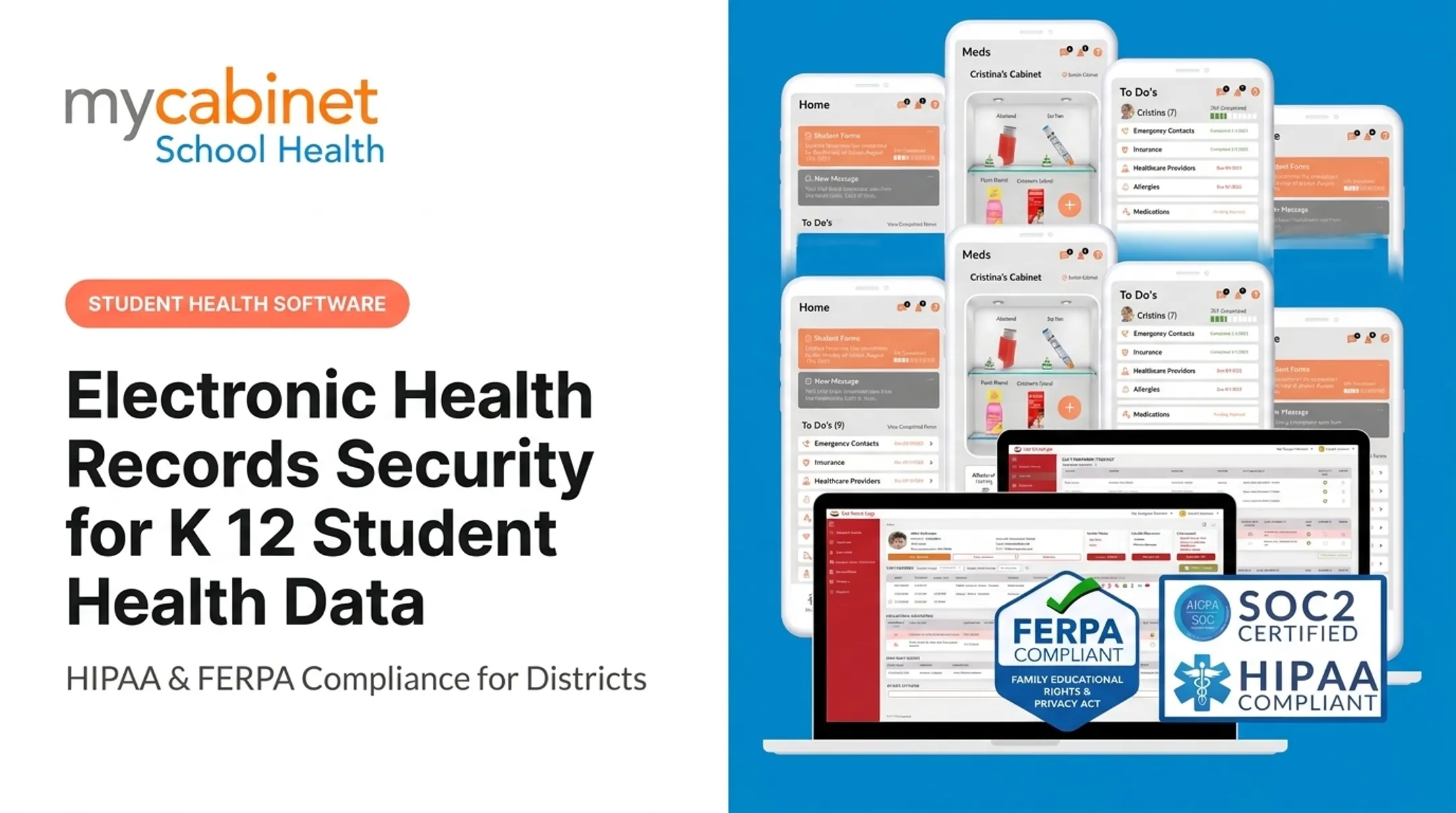
The platform is SOC 2 Type II certified, HIPAA and FERPA compliant, and a ClassLink Certified Partner. It connects a Nurse Portal with a Parent App and web portal for structured documentation, medication oversight, audit trails, and digital form review.

Districts should still verify these details and complete their own due diligence before signing.
Use a Phased Implementation Plan
- Define owners and configure roles and permissions
- Migrate or enter records carefully, testing integrations along the way
- Train staff and validate emergency access before go-live
- Schedule recurring access reviews, backup tests, and vendor reviews afterward
Conclusion
Securing K-12 health records isn't a one-time purchase. It's an ongoing program built from privacy governance, access control, secure workflows, staff behavior, vendor accountability, and incident readiness.
The practical starting point is straightforward:
- Map data flows and classify records
- Apply least-privilege access
- Secure communication channels
- Review audit logs regularly
- Train staff and test recovery procedures
- Document your incident response plan
Done well, a secure and usable school health EHR gives nurses reliable information exactly when they need it, while protecting student dignity and family trust.
If your district is still relying on paper files, fax machines, spreadsheets, and email chains to manage student health data, it may be worth evaluating whether a nurse-centered platform like MyCabinet School Health can replace that patchwork with a connected, controlled workflow.
Frequently Asked Questions
How can I keep electronic health records (EHR) secure?
Use unique accounts, MFA, role-based least-privilege access, encryption, audit logs, and secure backups. Pair those controls with staff training, vendor oversight, incident-response planning, and regular access reviews.
Does the HIPAA Security Rule only apply to electronic health records?
No. It applies to electronic protected health information handled by covered entities and business associates, not to every EHR or every school record. Confirm separately whether FERPA governs a given record.
What is the difference between FERPA and HIPAA for student health records?
FERPA generally covers student education records held by schools, while HIPAA applies to protected health information held by covered entities and business associates. Which framework governs a student health record depends on the record type, who holds it, and the care context. Confirm with your district's privacy leadership or counsel before disclosing.
What security features should a K-12 school look for in an EHR?
Look for role-based access, MFA, encryption, audit trails, secure parent access, automatic logoff, backups, and configurable permissions. Documented incident response and recovery capability matter just as much as day-to-day features.
How should a school district evaluate an EHR vendor's security?
Review independent assurance documentation like SOC 2 reports, contract terms, data flows, subprocessors, and breach obligations. Also check how support staff access records and how data is retained or deleted at contract end.