
That gap matters more than it looks. Poor documentation puts student safety at risk, exposes districts to liability, and can blur the lines between FERPA and HIPAA obligations. A missed follow-up note or a vague entry can turn a minor incident into a legal headache months later.
This guide covers what to document, the main incident types nurses handle, the legal rules that apply, and how platforms like MyCabinet School Health are changing how districts manage it all.
Key Takeaways
- Objective, timestamped documentation protects students, nurses, and districts alike
- Most school health records fall under FERPA, not HIPAA — know the exceptions
- Four incident types cover nearly everything nurses log: injury, illness, medication error, and near-miss/hazard
- Retention rules vary by state; districts must set their own schedules
- Digital platforms reduce missed follow-ups and centralize incident records
Why Incident Documentation Matters in School Health
Every entry a nurse writes becomes part of a student's ongoing health story. A well-documented allergic reaction today gives the next nurse, specialist, or ER doctor critical context tomorrow. Without that continuity, care decisions get made blind.
Strong documentation also protects nurses and improves safety at scale:
- Legal protection: When a parent disputes how an injury was handled or a claim is filed, the written record is often the deciding evidence. NASN requires records to be timely, accurate, complete, retrievable, and secure—the professional benchmark nurses are held to (NASN electronic health records position statement).
- Pattern detection: Aggregated incident data flags hazards early. A 2008 school-nurse study found that tracking injuries by location, equipment, and mechanism helped identify unsafe playground conditions before repeat injuries occurred (research on school playground safety practices). One entry tells a student's story; hundreds can show a district where to fix a fence or replace a mat.
What Should Incident Documentation Include?
At minimum, every incident report needs:
- Date and exact time of the event
- Student name and ID (two identifiers, per NASN guidance)
- Location where the incident occurred
- Description of the event — observed facts only
- Witnesses, if any
- Actions taken, including any delegated care
- Notifications made — who was contacted and when
Stick to Facts, Not Assumptions
Write what you observed, not what you infer. "Student found on ground near swing set" is defensible. "Student fell off swing" is a guess unless you saw it happen.
Use the student's own words in quotes when possible. Iowa's Department of Education guidance explicitly warns against vague language, personal opinions, or unverified conclusions in nursing notes Iowa DOE documentation guidance.
Reference the Student's Existing Health Record
Pre-existing conditions, allergies, and medication history change how an incident should be handled. If a student with a known seizure disorder has an episode, your note should reflect that context, not just the isolated event.
Document Parent Notification and Follow-Up
Record who you called, when, and what they said. Then note next steps: physician referral, return-to-class clearance, or ongoing monitoring. Iowa DOE separates this incident report from the clinical nursing note. The two serve different purposes, and neither replaces the other.
Four Types of Incident Reports School Nurses Encounter
School nurses typically document four categories of incidents, each with its own focus.
- Injury or accident reports: Playground falls, sports injuries, classroom accidents. Document mechanism, body site, treatment given, and disposition (returned to class, sent home, or referred out).
- Illness or medical emergency reports: Fevers, asthma attacks, allergic reactions. Capture presenting complaint, assessment findings, and response to intervention.
- Medication error reports: Wrong dose, wrong time, wrong student, or missed dose. Log dosage, frequency, and timing precisely. NASN's 2021 clinical guideline recommends standardized error reporting to help reduce error rates.
- Near-miss or hazard reports: Unsafe equipment, spilled chemicals, a loose railing. No injury occurred, but the report helps prevent one.

Example of a Well-Documented Entry
"2:15 PM: Student reported to clinic stating, 'I fell off the top of the slide.' Observed 2cm abrasion on left elbow, no swelling or deformity noted. Wound cleaned and bandaged. Student ambulatory, no signs of distress. Parent contacted 2:22 PM, spoke with mother, informed of injury and treatment. Student returned to class 2:30 PM. No further symptoms observed."
Notice what's missing: no blame, no guesswork about how the fall happened, just what was seen and done.
Legal and Compliance Considerations
FERPA vs. HIPAA in School Health Records
Here's the rule most nurses get wrong: most school health records fall under FERPA, not HIPAA.
The Department of Health and Human Services is clear that records maintained by a school nurse acting on the school's behalf are FERPA education records, regardless of where care happens HHS guidance on school health records.
HIPAA applies only in narrow cases, such as school-based health centers that bill insurance electronically. Most districts fall outside that scope and operate under FERPA.
What this means practically:
- Access should be limited to authorized school officials with a legitimate educational interest
- Role-based permissions matter — not every staff member needs to see incident records
- Parents and eligible students retain specific inspection and correction rights under FERPA

How Long Should Records Be Retained?
Retention periods vary by state, and there's no single national standard. Department of Education guidance points districts to state data-governance policies rather than a uniform rule. Incident reports tied to possible injury claims often need longer retention than routine visit notes—they may become evidence years later.
Check your state's records retention schedule and confirm the policy with district legal counsel before you lock anything in. Don't assume a national default exists.
Best Practices for Consistent, Defensible Documentation
Small habits separate solid documentation from records that fall apart under scrutiny:
- Document same-day, ideally in real time. Iowa DOE guidance is explicit: don't wait until end of day, and never pre-chart before an event happens.
- Standardize forms across the district. When every nurse uses the same visit types and fields, coverage gaps during absences or staff turnover shrink quickly.
- Avoid blame-oriented language. Stick to what happened, not who's at fault. "Student stated peer pushed them" is factual; "peer bullied student" is a conclusion.
- Audit regularly. Spot-check records for completeness and consistency before a compliance issue forces the review.

None of this is complicated—but it only holds if every nurse follows the same habits, which is where paper-based systems usually break down.
How Digital Health Platforms Simplify Incident Documentation
Paper logs and scattered spreadsheets make it hard to track who documented what, when a follow-up is due, or whether a parent was actually notified. NASN's own position statement calls electronic health records an essential tool for school nursing, citing better workflow, error prevention, and record retrievability NASN's EHR position statement.
MyCabinet School Health was built around this exact problem. The platform gives nurses structured visit documentation, audit trails, and role-based access instead of relying on binders and shared drives.
Features that matter directly for incident work include:
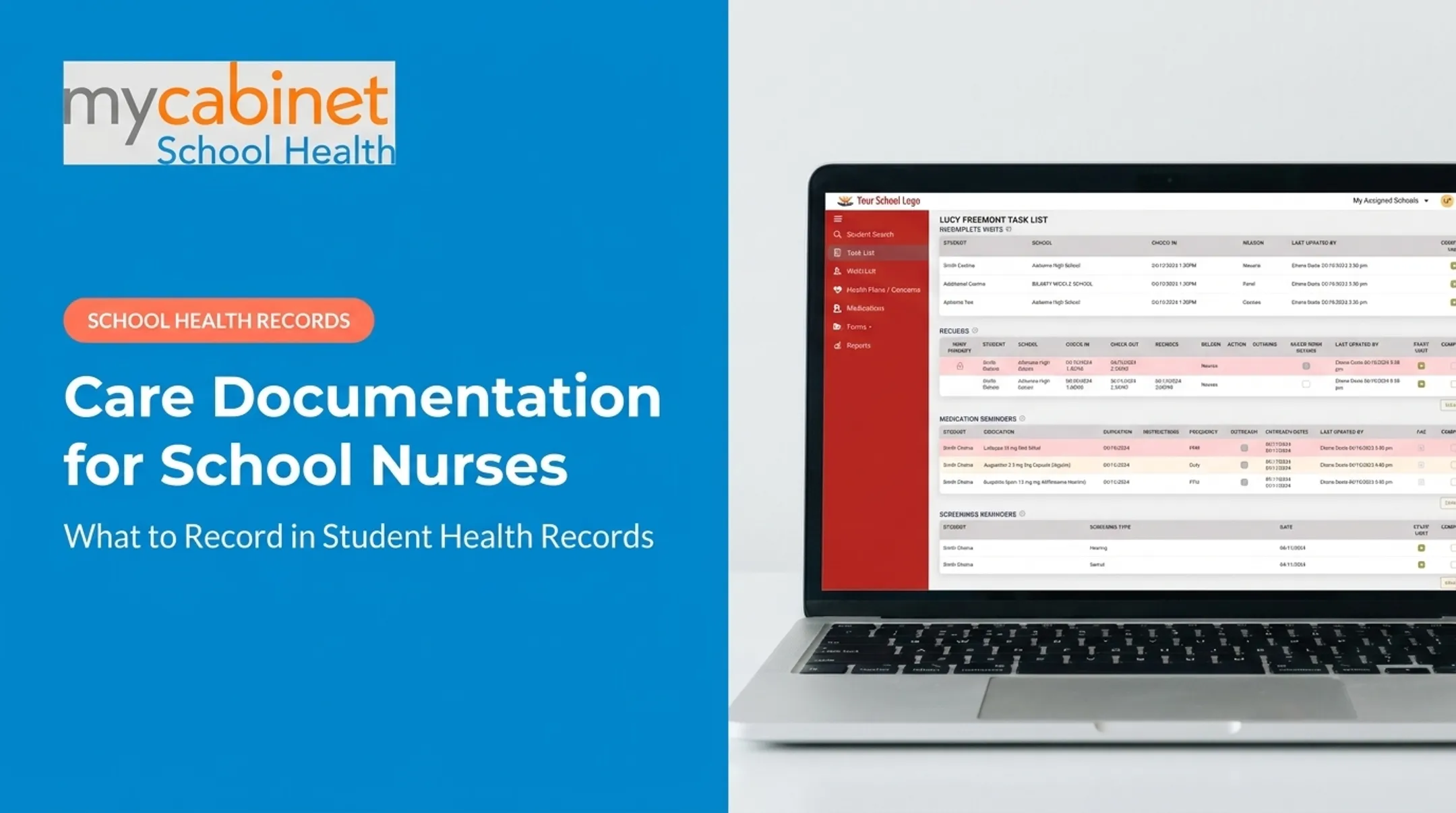
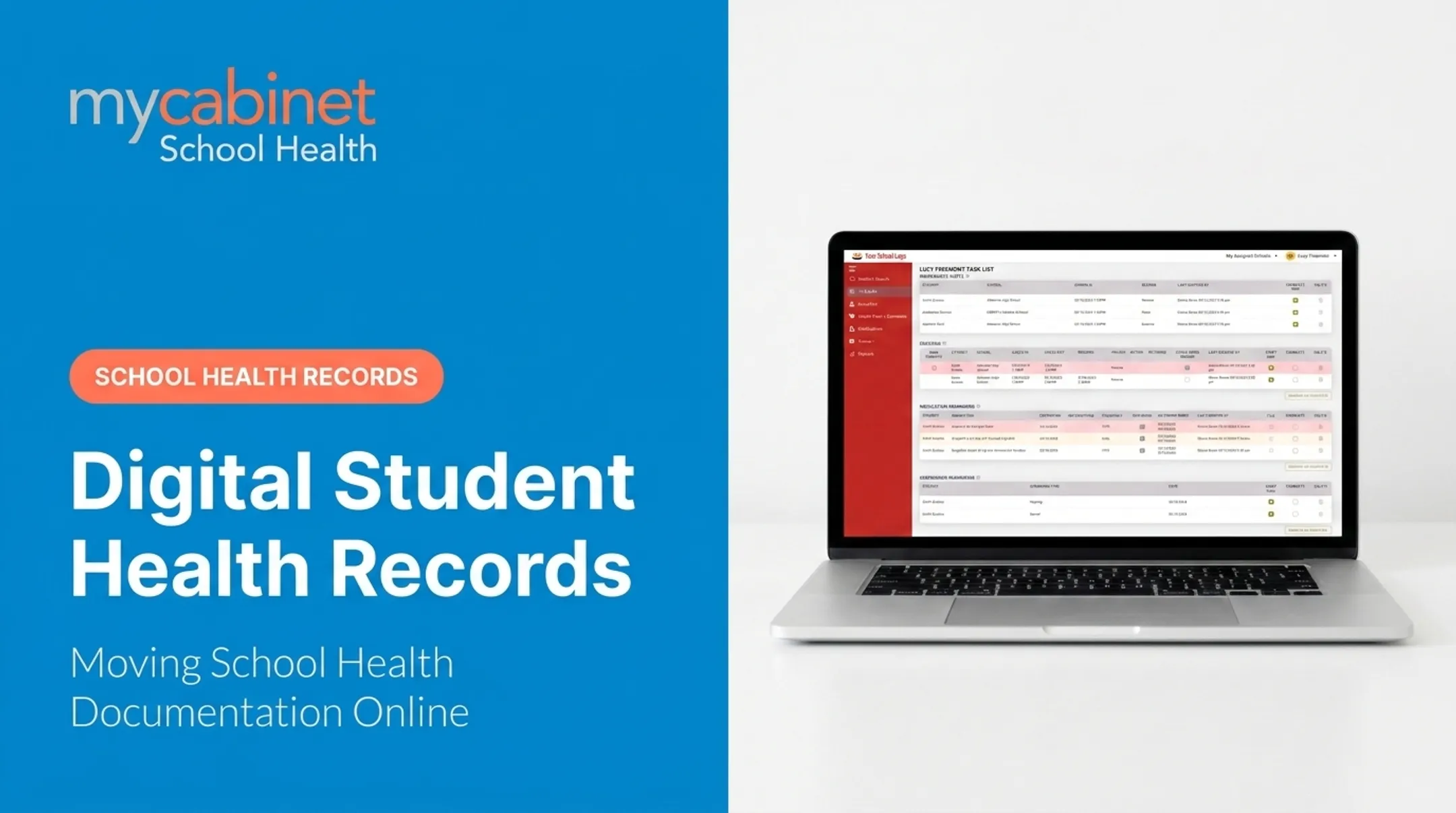
- Intelligent task lists keep incomplete visits, rechecks, medication tasks, and screenings visible instead of buried in a to-do pile
- One-way parent notifications alert families when their child was seen in the clinic, without opening up unmanaged two-way messaging
- FERPA-aligned, SOC 2 and HIPAA-compliant infrastructure gives districts confidence that records are secure and audit-ready

That combination shows up in day-to-day district use. Cobb County School District's superintendent noted that the platform "digitized and makes documentation easier," specifically pointing to parents being able to submit paperwork electronically and see when their child was seen and given medication.
It's a testimonial about reduced friction, not a formal efficiency study. Still, it reflects the real problem digital tools solve: getting information where it needs to go without a stack of paper in between.
Frequently Asked Questions
What should incident documentation include?
At minimum, include date and time, student identifiers, location, an objective description of the event, actions taken, and notifications made. Add follow-up steps and physician referrals as they occur.
What are the four types of incident reporting?
School nurses handle four main types: injury/accident reports, illness or medical emergency reports, medication error reports, and near-miss or hazard reports. Each needs slightly different documentation fields.
What is a good example of an incident report?
Example: "Student stated, 'I slipped near the gym,' at 1:40 p.m.; ice applied 10 minutes; parent called at 1:55 p.m." A strong report sticks to observed facts, quotes the student, and skips assumptions about cause.
Is student health information covered by HIPAA or FERPA?
Most school health records fall under FERPA because they're maintained by school employees. HIPAA applies only in specific cases, such as school-based health centers that bill insurance electronically.
How long should schools keep student health incident records?
Retention periods vary by state, so there's no single national rule. Districts should follow their state's records retention schedule and consult legal counsel, especially for records tied to potential injury claims.