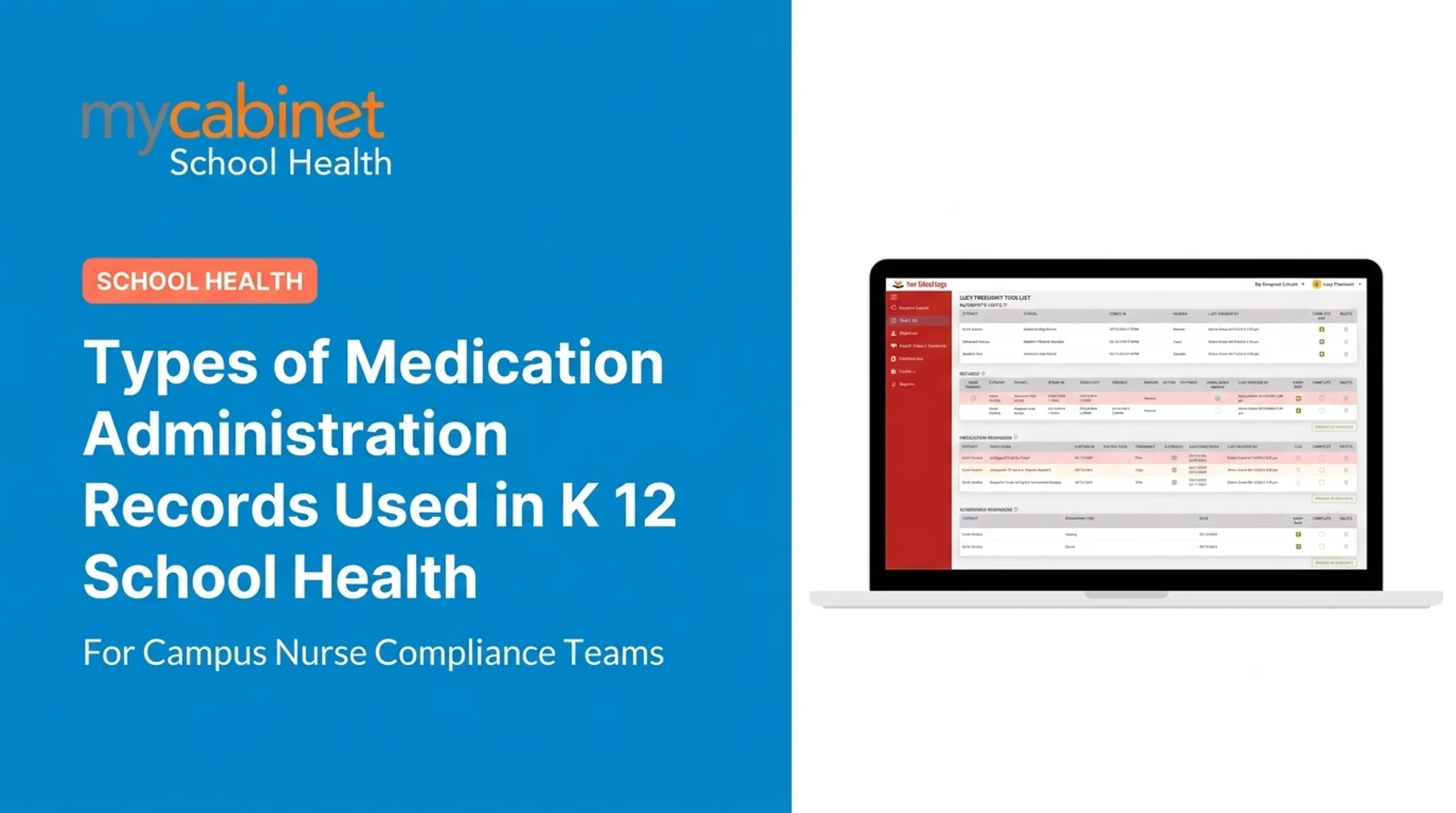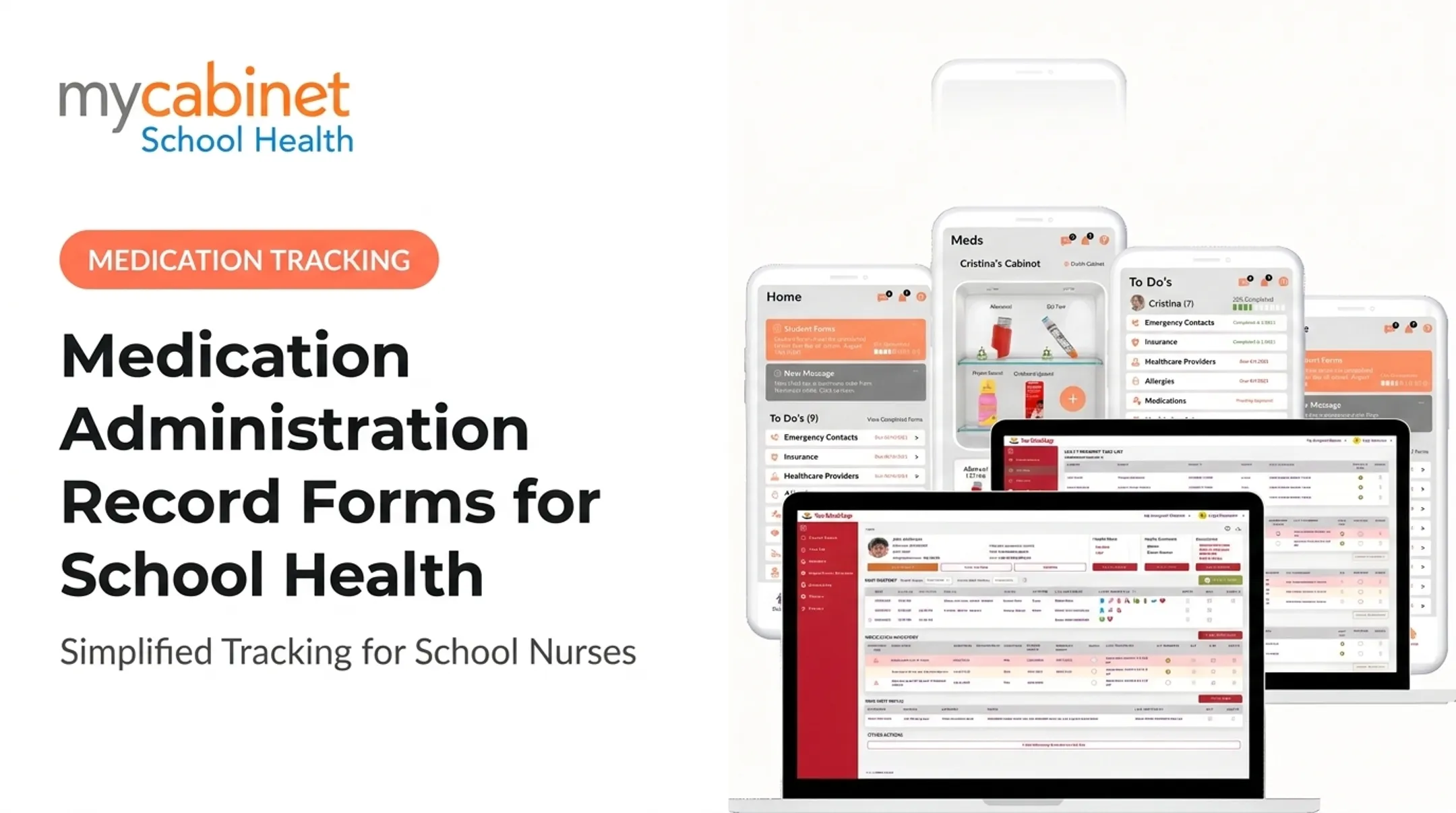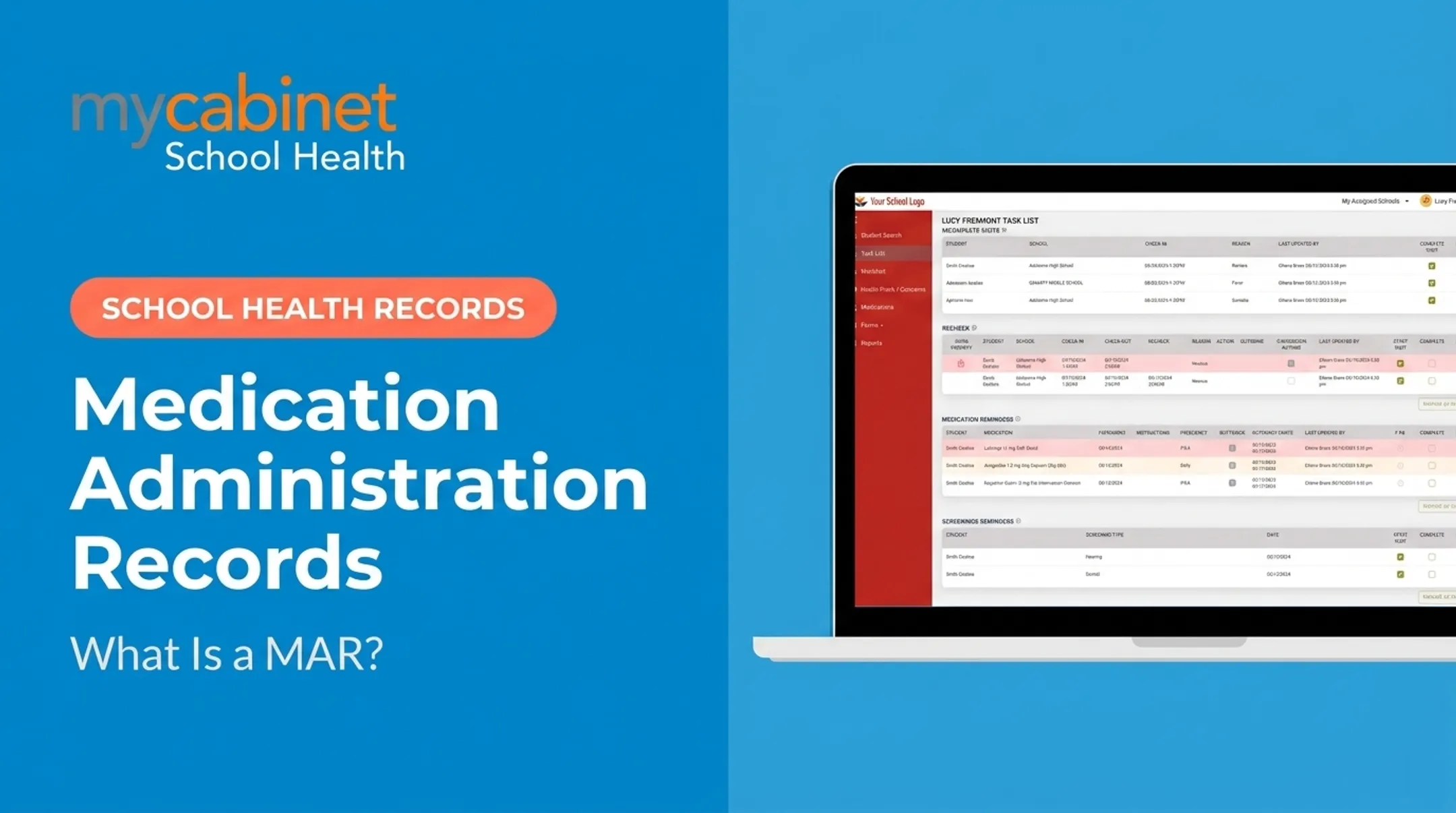

A 2000 survey of school nurses found that 48.5% reported a medication error, with missed doses being the most common type at 79.7% (McCarthy et al.). That's why Medication Administration Records, or MARs, exist. A MAR is the legal and clinical record that proves every dose was given correctly, to the right student, at the right time.
This article covers what a MAR is, what belongs on one, real-world examples, the 7 rights of medication administration, and how digital tools like MyCabinet simplify the process for school health offices.
Key Takeaways
- A MAR documents every medication dose given, including time, dosage, and the staff member who administered it
- Accurate MARs protect schools legally and support FERPA-aligned recordkeeping standards
- The 7 rights of medication administration form the backbone of every properly completed MAR
- Digital MAR systems cut down on missed doses and administrative burden compared to paper logs
What Is a Medication Administration Record (MAR)?
A MAR is a standardized document nurses use to log every dose of medication given to a student. It serves two purposes:
- Clinical tracking: confirming the right medication was given, correctly, every time
- Legal documentation: proof of care if a dispute, audit, or state review comes up
MARs show up in hospitals, care facilities, home care, and K-12 schools. In a school setting, the stakes look a little different. Roughly 1 in 4 children in the U.S. has a chronic health condition, and many of those students need medication during school hours.
For school nurses, the MAR usually ties directly into a student's broader health profile. Dosage, frequency, allergy history, and expiration dates all need to live in one place, not scattered across sticky notes, spreadsheets, and a filing cabinet.
What Should Be Included on a Medication Administration Record?
A complete MAR needs a full set of fields, not only a signature line. Pennsylvania and Minnesota school health guidance both point to a consistent set of required fields:
- Student identifying info: name, date of birth, known allergies
- Medication details: name, dosage, route, and administration time/frequency
- Prescriber authorization: physician order and parent/guardian consent
- Administration log: date, time, staff initials, and notes on refusals, missed doses, or side effects
- Expiration and storage info: any special handling instructions
- Signature key: which staff member is authorized to administer

Skipping any of these fields creates a documented gap that can turn into a liability issue during an audit or a parent dispute.
Example of Medication Administration in a School Health Office
These two school-clinic examples show how a MAR should read for a routine dose and for PRN use.
Scenario 1: Daily allergy medication. A student is prescribed a daily antihistamine. The nurse retrieves the labeled medication, verifies the student's identity, and checks the dose against the physician's order. After giving the dose, they log the time and initials on the MAR right away. Simple, routine, and fully documented in under two minutes.
Scenario 2: PRN inhaler use. A student uses an as-needed inhaler for asthma. This is trickier to log because it's not on a fixed schedule. The MAR needs to capture:
- The date and time of use
- The symptom that triggered it (wheezing, shortness of breath)
- The outcome after administration
Missed or refused doses matter just as much as successful ones. A blank field on a MAR is worse than a documented refusal — it leaves no record of what happened, which creates ambiguity during a review. Every deviation needs a reason code, not silence.
How to Fill Out a Medication Administration Record (MAR)
Step-by-Step Process
- Verify the student and medication order against the health record before administering anything
- Record immediately the exact date and time right after administration, never in advance or hours later
- Initial or sign using credentials that match an authorized staff log; note any deviation with a clear reason
- Cross-check expiration dates and flag re-order needs every time the MAR is updated

Common Mistakes to Avoid
- Retroactive documentation — filling in times after the fact creates legal and audit risk
- Illegible handwriting on paper logs, which makes entries impossible to verify later
- Ignoring expiration dates, which can leave a student without access to a needed medication
Digital MAR tools reduce these documentation and expiration gaps. MyCabinet School Health's Nurse Portal flags expiring medications automatically and ties dosage and frequency data to the student profile. Nurses can catch issues without relying on memory or sticky notes.
The 7 Rights of Medication Administration
Every MAR exists to prove these rights were followed. School health guidance from Minnesota, NASN, and the American Academy of Pediatrics generally treats documentation itself as one of these rights, not an afterthought:
- Right student — verified before every dose
- Right medication — matched against the physician's order
- Right dose — exact amount, no estimating
- Right route — oral, inhaled, topical, as the order specifies
- Right time — administered on schedule, not "close enough"
- Right documentation — logged promptly and legibly
- Right reason — confirming the medication matches the student's condition

Miss even one of these (documentation, for example) and a correctly administered dose can still turn into a compliance issue. The medication being right doesn't matter if there's no proof it happened.
Paper vs. Digital MARs: Templates and Modern Alternatives
Free blank MAR templates exist online, and they can work fine for a home caregiver or a small clinic managing one or two people. Schools are a different story.
A single school nurse might be responsible for dozens of students on daily medications, plus PRN cases like inhalers and EpiPens. Paper and spreadsheet-based MARs tend to break down at that volume:
- Forms get lost or misfiled
- Handwritten entries are illegible or incomplete
- There's no automated alert when a medication is about to expire
- Data gets duplicated across multiple systems, creating reconciliation errors
A North Carolina study covering six school years across 115 districts found that transitioning from paper to computer-based submissions created transcription and storage problems on its own (PMC, 2024), so the real fix is a system built for school medication workflows—not a generic digital form.

MyCabinet School Health's Nurse Portal supports that workflow with:
- Automatic flags before a medication expires
- Dosage and frequency details tied to each student's profile
- Structured documentation with time-stamped audit trails
For example, a student's Albuterol inhaler can be logged as stored at school, linked to their asthma action plan, and connected to the clinic visit log in one view instead of three separate systems.
Frequently Asked Questions
What is a MAR (Medication Administration Record)?
A MAR is a documented record of every medication dose given to a student. It exists for both safety tracking and legal compliance, showing proof of care if questions arise later.
What should be included on a Medication Administration Record?
A complete MAR includes student identifying information, medication details (name, dose, route, timing), prescriber authorization, and the date, time, and initials of whoever administered each dose.
How do you fill out a Medication Administration Record (MAR)?
Verify the student and order first, then log the exact time immediately after administering. Note any missed, refused, or delayed doses with a specific reason rather than leaving the field blank.
What are the 7 rights of medication administration?
The 7 rights are: right student, right medication, right dose, right route, right time, right documentation, and right reason. Together, they form the checklist behind every properly completed MAR.
Where can I find a free blank Medication Administration Record template?
Free templates exist online and work fine for basic, low-volume use like home caregiving. Schools managing many students and medications typically need a digital system built for higher volume.
What is an example of medication administration?
A common example is a daily allergy medication given at the same time each day, verified and logged immediately. A more complex example is a PRN inhaler, where the MAR also records the triggering symptom and outcome.