
EHR usability isn't a nice-to-have feature. It's directly tied to whether a nurse catches a medication allergy in time or misses it because the alert was buried under twelve other pop-ups. This article breaks down where EHR usability commonly fails, what that failure costs in real safety terms, and how purpose-built platforms like MyCabinet School Health are designed to close those gaps.
Key Takeaways
- Usability failures in EHRs are directly linked to documentation errors, delayed care, and nurse burnout
- 1,956 EHR safety reports reviewed; 557 tied usability issues to potential harm in clinical settings
- School nurses work under high student volume, minimal backup, and time-critical medication demands
- Workflow-first EHR design lowers cognitive load and helps nurses catch critical issues in time
What Is EHR Usability and Why It Matters for Student Safety
EHR usability measures how effectively, efficiently, and safely a user can complete critical tasks inside the system. Feature presence alone is not enough. What matters is whether a nurse can find and use that feature in the middle of a chaotic clinic visit.
Usability and learnability are related but different concepts:
- Usability applies to daily, expert users (nurses) who need speed and efficiency for repeated tasks
- Learnability applies to occasional users (parents) who log in a few times a year and need clarity without training
Three User Groups, Three Different Needs
School health systems serve at least three distinct audiences:
- Nurses — daily, expert users who need speed, minimal clicks, and clear prioritization
- Parents — occasional users who need simple, self-explanatory interactions
- Administrators — periodic users who need oversight dashboards and compliance reporting
A system optimized only for one group inevitably frustrates the others. When nurses burn clicks hunting for a medication record, or parents miscomplete a health form, delayed care and documentation gaps follow. That mismatch is where safety risks begin.
Common EHR Usability Challenges That Put Student Safety at Risk
Cluttered Interfaces and Missed Alerts
Excessive clicks and crowded screens cause nurses to miss critical information: allergy flags, medication timing, and chronic condition notes — the exact fields a school nurse needs in the first ten seconds of a visit.
Research analyzing 1.735 million voluntarily reported safety events found that among reports tying EHR usability to potential harm, alerting problems accounted for 22% of cases, and medication administration was involved in 37% of the EHR-related clinical processes flagged (Howe et al., JAMA, 2018).

Unclear Labeling and Data Entry Fields
When fields aren't intuitive, nurses guess. Guessing leads to incomplete or inaccurate records. In the same study, data entry issues made up 27% of the usability-related harm reports.
Insufficient Workflow Support
Systems built around generic data storage, not real workflows, create dangerous gaps, and a school health office is where generic design shows up fastest.
The Pew Charitable Trusts documented a case where a hospital EHR blocked creation of a newborn's record until weight and Apgar score were entered. When an infant needed emergency care before those values existed, staff couldn't order a blood transfusion under her own record. They had to route it through her twin brother's chart instead, delaying treatment and risking a mismatched transfusion (Pew, 2019).
Alert Fatigue and Lack of Prioritization
When every alert looks equally urgent, none of them are. In a school that means an expiring rescue inhaler competing with a routine screening reminder. Nurses start tuning out notifications, including flags for expired medications or overdue rechecks, and time-sensitive safety cues get lost in the noise.
Disconnected Communication Channels
The same usability gaps show up outside the chart. Fax-and-email follow-up chains leave holes between school, nurse, and parent. A consent form sitting in someone's inbox doesn't help a student who needs medication today.
Lack of Specialty Customization
Hospital-grade EHRs weren't built for school health offices, so the risk compounds in that setting. Forcing a school nurse into a system designed for hospital units means working around irrelevant fields instead of moving through purpose-built ones.
How Poor EHR Usability Translates Into Real Student Safety Consequences
Usability scores aren't abstract. Mayo Clinic Proceedings research surveying 5,197 US physicians found the average EHR System Usability Scale score was 45.9, an F grade.
Each 1-point improvement in that score correlated with 3% lower odds of burnout (Melnick et al., 2020). A companion study of US nurses found similar results: each 1-point SUS improvement tied to 2% lower burnout odds, with 38.4% of surveyed nurses already meeting burnout criteria (Melnick et al., 2021).
Burnout and clunky workflows don't stay on the screen. In school health offices, they show up as real safety gaps:
- Delayed emergency response — when allergy or medication history isn't instantly visible, seconds matter
- After-hours documentation fatigue — nurses finishing charting at home, tired and rushed, are more error-prone
- Missed medication or status updates — disconnected parent communication means changes in a student's health status go unreported
- Compounding district-wide risk — a single nurse often covers an entire district, so one usability failure reaches every school that nurse serves

Best Practices for Designing and Selecting a Safer EHR
Safer EHRs start with design that matches how school health work actually runs. Focus on these fundamentals:
- Workflow-first design — the system should mirror actual tasks (visit documentation, medication checks, screenings), not just store data
- Intelligent task organization — critical items like rechecks and expirations should never get buried under routine notes
- Role-based access with audit trails — limit who can view or edit records and keep a clear trail for compliance reviews
- Structured documentation — predefined visit types cut free-text entry errors and keep records consistent
- Ongoing end-user testing — nurses and parents should shape the feedback loop, not arrive as an afterthought
When selecting a system, validate these capabilities in live demos with nursing staff—not slide decks alone. A platform that surfaces incomplete visits, medication tasks, and expirations shifts mental load from remembering what needs attention to acting on what is already prioritized.
How MyCabinet School Health Reduces Usability-Driven Safety Risks
MyCabinet School Health is built around nurse actions, not passive record storage. That design choice cuts the usability friction—missed follow-ups, incomplete charts, broken handoffs—that turns routine clinic work into safety risk.
Task-Based Workflow
Instead of hunting menus to recall what's outstanding, nurses get a Task List that surfaces incomplete visits, rechecks, medication reminders and expirations, and screening reminders, with color-coding for fast triage. One-click actions like Start Visit, Add Medication, and Add Note let nurses act from the student record before a time-sensitive task slips.
Structured Documentation
Predefined visit types and structured visit flows reduce the guesswork that produces incomplete or inconsistent entries—the kind of gaps that weaken clinical handoffs and later reviews. Every visit keeps an audit trail, supporting accuracy and compliance reporting.

Connected Communication
Three connected access points close the usual communication gaps:
- Nurse Portal: the operational hub for documentation and form review
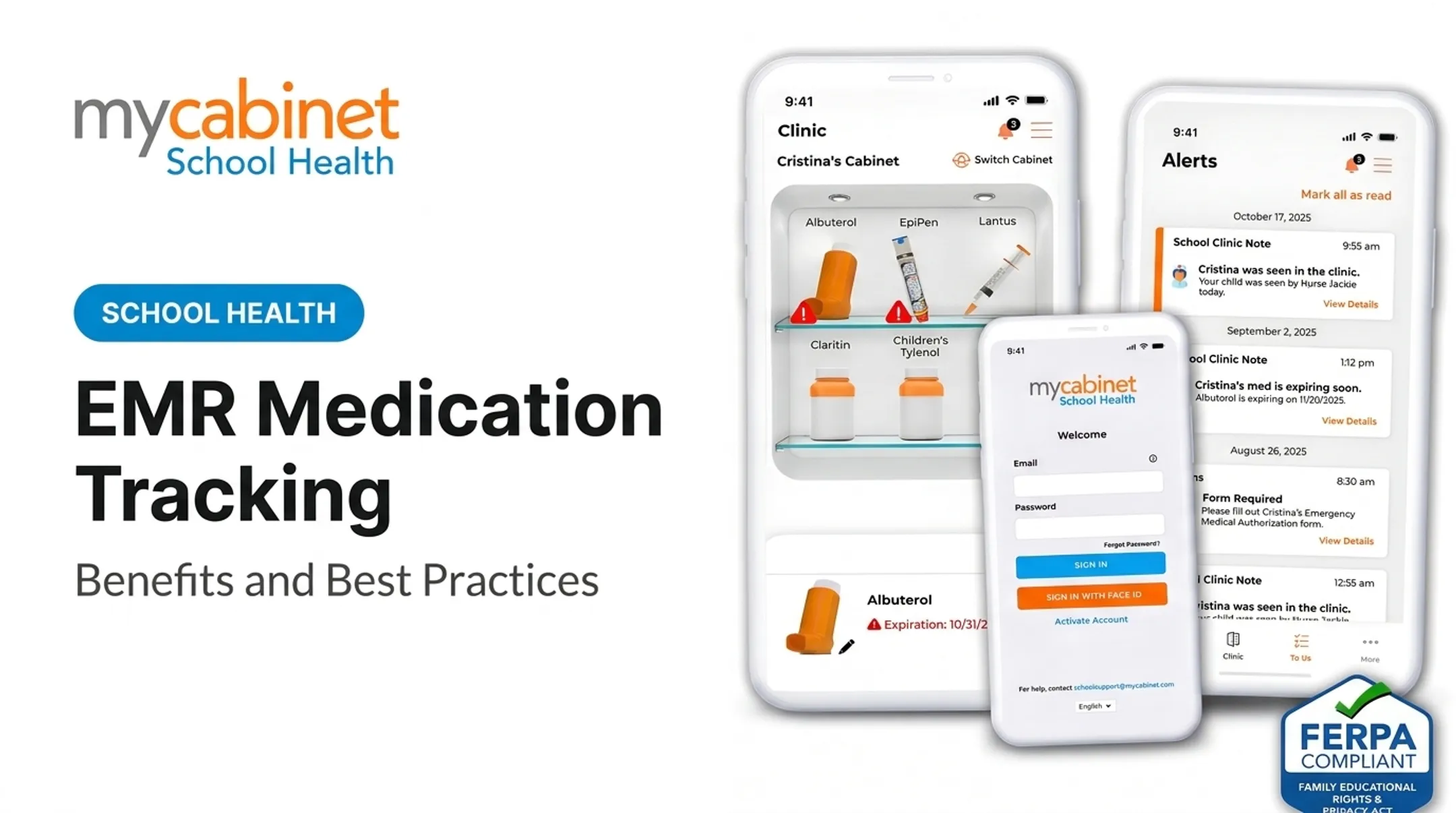
- Parent App: one-way visibility into clinic visits, active medications, and expiration alerts
- Parent Web Portal: same access, browser-based, for families who skip the app
Health forms follow a closed loop: parents upload digitally, nurses review and approve in-system, and approved documents attach to the student record. No printing, faxing, or lost paperwork means fewer missing forms when a nurse needs them for safe care decisions.

Compliance Built In
Role-based access ensures nurses see only what they need for care, administrators get compliance dashboards, and parents see only their own child's information. This structure supports HIPAA, FERPA, and SOC 2 Type II compliance while keeping the interface clean for each user type.
Cobb County School District Superintendent Chris Ragsdale summed up the shift after adoption: MyCabinet "digitized and makes documentation easier," letting parents submit paperwork electronically and see when their child was seen and given medication—"a win for the parents and a win for the district." Easier documentation and shared visibility close the same gaps that usability problems open in student care.
Frequently Asked Questions
What is an example of an EHR?
Epic and Oracle Health (formerly Cerner) are widely used EHR platforms in hospitals and large health systems. Purpose-built platforms like MyCabinet School Health serve a different niche: student health records, medication tracking, and parent communication designed for school health offices.
How does poor EHR usability affect student safety?
Confusing interfaces and workflow mismatches delay care, bury critical alerts, and increase documentation errors. Studies linking usability to harm rank alerting and data entry problems among the top contributing factors.
What makes an EHR "usable" versus just "functional"?
A functional EHR has the right features. A usable one lets real users complete tasks efficiently and accurately without extra clicks, confusion, or workarounds. Usability is measured by actual task performance, not a feature checklist.
Why do school nurses need a different EHR than hospitals or clinics?
School health workflows revolve around medication tracking, parent communication, and screenings. Those needs differ sharply from hospital workflows built around unit-based care, order entry, and lab results.
How can districts evaluate EHR usability before purchasing?
The System Usability Scale, a 10-item survey scored 0-100, is a standard benchmarking tool. Involving actual end users (nurses and parents, in the school health context) in trial evaluations catches problems that vendor demos won't reveal.
Can improving EHR usability reduce nurse burnout?
Each 1-point improvement in EHR usability score has been associated with 2-3% lower odds of burnout among physicians and nurses. That link is an association, not proof of direct causation, but the pattern holds across studies.