
The problem is that manual tracking doesn't scale. Paper forms get lost. Spreadsheets fall out of date. Fax machines sit unanswered. One missed deadline can mean an incomplete state submission or an exposed communicable disease case with no documented follow-up.
This guide breaks down what school health compliance reporting actually involves, the public health requirements driving it, who's responsible when something slips, and how districts are building more reliable reporting processes.
Key Takeaways
- School compliance reporting covers immunization records, communicable disease notices, medication logs, and screening data
- FERPA (not usually HIPAA) governs student health privacy under state and local public health mandates
- Nurses, administrators, and district health officials share reporting responsibility
- Purpose-built digital platforms reduce missed deadlines and keep records audit-ready
What Is School Health Compliance Reporting?
School health compliance reporting is the formal process of documenting and disclosing health data (immunizations, screenings, incidents, communicable diseases) to satisfy public health and education agency requirements. It's distinct from the day-to-day work nurses log for clinical purposes.
Two different activities, often confused:
- Routine documentation: visit logs, outreach notes, screening results recorded as they happen
- Compliance reporting: formal submissions to state health departments or district administrators on a set schedule
California illustrates this well. The California Department of Public Health requires all schools and pre-K facilities to assess and annually report enrollee immunization status through its CAIR Hub system, covering Pre-K, TK/K, and seventh grade specifically.
This is not the same as healthcare-facility compliance. Most student health records fall under FERPA, not HIPAA, with public health reporting laws layered on top. That distinction controls who can access records and which submissions schools must file.
Key Public Health Requirements Schools Must Follow
Immunization Compliance Reporting
States set immunization schedules, and schools report compliance rates and exemptions back to health departments. Texas, for example, requires by seventh grade:
- Two MMR doses
- Three hepatitis B doses
- Two varicella doses
- One MCV4 dose
Provisional enrollment is allowed while remaining doses are completed.
The CDC's 2024 MMWR report on kindergarten vaccination found coverage below 93% for every reported vaccine in the 2023-24 school year, ranging from 92.3% (DTaP) to 92.7% (MMR), with exemptions climbing to 3.3%.
That gap matters because incomplete records can trigger exclusion policies and separate reporting obligations. A dashboard that lumps "missing" and "exempt" into one bucket hides real operational risk — those are two different problems requiring two different responses.

Communicable Disease Reporting
Nurses are often the first point of contact when a notifiable condition shows up: flu clusters, measles, tuberculosis. Wisconsin's model shows how timing varies by severity:
- Immediate phone report, then a written case report within 24 hours, for Category I diseases such as measles, pertussis, and tuberculosis
- Report within 72 hours of a confirmed or suspected case for Category II diseases such as mumps and varicella
Outbreaks work differently. California requires reporting any disease outbreak to the local health department, regardless of whether it's on a named list. Head lice, notably, doesn't appear on most state notifiable-conditions lists — a common misconception among school staff.
Medication Administration and Screening Documentation
Medication orders need clinical specificity, not just a signature. The American Academy of Pediatrics recommends orders capture dosage, route, frequency, effective dates, side effects, order date, and discontinuation date — with prompt updates whenever anything changes.
Screening programs run on their own reporting cycle:
- Vision, hearing, and spinal screening for students ages 4–18 in Texas, reported annually through VHSSARS
- Vision, hearing, and scoliosis screening in specific New York grades when not already documented on a health exam
Keep student-level results and aggregate submission records as separate artifacts. Auditors want both.

FERPA and Data Privacy Considerations in Reporting
FERPA governs what student health information schools can share, with whom, and under what exceptions — including health-and-safety emergencies. The 2019 joint guidance from the Department of Education and HHS clarifies that when information qualifies as an education record, FERPA applies rather than HIPAA.
Structured, role-based access controls make this manageable in practice:
- Parents see only their own child's records
- Nurses and approved staff access only what's needed for care
- Technical/support staff access data only for system maintenance, under strict controls
MyCabinet School Health applies the same role-based permissions so schools can meet disclosure duties without weakening student privacy.
Can You Give Me an Example of a Compliance Report?
Two common examples are immunization compliance summaries and communicable disease incident reports.
Immunization compliance report typically includes:
- Total enrolled students by grade
- Exemption categories (medical, religious, personal belief where allowed)
- Compliance percentage by grade level
- Submission date and confirmation receipt
Communicable disease incident report typically includes:
- Case description and condition name
- Symptom onset date
- Notification timestamp (when and how the health department was contacted)
- Health department confirmation of receipt
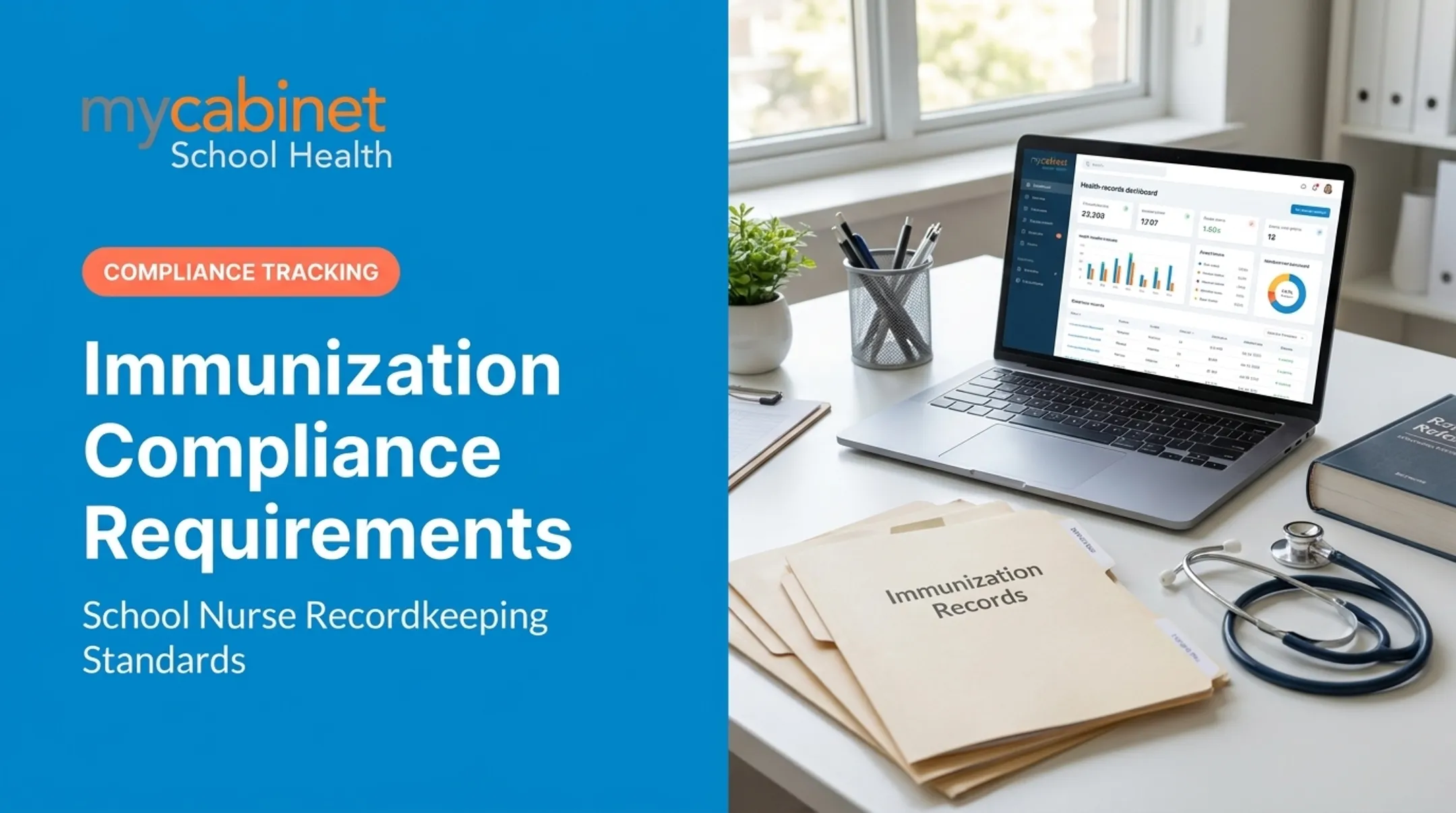
Standardized templates in a school health platform keep these reports complete and consistent. MyCabinet supports this with compliance dashboards, immunization tracking, and audit trails—confirm required fields with your local health department, since layouts vary by district and state.
Who Is Ultimately Responsible for Compliance?
Compliance reporting doesn't rest on one person's shoulders. Responsibility is shared across three groups:
- School nurses — frontline reporters who identify and document reportable events as they happen
- School and district administrators — accountable for policies, staffing, and systems that make timely reporting possible
- State and local health departments — set the requirements, but rely on schools' internal processes for accurate data
Health departments can't fix a broken internal workflow. If a district understaffs or skips usable systems, reporting gaps show up downstream at the state level as missing or late data.
A shared culture of accountability — backed by clear workflows and the right technology — is what actually reduces missed or incomplete reports. Not another policy memo.

Common Compliance Reporting Challenges in Schools
Paper and spreadsheets create bottlenecks. Disconnected fax and email processes introduce delays at every handoff, and delays compound into missed deadlines.
Staffing ratios work against manual tracking. A 2024 study of nearly 7,000 school nurses found 63% reported inadequate COVID-era staffing support and 82% felt inadequately compensated. Adequate staffing was directly linked to lower difficulty completing core nursing tasks, including compliance tracking.
Incomplete parent communication creates data gaps. When health forms come back partial or late, nurses are left chasing paperwork instead of documenting compliance. Common gaps include:
- Missing immunization proof at enrollment
- Incomplete medication authorization forms
- Screening consent forms that never make it back
None of these problems are new. Digital school health workflows can close the gaps in real time instead of only documenting them after the fact.
How Modern School Health Platforms Simplify Compliance Reporting
Modern school health platforms catch compliance gaps in the workflow—not after a report is due. Two capabilities do most of the work:
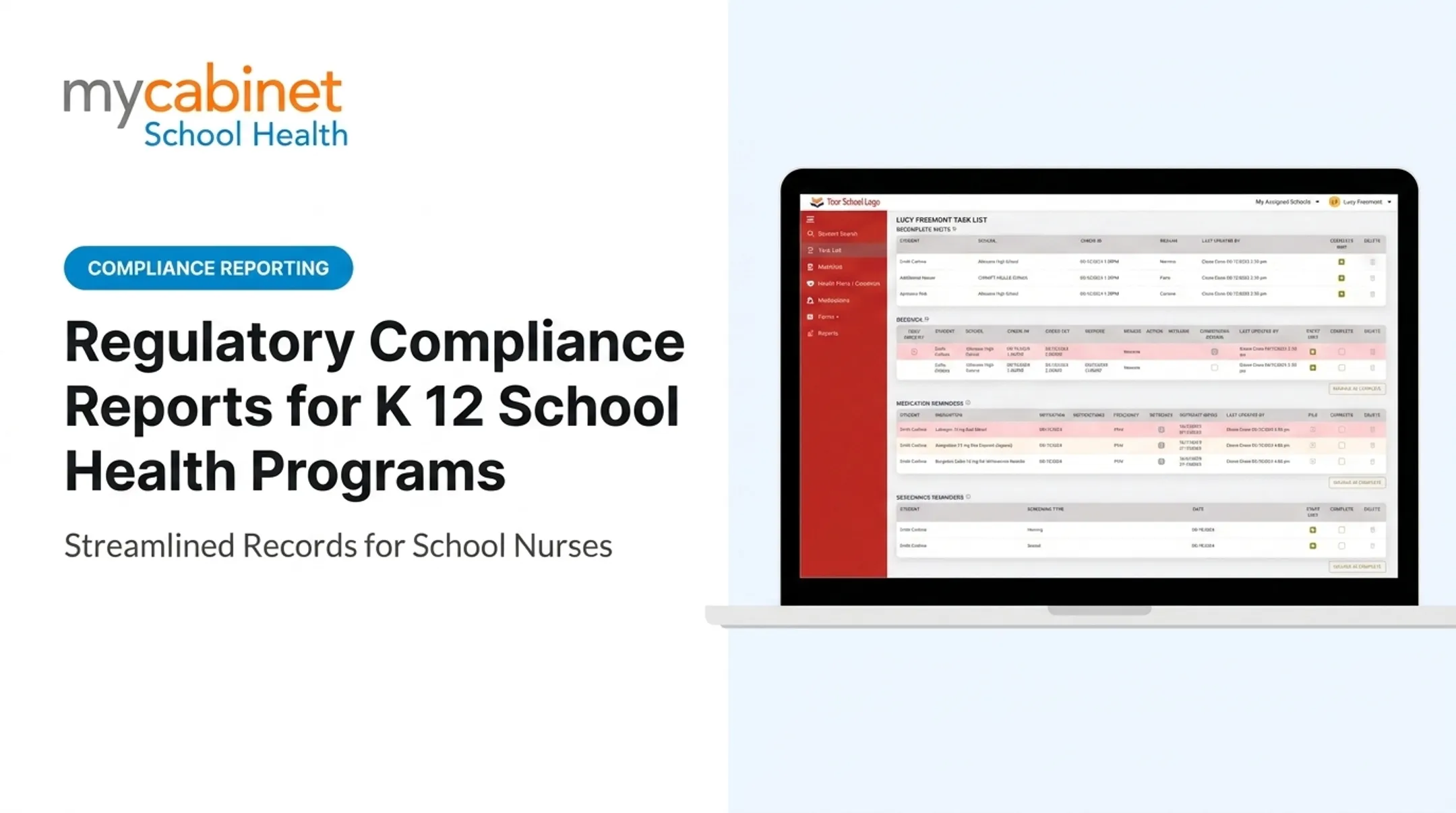
- Intelligent task lists flag incomplete visits, medication expirations, and pending screenings in a centralized, color-coded queue so nurses are not relying on memory
- Structured visit documentation uses predefined visit types so every record follows the same format and audit trails hold up under scrutiny
MyCabinet School Health was built around these nurse workflows. For compliance reporting, the platform connects three pieces so visit, medication, and form data stay in one auditable record:
- Nurse Portal — the operational hub for visits, medications, screenings, and follow-ups
- Parent App — controlled, one-way notifications about visits and medication expirations, plus secure document upload
- Parent Web Portal — the same functionality for families who'd rather not download an app
That setup closes a loop that used to run through fax machines and email threads. Parents upload required health forms digitally; nurses review, approve, and attach them to the student record—without printing, scanning, or chasing paper between the front office and the clinic.

At Cobb County School District, Superintendent Chris Ragsdale noted that the platform "digitizes and makes documentation easier," so parents can submit paperwork electronically and see when their child was seen or given medication. Those same digital handoffs cut the missing-form and missing-visit gaps that weaken compliance reports.
Frequently Asked Questions
Can you give me an example of a compliance report?
An immunization compliance report typically shows student counts, exemption categories, and compliance percentage by grade. A communicable disease incident report includes case description, symptom onset, and notification timestamp with health department confirmation.
Who is ultimately responsible for compliance?
School nurses identify and document events; administrators own staffing, systems, and final accountability. State health departments set the rules, but schools must report accurately.
What health data must schools report to public health authorities?
Schools typically report immunization status and exemptions, notifiable communicable diseases, and aggregate screening results for vision, hearing, and scoliosis programs. Exact requirements vary by state.
How quickly must schools report a communicable disease case?
Timelines vary by state and condition severity. Some conditions require immediate phone notification, while others allow a 24 to 72-hour reporting window.
Does FERPA or HIPAA apply to school health records?
Most student health records fall under FERPA rather than HIPAA, because schools maintain them as education records. HIPAA can apply when a school-based clinic bills insurers or operates as a covered entity.
How can schools reduce the risk of missed compliance reporting deadlines?
Digital task tracking, centralized records, and automated alerts for medication expirations and pending screenings cut reliance on memory and manual follow-up. A school health platform like MyCabinet keeps these tasks in one workflow so deadlines are harder to miss.