
Introduction
It's the second week of school. A sixth grader starts wheezing during PE, and the substitute nurse pulls his file, only to find a health form from three years ago with no mention of his new asthma diagnosis. Minutes matter here.
That gap shows up in the data. CDC estimates that roughly 1 in 13 U.S. children (8%) have food allergies, and about 3 children in a classroom of 30 have asthma.
Yet in one K-12 assessment covering 15,191 students, only 46.8% of asthmatic students had inhalers on file and just 20.9% had documented asthma action plans.
A current student health history form closes that gap. This guide walks through what to include, how to collect it, and how digital tools keep records accurate—plus a framework you can adapt for your school or district.
Key Takeaways
- A complete health history form centralizes medical, immunization, and emergency contact data so nurses can respond quickly
- Six core categories matter: student info, medical history, immunizations, family history, wellness needs, and emergency consent
- Paper and email-based collection creates delays, illegible entries, and compliance gaps
- Annual updates and physician input for complex cases keep records current, not just complete
What Is a Student Health History Form?
A student health history form is a comprehensive record schools use to collect a student's medical background before or during enrollment. Unlike a single-purpose document, such as a physical exam form or an immunization card, this form consolidates everything in one place:
- Chronic conditions and medications
- Allergies and reaction protocols
- Immunization dates
- Family medical history
- Emergency contacts and consent details

Parents or guardians typically complete it, and a physician's verification may be required for complex health conditions. School nurses, administrators, and coaches all rely on the same record for different reasons:
- Nurses need medication dosages and allergy protocols
- Coaches need activity restrictions before practice starts
- Administrators need emergency contacts and consent details
This differs from a single-purpose exam record such as Illinois's Certificate of Child Health Examination, which the Illinois Department of Public Health requires both parent and provider to sign.
A health history form is broader. It pulls multiple data categories into one working document nurses can reference instantly.
What to Include in a Student Health History Form
A strong template covers six categories. Miss one, and a nurse may only discover the gap when it matters most.
Student Information and Medical History
Start with the basics: full name, date of birth, grade, address, and primary emergency contact. Then move into the substance of the form:
- Chronic conditions (asthma, diabetes, seizure disorders)
- Past hospitalizations or surgeries
- Current medications, including exact dosages
- Allergies (food, drug, insect, environmental)
- Behavioral, learning, or mental health considerations
Immunization and Vaccination Records
Document dates for each required vaccine. According to the CDC's 2025 immunization schedule, schools typically track:
- DTaP/Tdap, Polio (IPV), MMR, and Varicella
- Hepatitis B and Meningococcal (MenACWY)
- HPV and annual influenza vaccination

Note that this CDC schedule is a clinical recommendation, not a uniform federal school-entry mandate. Requirements vary by state.
Family History, Wellness, and Emergency Consent
After clinical history and vaccines, capture the context nurses need for day-to-day care and emergencies:
- Family health history: hereditary illnesses, inherited conditions, and family mental health background
- Wellness needs: dietary restrictions, activity limits, and assistive devices (glasses, hearing aids)
- Emergency and consent: secondary contacts, treatment consent, preferred provider, and special instructions
If every category is complete, clinic staff can act on documented facts instead of filling gaps under pressure.
Best Practices for Collecting and Managing These Forms
Getting a form built is one thing. Getting it filled out correctly, on time, every year, is the harder part.
- Distribute early. Send forms at least two weeks before the school year starts, giving families time to gather vaccination and medical records.
- Request physician sign-off for complex cases. When a student has a chronic illness, mental health condition, or activity restriction, get provider verification before the nurse relies on that information.
- Build a quick-reference summary. Allergies, medications, and emergency contacts should be accessible instantly, not buried on page four of a PDF.
- Flag incomplete immunization records early. Catch immunization gaps as soon as forms come in. Colorado’s individualized health plan guidance calls for annual review and updates whenever a student’s health status changes; treat missing shots with the same urgency.
- Schedule annual reviews. Don't carry forward outdated information for returning students. New Jersey, for example, requires annual updates to health-care and emergency-care plans for conditions like diabetes and seizure disorders.

Why Digital Health Forms Beat Paper and Spreadsheets
Paper forms get lost in backpacks. They arrive illegible, half-filled, or three weeks late. Spreadsheets and email attachments aren't built for sensitive health data either—they lack the access controls this information demands.
The National Association of School Nurses says school nurses need information that's timely, accurate, legible, complete, and secure. Paper rarely delivers on all five. NASN also warns that generic academic student-information systems often fall short for clinical use, since they weren't built around nursing workflows or confidentiality requirements in the first place.
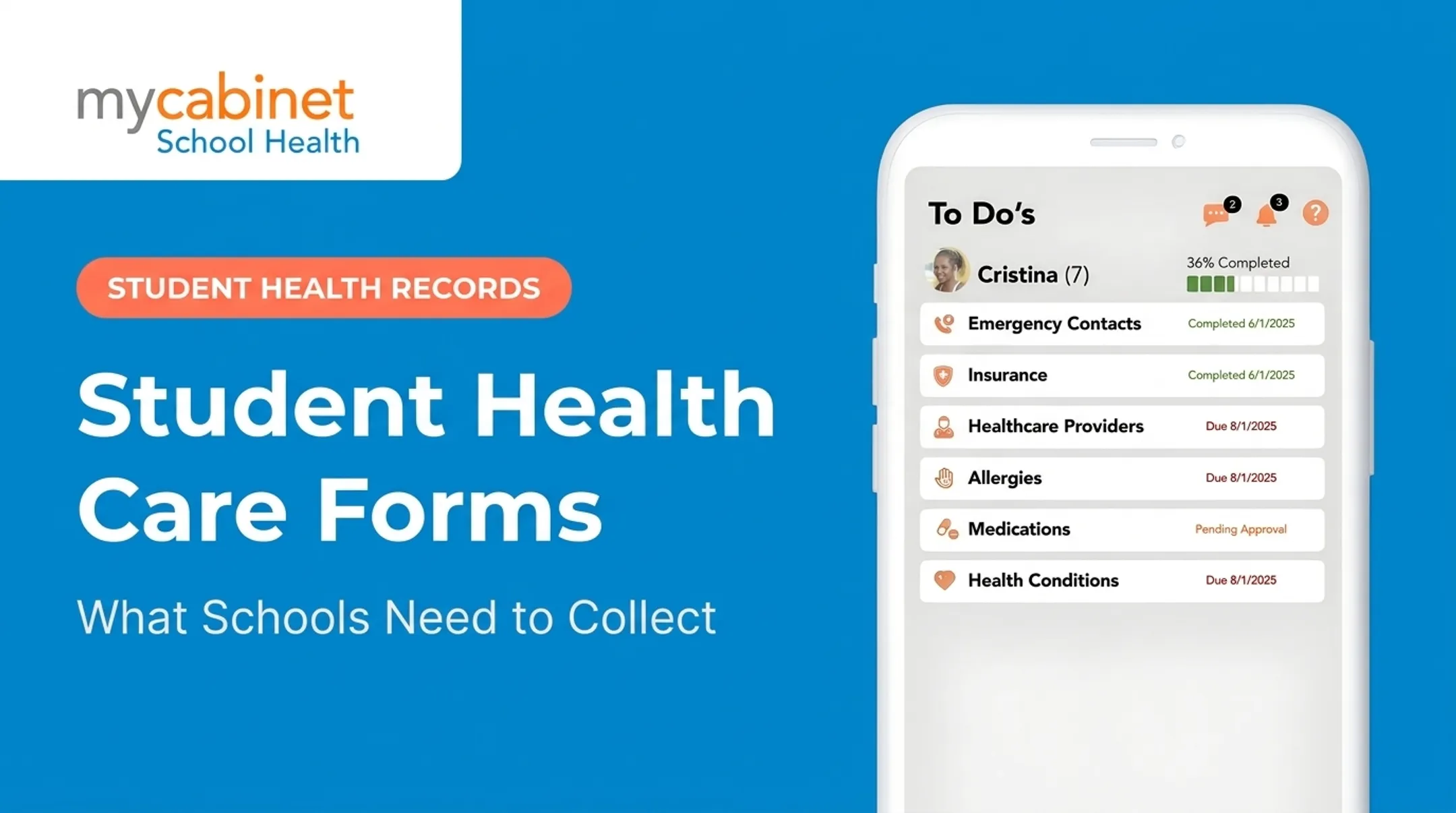
A platform built for school health closes those gaps. MyCabinet School Health lets parents submit forms through a Parent App or Web Portal. From there:
- Submission appears in the Nurse Portal
- Nurse reviews and approves or accepts it
- Approved document attaches to the student's record
No scanning, no faxing, no scattered email threads to track down later.
At Cobb County School District, Superintendent Chris Ragsdale described this shift directly: the platform "digitizes and makes documentation easier," letting parents submit paperwork electronically and see when their child was seen and given medication. He called it "a win for the parents and a win for the district."
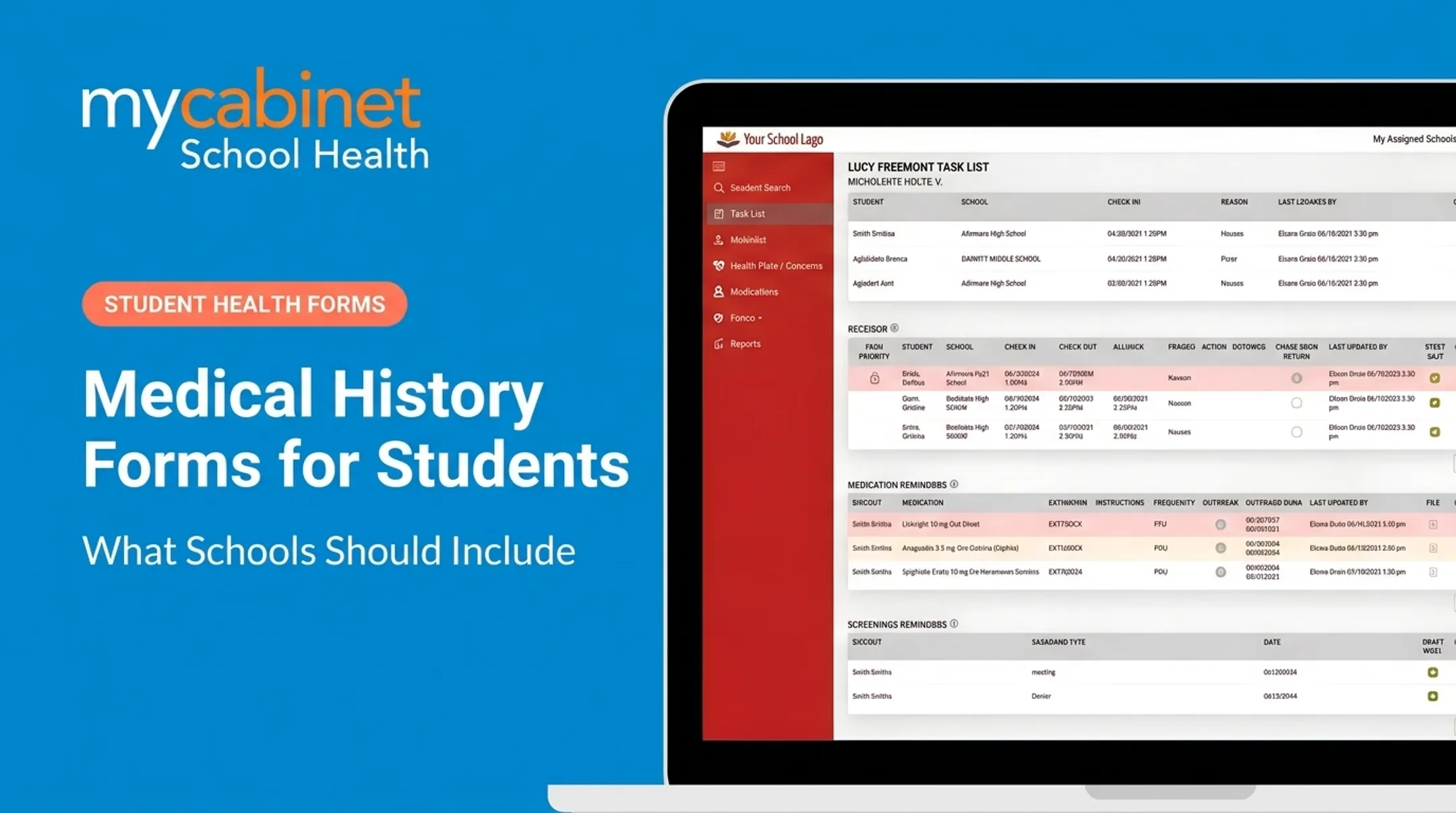
A connected system like this also reduces duplicate data entry and keeps role-based access aligned with FERPA and HIPAA expectations. Nurses get an organized task list instead of a stack of manila folders—less chase-down work for staff, and less paperwork stress for families.

Compliance Considerations for School Health Records
Health data in schools sits in a specific regulatory space. According to joint HHS/Department of Education guidance, records maintained by a school nurse acting on behalf of a FERPA-covered school are considered education records under FERPA, not HIPAA, regardless of whether care happens on or off campus.
Practically, this means:
- Role-based access limits who sees what — parents see only their own child's data, staff see only what's needed for care
- Controlled data sharing applies even between school departments
- Outside provider records may fall under HIPAA when the provider is not acting on the school's behalf
State requirements vary significantly. Illinois, for example, requires students entering kindergarten, sixth grade, and ninth grade to submit a physical exam and immunization record on an ISBE/IDPH-approved form. That form must be completed within 365 days of attendance and is typically due by October 15.
Other states set entirely different grade triggers and deadlines. Always confirm current requirements with your state department of education before finalizing a form template.
Frequently Asked Questions
What is a student health form?
A student health form collects medical history, immunizations, allergies, medications, and emergency contacts. Schools use it for routine care planning and emergency response.
What are the requirements for the Illinois school Physical Form?
Illinois requires health examinations and immunization documentation at specific grade levels, including kindergarten, sixth, and ninth grade. Check the Illinois State Board of Education for current forms and deadlines.
How often should a student health history form be updated?
Update it annually, ideally each spring before the next school year begins. Update it immediately whenever a student's medical circumstances change, regardless of the annual schedule.
Who is responsible for completing a student health history form?
Parents or guardians typically complete the form. For complex conditions such as chronic illness or mental health diagnoses, have a physician verify the details.
Can schools store student health forms digitally?
Yes, digital storage is allowed and often preferred when the platform is HIPAA and FERPA compliant. Look for secure nurse review workflows, audit trails, and role-based access controls.
What happens if a student's immunization records are incomplete?
Schools typically flag the gap and follow up with families directly. Depending on state law, enrollment may be restricted or conditional until requirements are met.