
Many school health offices still lean on paper logs, shared spreadsheets, or generic EHRs never built for school workflows. That creates gaps, missed follow-ups, and real compliance exposure. This guide breaks down what belongs in a school medical note, the documentation types nurses create daily, what compliance actually requires, and how purpose-built platforms close the gaps paper and spreadsheets leave open.
Key Takeaways
- School health records include visit notes, medication logs, screening results, immunization files, and parent communication trails.
- FERPA governs most school health records; HIPAA typically applies only to school-based health centers billing insurance.
- Timestamped, factual documentation protects nurses legally and keeps care connected between school, home, and outside providers.
- Purpose-built school health systems reduce documentation errors and admin load versus paper or spreadsheets.
What Are Medical Notes in a School Health Record?
A school health record is the official trail of a student's in-school medical encounters. It stays separate from the family's outside medical chart, though the two must often be shared or reconciled.
School nurse documentation does three jobs at once:
- Protects the nurse legally if care is ever questioned
- Keeps parents informed about what happened and when
- Supports continuity when an outside provider needs follow-up
A school medical note isn't the same as a physician's clinical note. Physicians document diagnosis and treatment planning. School nurses document incidents: an illness, an injury, a medication given, a screening performed. The focus is on what happened during the school day, what was observed, and what action followed.
That incident-level focus matters at scale. A peer-reviewed analysis of standardized electronic school-nurse encounters documented 3.4 million K–12 visits across U.S. public schools in 2019 and 2020 combined (PMC, 2023. That figure is one dataset, not a national annual count, but it shows the daily volume nurses handle. No reliable published figure breaks out documentation time versus direct care, so treat specific percentages you see elsewhere with caution.
What Do School Nurses Document?
Clinic Visit Notes
A structured visit note typically includes:
- Date and exact time of the encounter
- Presenting complaint, in the student's own words when possible
- Objective assessment findings
- Intervention or action taken
- Disposition: returned to class, sent home, called 911
- Follow-up needed, if any
Predefined visit types (injury, illness, headache, allergic reaction) keep entries consistent across nurses and create a cleaner audit trail. MyCabinet's platform builds those predefined visit types into structured clinic workflows, so each encounter follows the same documentation path.

Medication Administration Records (MAR)
Missouri's state health guidance requires medication logs to capture the student's name, prescriber, drug, dose, date, time, and the name of whoever administered it, plus documentation of any errors or refused doses (Missouri DHSS). Expiration tracking is its own recurring task. Medications stored at school expire, and staff need to catch that before a dose is due and the drug is no longer usable.
Screenings and Assessments
Vision, hearing, scoliosis, and BMI screenings each need documented results, referral status, and proof that parents were notified. Maine's Department of Education reported 122,310 screenings coordinated by school nurses in the 2022-2023 school year, with 7,082 referrals for further evaluation (Maine DOE, 2024). That referral volume is why status tracking matters: a missed follow-up can delay diagnosis and care.
Immunization and Health Form Records
Immunization records, physicals, and allergy or asthma action plans get logged, reviewed, and attached to the student's file. Cobb County Superintendent Chris Ragsdale described the shift to digital collection simply: parents can now "submit paperwork electronically," instead of the school chasing down paper copies every fall.

Incident and Injury Reports
Injury notes need more detail than a routine visit: mechanism of injury, symptoms observed, actions taken, and whether parents and administrators were notified. Missouri's guidance treats these as records of internal concern, stored separately from the general student file.
Communication Logs
Every parent outreach attempt — a call, a message, a notification — should carry a timestamp. Timestamps create a clear record of each attempt to reach the family.
What Medical Notes Should Include for Compliance
Iowa's Department of Education lays out a practical field-level standard for school nurse documentation (Iowa DOE). A compliant note includes:
- Two student identifiers (name plus one other)
- Exact date and time
- Nurse's name and credentials
- Objective, factual observations
- Actions taken or delegated
- Outcome or disposition Those elements support clinical quality and keep notes aligned with the privacy rules that control who can see student health documentation. FERPA governs most school health records. It protects student education records, including health documentation, and limits access to staff with a legitimate educational interest. HIPAA usually doesn't apply to a standard school nurse office. Joint guidance from the Department of Education and HHS confirms most elementary and secondary schools aren't HIPAA-covered entities, since school nurses don't conduct HIPAA-covered transactions (ED/HHS Joint Guidance). HIPAA becomes relevant when a school-based health center bills insurance through a covered provider. That requires a case-by-case look at who holds the record and why. A few non-negotiables for any note:
- Use factual, objective language, not judgment calls
- Document as close to the encounter as possible
- Correct errors with a dated addendum, never by deleting the original entry

Common Documentation Challenges School Nurses Face
Many school nurses cover multiple buildings with little administrative support, and documentation piles up fast. The 2024 National School Nurse Workforce Study estimated 78,869 full-time-equivalent school nurses nationally (National School Nurse Workforce Study 2.0). Fewer than half of respondents reported RN supervision. That thin staffing model means less time for double-checking paperwork.
Paper and spreadsheet systems compound the problem:
- Records get lost or misfiled
- Handwriting becomes illegible over time
- Audit trails are missing or incomplete
- Medication expiration dates slip through unnoticed
Coordinating outside physician orders adds another layer. Parents submit forms by fax, email, or paper, and someone has to match that document to the right student file before it's useful.
How a Modern School Health Platform Improves Documentation
MyCabinet is designed around school nurse workflows from the ground up. It closes common documentation gaps in practical ways:
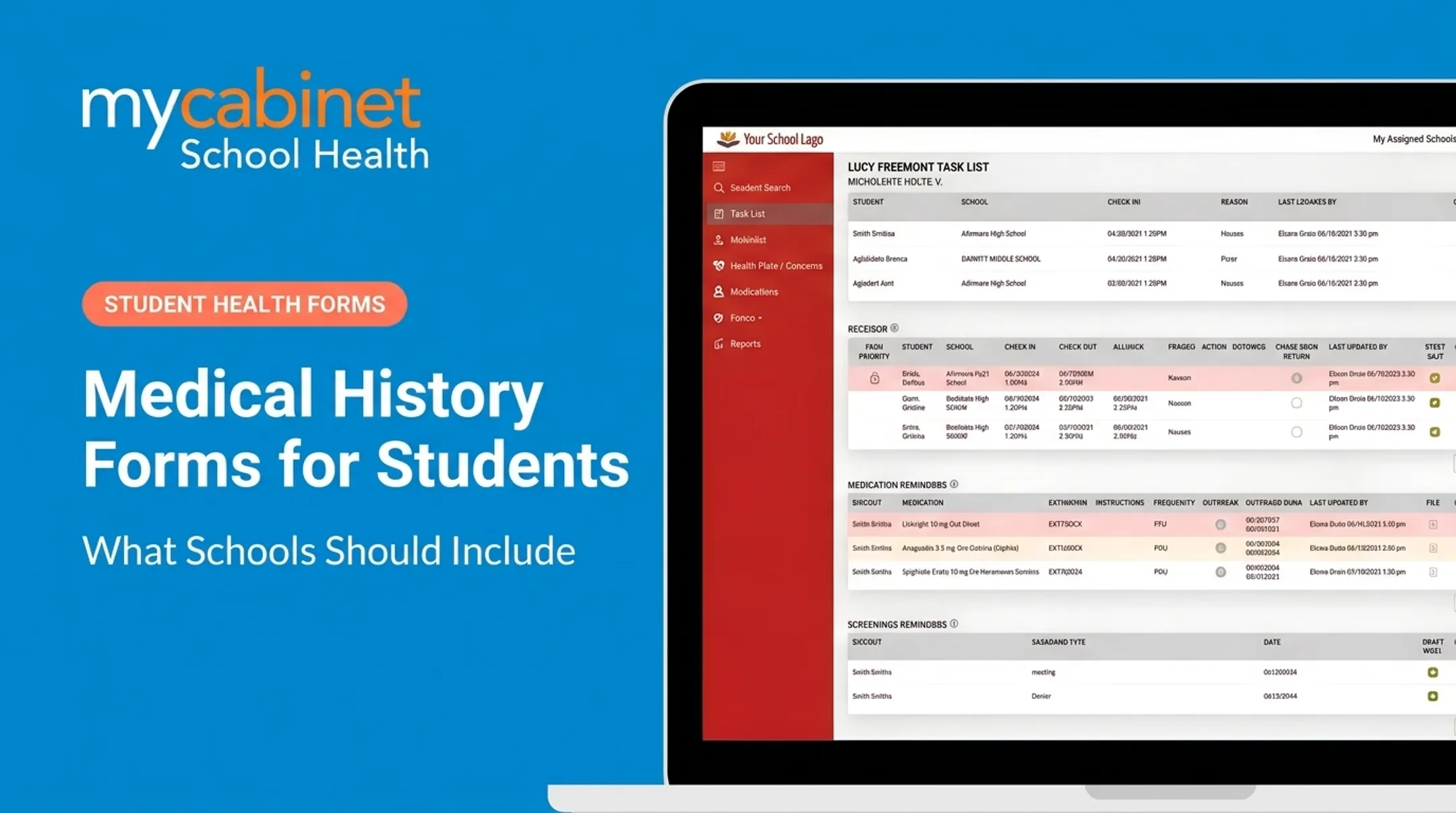
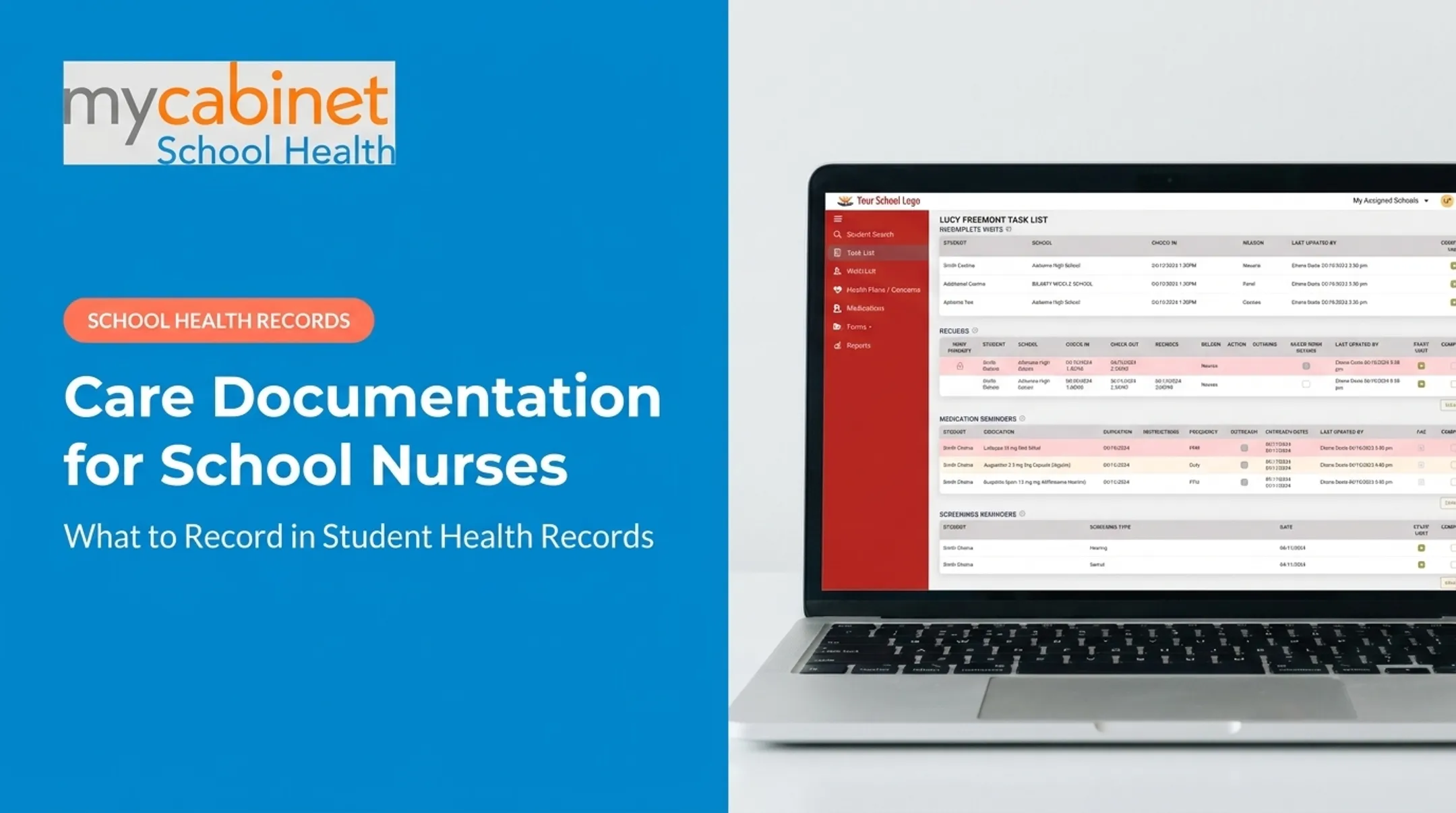
- Intelligent task lists surface incomplete visits, rechecks, medication reminders, and screening follow-ups in one place, color-coded by priority, so follow-ups don’t slip.
- Medication expiration tracking alerts parents as a medication nears its expiration date, giving them time to arrange a replacement before school supply runs out.
- Digital health-form collection lets parents upload immunization records, physicals, and action plans for nurse review and approval on the student profile, without fax follow-up.
- Role-based access keeps records visible only to staff with a legitimate need, supporting FERPA alignment as a built-in structure rather than an added policy.

Cobb County School District has seen the shift in practice. Superintendent Chris Ragsdale told the school board that MyCabinet "digitized and makes documentation easier," citing electronic paperwork submission and parent visibility into when a child was seen and given medication.
Frequently Asked Questions
What do medical notes look like?
A typical school medical note includes the date and time, student identifiers, reason for visit, objective observations, action taken, and outcome. Modern systems capture this in structured digital fields rather than free-text paragraphs.
What is included in a school nurse's daily log?
A daily log covers clinic visits, medications administered, screenings performed, and parent communications logged for that day. It is a snapshot of everything that happened in the health office that day.
How long are school health records kept?
Retention follows state and district policy. Texas keeps records until withdrawal plus 7 years or age 21, whichever is later; Oregon keeps them until age 21 or graduation—always confirm local rules.
Are school health records protected under HIPAA or FERPA?
Most school health records fall under FERPA. HIPAA typically applies only when a school-based health center bills insurance through a HIPAA-covered provider, which requires a separate analysis.
Can parents access their child's school health records?
Yes. FERPA gives parents the right to inspect their child's education records, and schools must comply within 45 days of a request. Digital portals, like MyCabinet's Parent App and Web Portal, make this review far more immediate.
Why is accurate documentation important for school nurses?
Accurate notes protect the nurse legally, support continuity of care between school and outside providers, and back up safe medication and treatment decisions. Incomplete records put both the student and the nurse at risk.