
That's a problem. When screening results aren't tracked consistently, follow-ups get missed. Records go incomplete. Districts fall behind on compliance requirements they can't even prove they're meeting during a state audit.
This guide breaks down exactly what data points belong on a student health screening form, why each one matters, and how schools can manage this information without drowning nurses in paperwork.
Key Takeaways
- Standardized forms capture vision, hearing, dental, scoliosis, and BMI data the same way every time
- Inconsistent screening records increase liability and delay interventions students need
- Digital tracking cuts administrative work and catches missed follow-ups automatically
- State-by-state rules make standardized digital forms essential for multi-school districts
What Are Student Health Screening Forms and Why They Matter
Student health screening forms are standardized documents that record results from routine checks: vision, hearing, dental, scoliosis, growth (BMI), and sometimes developmental screenings. They're not the same as a full physical exam.
The purpose is early detection. Catching a hearing or vision problem early can keep it from derailing learning. The New York State Education Department notes that undetected vision and hearing issues can affect both behavior and academic achievement, which is why vision and hearing checks are standard practice in the state's health screening program.
Vision problems are more common than many schools expect. The CDC reports that amblyopia — the most common cause of childhood vision impairment — affects an estimated 2% to 3% of the population. Left uncaught, it can limit a child's classroom performance for years.
Screening Forms vs. Physical Exam Forms
These two documents serve different purposes:
- Screening forms capture routine, quick checks conducted at school (vision, hearing, dental, scoliosis, BMI)
- Physical exam forms are comprehensive medical evaluations, usually required for kindergarten entry or sports participation, and completed by a physician
Most states mandate screenings at specific grade levels:
- Texas: Vision and hearing checks for kindergartners and first-time entrants, plus grades 1, 3, 5, and 7
- Indiana: Hearing in grades 1, 4, 7, and 10; vision in kindergarten (or grade 1) plus grades 3, 5, and 8
Key Data Points Schools Should Track on Screening Forms
A screening form is only useful if it captures the right information, consistently, every time. Here's what belongs on every form:
1. Student identifying information Name, date of birth, grade, homeroom, and a unique student ID. Without this, records get mismatched, especially in larger districts where multiple students share similar names.
2. Screening type and date Which screening (vision, hearing, dental, scoliosis, BMI, developmental), the exact date it was administered, and the screener's name and credentials.
3. Test results and measurements Specific, quantifiable values:
- Visual acuity scores (such as 20/20 or 20/40)
- Decibel thresholds for hearing
- BMI percentile
- Scoliosis curvature notes
4. Pass/fail or referral status A clear flag: passed, needs rescreening, or referred to a specialist. Vague notes like "seemed okay" don't hold up during an audit.
5. Parent/guardian notification status Documentation of whether (and when) parents were told about results, particularly for failed screenings that require follow-up.
6. Follow-up and resolution tracking Did the student see an outside provider? Is there a physician's note on file? Was the student cleared after a rescreen? This is often the piece that falls through the cracks on paper.

MyCabinet School Health's portal keeps all six of these data points tied directly to a student's profile, so a nurse pulling up a record sees the full picture, not just a scanned form buried in a folder.
Compliance Requirements and Common Recordkeeping Challenges
Which Screenings Are State-Mandated
Requirements differ by state. Florida's school-health statute, for example, names five required screening categories in each county's school-health-services plan: preventive dental, vision, hearing, scoliosis, and growth-and-development.
Florida also requires a school-entry health examination certification for kindergarten enrollment or any initial entry into a Florida school, completed within one year before enrollment. This is a separate, more comprehensive document than a routine screening form, closer to a full physical exam than a vision check.
Challenges With Paper-Based and Fragmented Systems
Paper forms create predictable problems:
- Forms get lost, damaged, or become illegible before anyone reviews them
- They sit in filing cabinets for weeks, delaying identification of students needing follow-up
- Spreadsheets and faxed communications between nurses and parents create version-control chaos
- Nobody can quickly answer "did this student get their recheck?"
The real risk shows up during a state health department review. Districts that can't produce clean, complete records face audit findings and, worse, may have genuinely missed students who needed care.

How Digital Platforms Simplify Screening Form Management
Digital screening management solves the tracking problem at its root. Instead of chasing paper, everything lives in one place.
Core capabilities include:
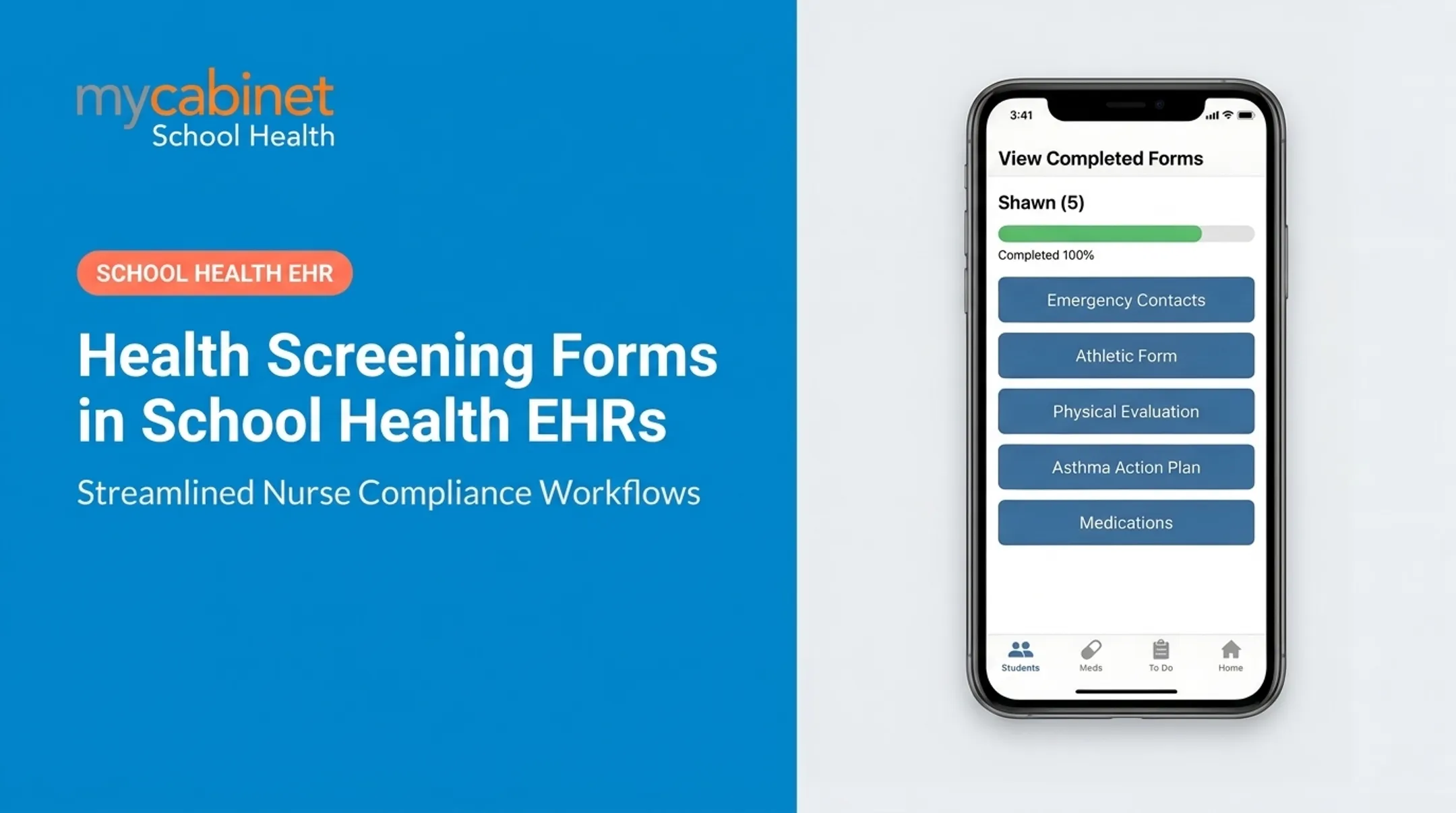
- Parents upload health forms and screening results directly; nurses review, approve, and attach them to the student record with no scanning or filing
- Predefined screening categories (vision, hearing, dental, scoliosis, BMI) keep data consistent district-wide, with every entry time-stamped and traceable
- Intelligent task lists automatically surface incomplete screenings, pending rechecks, and upcoming deadlines so nurses are not relying on memory or sticky notes
MyCabinet School Health's Nurse Portal and connected Parent App/Web Portal are built around this workflow. Screening results, parent notifications, and follow-up documentation live in one FERPA-aligned platform. Color-coded task lists help nurses see rechecks, overdue parent notifications, and cleared students at a glance.

The real payoff is time returned to care. Every minute a nurse spends chasing a lost form or re-entering data by hand is a minute not spent with a student who needs attention.
Best Practices for Implementing a Screening Program
Reliable screening programs run on consistent process across every school. Three practices matter most:
- Standardize templates district-wide. Use the same screening form fields in every building so district data is comparable, not siloed by school.
- Automate reminders. Trigger alerts for rescreening deadlines and parent follow-up so nothing hinges on someone checking a spreadsheet.
- Train screening staff consistently. Nurses and volunteers should follow the same measurement and documentation protocols. Inconsistent technique produces inconsistent, and sometimes wrong, data.

Districts that standardize early avoid the scramble of reconciling five different paper formats during an audit.
Frequently Asked Questions
What is a health screening at school?
It's a routine check (vision, hearing, dental, scoliosis, or BMI) conducted by school health staff. The goal is to catch early signs of issues that could affect a student's learning or development.
What form do I need for the Florida school physical exam?
Florida requires certification of a school-entry health examination for kindergarten or initial enrollment, completed within one year before entry. This is separate from routine screening forms; sports participation often requires its own physical.
How often are student health screenings required?
It depends on state law, but common checkpoints include kindergarten, 1st grade, and 3rd grade. Some states, like Texas and Indiana, also screen in later grades such as 5th and 7th.
What happens if a student fails a screening?
The student is typically flagged for rescreening or referral to a specialist. Parents are notified, and the school documents the outcome, whether outside care, a physician's note, or clearance after a recheck.
Who is responsible for conducting school health screenings?
School nurses, trained staff, or contracted health professionals typically administer screenings, depending on district policy and state requirements.
Are digital health screening records legally compliant?
Yes, when the system is designed for school health compliance. MyCabinet School Health is SOC 2 Type II certified and FERPA compliant, supporting secure, auditable recordkeeping for districts of any size.