
That gap matters. A missed dose or documentation error isn't just a paperwork problem; it can lead to a health emergency and real liability exposure for the district. This article breaks down what medication adherence software actually does, the features worth prioritizing, and how to choose a platform that fits real nurse workflows—not just digital filing.
Key Takeaways
- School medication work spans allergies, asthma, ADHD, and seizure disorders, each with distinct documentation needs
- Digital medication administration records (MAR) reduce reliance on paper logs and fragmented parent communication
- FERPA—not HIPAA—typically governs school health records, making role-based access a compliance essential
- Parent-facing visibility into medication status improves engagement without compromising student privacy
- Platforms should be tested on nurse workflow speed, not just documentation storage capacity
Why Medication Adherence Is a Growing Challenge in Schools
School nurse staffing is uneven across the country. Ratios vary widely by district and state, so no single national figure tells the full story.
The most recent National School Nurse Workforce Study surveyed nearly 2,800 schools and estimated 78,869 full-time-equivalent school nurses nationally (NASN workforce study).
Chronic conditions that need school-day medication are common. CDC data shows:
- Food allergies affect 1 in 13 children (about 8%)
- Asthma affects 4.8 million children under 18 (6.7%)
- ADHD affects an estimated 7 million children ages 3–17 (11.7%)
- Epilepsy affects roughly 6.3 per 1,000 children

With that many conditions in play, common failure points show up fast:
- Paper logs that get lost, smudged, or filed inconsistently
- Fragmented email or phone communication with parents
- Missed medication expiration dates sitting unnoticed in a cabinet
- Administrators with zero real-time visibility into clinic operations
School nurses aren't the bottleneck. Manual systems weren't built for this volume of clinical complexity.
Key Features to Look for in School Medication Adherence Software
Not every EHR built for schools handles medication the same way. Here's what helps nurses manage daily doses without losing track.
Digital MAR and Automated Alerts
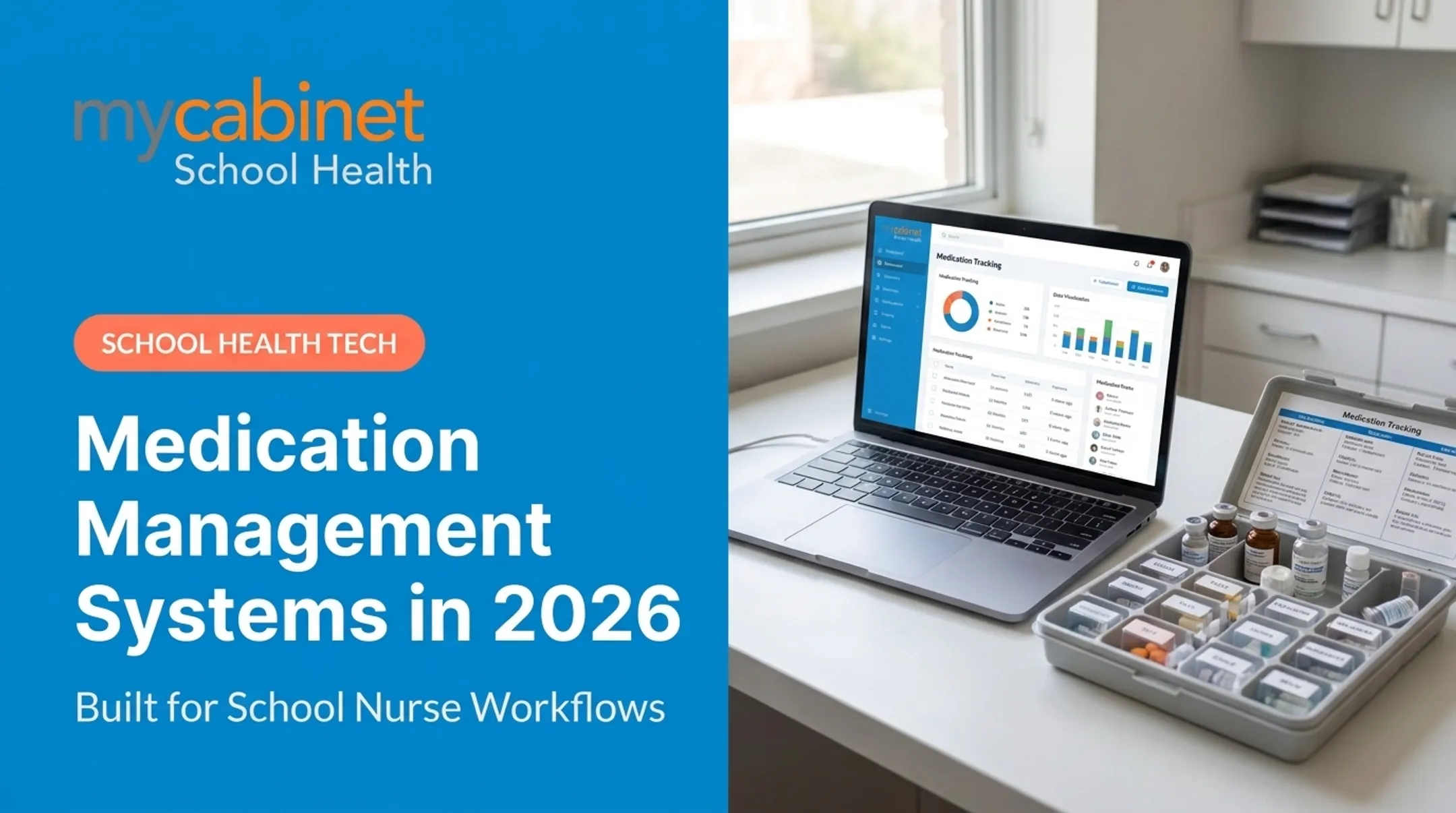
A digital medication administration record should log every dose given, missed, or refused, with a timestamp and staff attribution. Beyond that, automated alerts matter just as much:
- Expiration warnings before medication goes bad in the cabinet
- Refill-needed flags before supply runs out
- Upcoming dose-window reminders during busy clinic hours

Task Organization and Access Control
Nurses aren't only managing medication. They're also running rechecks, screenings, and walk-in visits. Software should organize incomplete medication administrations alongside these other duties in one prioritized list, cutting down on mental juggling.
Equally important: role-based access. Since school health records generally fall under FERPA rather than HIPAA, permissions need to be tight. Only authorized staff should view or edit sensitive student health data.
Parent Communication and Digital Forms
Family engagement drives adherence. Look for:
- A parent app or portal showing medication authorization status and expiration notices
- Digital collection of consent forms, physician orders, and self-carry authorizations, so the front desk isn't stuck chasing paper
- One-way notifications when doses are given, missed, or about to expire, keeping families informed without phone tag
Why MyCabinet Fits These Criteria
MyCabinet's Nurse Portal was built around these exact workflows. It tracks medication expiration status, surfaces dosage and frequency information, and logs parent outreach, all connected to the student's health profile in one system rather than scattered across spreadsheets and sticky notes.
Technologies That Improve Medication Adherence
Three technology categories show up repeatedly in effective school medication programs:
- Mobile reminder apps – Prompt nurses about scheduled doses and notify parents when medication needs attention, replacing memory-dependent workflows.
- Electronic health record (EHR) systems – Centralize documentation instead of spreading it across spreadsheets, fax machines, and paper binders. NASN's EHR position statement calls for records that are timely, accurate, legible, and securely protected (NASN EHR position statement).
- Automated notification systems – Text, email, or in-app alerts flag missed doses and expiring prescriptions to staff and families simultaneously.

A peer-reviewed North Carolina study found that only 12.3% of districts had school-specific medication policies, and inconsistent reporting created data gaps. That points to a larger gap: traceable, standardized documentation is often the missing piece, not software adoption alone (North Carolina medication administration study).
Technology helps, but only when paired with consistent workflows.
How School-Based Medication Adherence Differs from Clinical or Home Settings
Adult patients manage their own adherence. Students can't. That fact changes how school medication programs are built.
Key differences:
- Minors depend entirely on nurses, delegated staff, or self-carry policies to receive medication correctly
- State laws vary significantly on self-administration and self-carry rules
- Coordination spans parents, prescribing physicians, nurses, and non-medical staff who cover when a nurse is out
Self-carry rules differ by state. Colorado requires signed provider orders, parent consent, and self-carry contracts for eligible students. Iowa requires annual renewal of both parent and prescriber authorization. Ohio permits self-possession of emergency medication with written approval from prescriber and parent.
That complexity means software built for adult clinical settings or generic home reminder apps simply doesn't fit. Schools need configurable authorization workflows, not one-size-fits-all reminders.
How MyCabinet Supports Medication Adherence in Schools
MyCabinet's platform is built around school nurse workflows and the medication adherence gaps districts face every day.
Key capabilities include:
- Intelligent task lists surface incomplete administrations, recheck visits, expiring medications, and screening reminders in one prioritized view so nothing slips during a hectic clinic day
- Parent App and Parent Web Portal give families visibility into medications stored at school, including approximate expiration dates, without exposing sensitive clinical details
- Structured visit documentation creates audit trails for state audits and parent inquiries—critical when FERPA, not HIPAA, governs most of these records
- Digital health-form collection lets parents submit consent paperwork electronically instead of mailing or faxing

MyCabinet was named a Healthcare Business Review Top 10 Medication Management Solutions Provider in 2024. At Cobb County School District, Superintendent Chris Ragsdale described the impact:
"It digitizes and makes documentation easier... parents can submit their paperwork electronically and see when their child was seen and given medication. It's a win for the parents and a win for the district."
Choosing the Right Medication Adherence Software for Your District
Selecting a platform isn't just about feature checklists. Here's what actually separates a good fit from a costly mistake.
Compliance and security first:
- Confirm FERPA alignment: verify the vendor operates under the "school official" exception with direct district control over data use
- Request the full SOC 2 Type II report, not just a badge claim. Ask which trust criteria (security, availability, confidentiality) were actually in scope
- Review role-based access controls to confirm only authorized staff can view or edit records
Parent engagement: A platform without a parent-facing app or portal misses a major adherence driver. Families who can see medication status and expiration dates stay more engaged.
Nurse workflow testing: Don't settle for a static tour of documentation storage. Ask to see:
- How fast a nurse can log a dose given, missed, or refused
- How task lists organize medication work alongside rechecks and screenings
- How expiration alerts surface before they become a problem

A platform that looks polished in a slide deck but slows nurses down in the clinic isn't solving the real problem.
Frequently Asked Questions
What are some effective apps for medication adherence?
Effective school tools combine dose reminders, tracking, and caregiver visibility. Platforms like MyCabinet add nurse-managed workflows and parent communication built for the clinic—not individual consumer use.
What technologies are used to improve medication adherence?
The core categories are EHR systems, automated reminders and alerts, digital documentation, and parent communication portals. Together, they replace paper logs and fragmented email or phone outreach.
How does medication adherence software help school nurses specifically?
It reduces manual documentation time, flags upcoming expirations automatically, and organizes daily tasks into one prioritized list. This frees nurses to spend more time on direct student care.
Is medication adherence software required to be HIPAA or FERPA compliant?
Student health records maintained by schools typically fall under FERPA, not HIPAA, though some data flows involve HIPAA-adjacent protections. Compliance certifications should be a non-negotiable part of vendor evaluation.
How do parents stay informed about their child's medication at school?
Parent apps and portals provide controlled, one-way visibility into medication status, including expiration timing and clinic visit history. This keeps families informed without opening unrestricted messaging channels.
What should a school district look for when evaluating vendors?
Look for FERPA-aligned compliance credentials, a SOC 2 Type II report, nurse-workflow-focused design, and strong parent engagement tools. Test actual logging speed during a demo, not just documentation features.