
That's what nurse charting does. It turns a brief health office interaction into a record the student, family, school team, and any authorized healthcare provider can rely on later. School documentation looks simple on the surface, but its quality depends on several details: the right student record, correct timing, objective observations, required fields, privacy safeguards, and whether follow-up actually gets tracked.
This article walks through a four-step charting workflow, what nurses need before they start, the variables that separate strong documentation from weak documentation, and the mistakes that trip up even experienced staff. We'll also look at when a school needs more structure than a simple paper form, and how platforms like MyCabinet School Health support documentation without replacing nursing judgment or district policy.
Key Takeaways
- Chart the visit reason, observations, actions taken, student response, and next steps every time.
- Keep notes timely, objective, and secure in the correct record with district-approved terms.
- Document medications, parent contact, provider communication, and follow-up tasks.
- Digital workflows cut duplicate entry and missed follow-up while keeping audit trails.
How to Chart a Student Health Visit: A Four-Step Workflow
Good charting follows a sequence, not a scramble.
Step 1: Confirm the Student and Prepare the Visit Record
Before typing a single word, verify the student's identity using whatever identifiers your district requires.
Wisconsin's school nursing guidance lists name, time of contact, and reason for contact as baseline fields for any encounter, along with the care provided and disposition Wisconsin Department of Public Instruction.
Then confirm the visit type:
- Walk-in complaint
- Scheduled medication
- Injury
- Chronic-condition check
- Screening or health-form review
- Follow-up from a prior visit
Check for allergies, care plans, medication orders, and prior notes, but don't copy forward anything you haven't reassessed. A structured school health EHR—such as MyCabinet School Health—can surface incomplete tasks and predefined visit types, but the nurse still validates every field before signing.
Step 2: Record the Assessment and Student Voice
Document the date, time, and reason for the visit first. Then capture the student's own words when relevant, followed by what you actually observed.
North Carolina's school health manual is specific here North Carolina School Health Program Manual:
- Document symptoms and concerns in the student's own language
- Include significant positive and negative findings
- Leave out personal opinions
Keep language neutral. "Student stated stomach hurt, rated pain 4/10" reads very differently from "student seemed dramatic about a stomachache." Only include information relevant to care, following your district's minimum-necessary policy.
Step 3: Document Care, Communication, and Response
Record what you did and why, under whatever order, protocol, or school policy applies:
- First aid or comfort measures
- Medication administration
- Health education
- Observation period
- Referral to another provider
Then document communication:
- Who you contacted
- Time of the call or message
- What was said and any instructions received
- Confirmations from a parent, provider, or administrator
Finally, record the student's response and disposition—returning to class, early dismissal, or continued observation. Don't write "returned to class" without the details that support it.
Step 4: Close, Review, and Route Follow-Up
Before signing off, confirm the entry is complete, consistent, and attached to the right nurse, medication record, or referral. Create follow-up tasks for rechecks, missing forms, or medication expirations instead of relying on a mental note or sticky pad.
Review once more for:
- Objective language
- Approved abbreviations
- Correct timestamps
- Accidental copy-forward content
If something needs correcting after signing, use your district's approved late-entry process rather than editing the original note.

When School Nurse Charting Workflows Need More Structure
A single low-risk visit might need nothing more than a short, complete note. But recurring medication tasks, chronic conditions, injuries, screenings, or frequent unresolved symptoms usually call for something more structured than a notepad.
System Requirements
Before choosing a system, schools should evaluate whether it offers:
- Secure access and student-record verification
- Role-based permissions and audit history
- Structured visit fields and medication documentation
- Attachment support and reporting tools
- Reliable access throughout the school day
Inputs and Materials Nurses Need on Hand
Charting goes faster when this information is already available:
- Current health forms and immunization records
- Authorized medication orders and emergency action plans
- Parent contact details and provider instructions
- District-approved templates and abbreviations
Skill and Compliance Readiness
Staff need training on:
- Charting standards and approved abbreviations
- FERPA and HIPAA applicability
- Late-entry procedures
- Escalation steps for incidents
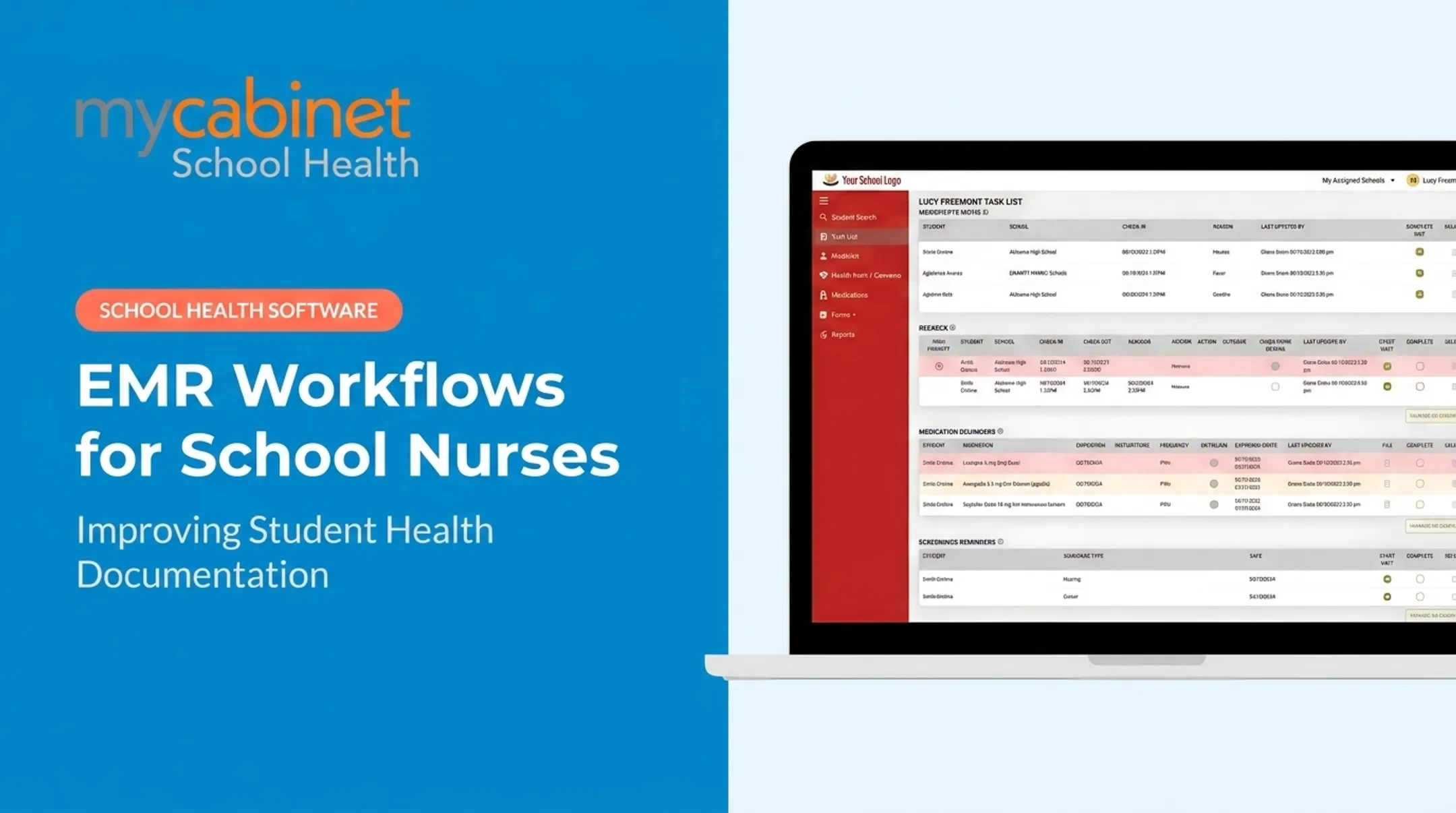
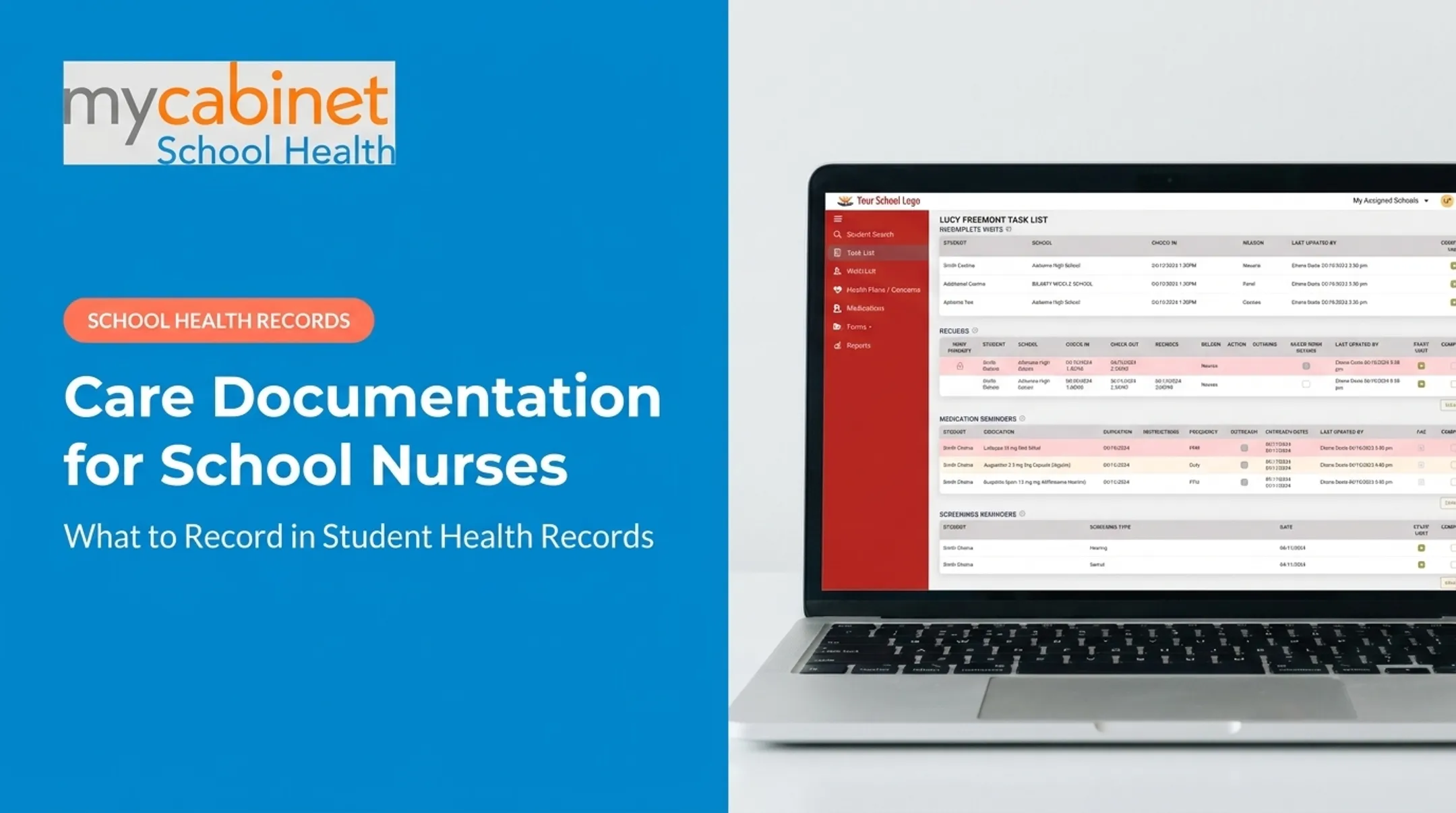
When those pieces are in place, a purpose-built school health system can hold the workflow together. MyCabinet School Health is one example built for this setting. It combines nurse documentation, digital form collection, medication oversight, and one-way family communication in a single platform. Nurses get real-time access to care plans, emergency contacts, and medication history without digging through paper files. Schools still need to review and follow local policy.

Key Documentation Variables That Affect Quality and Compliance
A complete note isn't automatically a long note. Quality depends on whether the record contains the right facts, actions, and follow-up, delivered on time and kept secure.
Timeliness
Charting close to the encounter reduces memory gaps and gives authorized staff current information to act on. North Carolina's manual requires timely documentation with current progress notes, and it distinguishes an original entry from a late entry, each following its own approved process North Carolina School Health Program Manual.
Objectivity and Specificity
Vague phrases create risk. Compare these two entries:
Weak: "Student didn't feel well. Parent notified."
Specific: "Student reported headache, rated 5/10, no fever noted (temp 98.4°F). Rested 15 minutes, offered water. Parent contacted at 10:42 AM via phone; advised to pick up if symptoms worsen. Returned to class at 11:05 AM."
The second version tells anyone reading it exactly what happened, without guessing.
Completeness and Relevance
Every school-health note should cover:
- Reason for visit
- Assessment
- Intervention
- Communication
- Student response
- Disposition
- Follow-up when applicable
Avoid both omissions and unnecessary narrative. Unrelated classroom drama or family details don't belong in a health record.
Privacy, Access, and Auditability
Student health records maintained by a school generally qualify as FERPA education records. HIPAA typically doesn't apply when a school isn't a covered entity or keeps health information only within those FERPA records.
That distinction shifts when a school acts as a HIPAA covered entity for specific electronic transactions, such as Medicaid billing U.S. Department of Education and HHS Office for Civil Rights.
Practical safeguards include:
- Correct-record checks before charting
- Role-based access controls
- Secure devices for clinic work
- Avoiding unnecessary student identifiers in free-text notes
Consistency and Structured Workflows
Standard visit types, required fields, and approved terminology make documentation more consistent across nurses and buildings, without stripping out clinically relevant narrative.
MyCabinet School Health uses predefined visit types, clean audit trails, and task tracking for medication expirations. That structure helps nurses avoid rebuilding the same checklist mentally for every visit.

Common Mistakes, Troubleshooting, and Alternatives
Most documentation problems trace back to rushed workflows, unclear ownership, or notes that blur fact and assumption.
Common Mistakes
Documentation errors:
- Charting in the wrong student record
- Waiting too long after the visit to document
- Entering care before it actually happens
- Copy-pasting prior notes without reassessing
- Using vague or judgmental language
Process and handoff errors:
- Omitting the student's response or disposition
- Missing parent or provider communication details
- Using unapproved abbreviations
- Attaching the wrong form to a record
Troubleshooting Common Issues
- Incomplete notes: Compare the entry against a checklist covering reason, assessment, action, response, communication, and disposition.
- Duplicate or inconsistent information: Verify the source record, review attachments, correct errors transparently, and escalate system issues to a designated administrator.
- Missed follow-up: Use task queues, expiration tracking, and end-of-day review instead of paper lists or untracked email threads.
Alternatives and Trade-Offs
| Method | Speed | Visibility | Auditability |
|---|---|---|---|
| Paper forms | Slow | Low | Difficult |
| Spreadsheets | Moderate | Moderate | Weak |
| General EHR | Fast | Moderate | Moderate |
| School-health platform | Fast | High | Strong |
A district-approved paper form might work fine for a small school with low visit volume. But recurring medication management, multi-school coordination, or high follow-up volume usually justifies a more structured system. Whatever the method, technology can't decide clinical significance or override district policy—that judgment stays with the nurse.
Conclusion
Strong school nurse charting follows a repeatable sequence every time: verify the student, document objective findings, record care and communication, capture the response and disposition, and assign follow-up. Strong documentation balances efficiency, completeness, privacy, and accountability—not length for its own sake.
If your current workflow relies on scattered paper, spreadsheets, or untracked emails, review where duplicate steps or missed follow-up creep in. Train nurses on local requirements first. From there, evaluating secure school-health technology like MyCabinet School Health makes sense when structured documentation and connected family communication become a priority.
Frequently Asked Questions
What is charting in nursing?
Charting is the timely, accurate, objective recording of assessment findings, care provided, communication, student or patient response, disposition, and follow-up in the authorized health record. In a school setting, this applies to every health office visit, not just medical emergencies.
What is FDAR charting in nursing?
FDAR stands for Focus, Data, Action, and Response, a format built around a specific issue like a symptom or change in condition. School nurses should only use it when it matches their district's approved documentation format and EHR structure.
What is the golden rule of chart documentation?
Document what you observed, what you did, and how the student responded. Entries should stay timely, objective, relevant, secure, and consistent with district policy.
Can you give me an example of nursing charting?
"Student presented with scraped knee from playground fall. Wound cleaned and bandaged. No dizziness or nausea reported. Returned to class at 1:15 PM; teacher notified." (Fictional, de-identified example.)
What should a school nurse document after a student visit?
Document the reason for the visit, relevant subjective and objective findings, care provided, medication details if applicable, communications, student response, disposition, and any follow-up needed.
How can school nurses make charting faster and more accurate?
Chart in real time using approved templates and structured visit types, keep language objective, and review entries before signing. Secure school-health software with task reminders reduces duplicate entry without removing clinical judgment from the process.