
That's the core problem. Manual documentation makes it nearly impossible to produce accurate, audit-ready compliance reports on short notice. Records live in different places, forms go missing, and reconstructing a clean timeline from a paper chart eats hours nobody has.
This guide breaks down what these reports actually include, which regulations drive them, and how modern school health platforms are changing the reporting process for nurses and administrators alike.
Key Takeaways
- Compliance reports prove adherence to FERPA, state immunization mandates, and medication administration rules.
- Build each report around scope, policies and procedures, incident logs, medication records, and corrective action plans.
- Standardize on four report types: immunization compliance, medication audits, incident reports, and screening summaries.
- Use digital school health platforms to centralize documentation and auto-generate regulator-ready audit trails.
What Are Regulatory Compliance Reports for K-12 School Health Programs?
A regulatory compliance report is documented evidence that a school or district's health services meet federal, state, and local requirements. It is proof—not only a written policy, but the data that shows the policy is followed.
These reports are typically requested by:
- State departments of education or health
- School boards and district administrators
- Federal auditors, particularly for school-based Medicaid claiming
Two report types matter in practice:
- Internal reports — nurse-to-administrator summaries used for oversight
- External reports — formal submissions to state or regulatory bodies with set formats and deadlines
Both depend on the same underlying records. According to the National Association of School Nurses, school nurses maintain health records covering more than 95% of U.S. school-aged children. Those records span screenings, immunizations, episodic care, emergency plans, and chronic-condition management.
NASN also expects documentation that is timely, accurate, complete, retrievable, and securely protected. That standard is hard to meet with paper charts alone.
Getting this wrong carries real consequences:
- Lost funding and failed audits
- Liability exposure for the district
- Gaps in care that put student safety at risk
Key Regulations Driving School Health Compliance Reporting
FERPA and Student Health Records
Under FERPA, an education record is anything directly related to a student and maintained by the school or a party acting on its behalf. That includes most health records school nurses maintain. Disclosure generally requires written consent identifying the records, purpose, and recipient, unless an exception applies, such as a health or safety emergency.
When HIPAA Applies (and When It Doesn't)
This trips up a lot of districts. Per joint guidance from ED and HHS, a school isn't automatically a HIPAA covered entity just because it employs a nurse or physician. If a school-employed provider maintains records as part of the school's FERPA education records, HIPAA generally doesn't apply to those specific records.
HIPAA becomes relevant mainly for outside providers—such as an independent school-based health center—that conduct covered electronic transactions on their own.
State Mandates Vary Widely
- Immunization deadlines and reporting windows change by state
- Vision, hearing, and scoliosis screenings trigger at different grade levels
- Medication rules, audit frequency, and record retention periods are not standardized
IDEA and Section 504
Health accommodations tied to an IEP or 504 plan add their own documentation load: annual reviews, service logs, and evidence that placement decisions drew on multiple information sources. Nurses and administrators often need to show who accessed the record, what changed, and when.
Those access and audit expectations are why platforms like MyCabinet align record-sharing and role-based controls with HIPAA and FERPA requirements schools must document against.
What Should Be Included in a School Health Compliance Report
A solid compliance report covers five components:
- Scope — which students, grades, health services, and time period the report covers.
- Policies and procedures — medication protocols, emergency response plans, and screening schedules.
- Data and evidence — visit logs, medication records, immunization status, incident reports, consent documentation.
- Findings summary — gaps identified, such as expired medications, missed screenings, or incomplete forms.
- Corrective action plan — concrete steps to close gaps: retraining, better parent outreach, updated processes.

Assembling all of this from paper charts means hours of manual cross-referencing. Structured visit documentation with predefined visit types changes that work.
When every clinic visit is logged consistently from the start—with a built-in audit trail—pulling evidence is a matter of filtering data, not reconstructing it after the fact.
Types of Compliance Reports School Nurses Prepare
School nurses prepare a recurring set of compliance reports that document student health status, clinic activity, and mandated program completion. Deadlines and formats vary by state, but most K–12 health programs center on the four categories below.
Immunization Compliance Reports
These track student immunization status against state mandates and flag out-of-compliance students for follow-up. Reports typically show dose completion, exemptions, and students still due for action. Florida, for example, requires public and private schools with kindergarten or seventh grade to submit immunization status reports every October.
Medication Administration and Safety Reports
These document dosage, frequency, expiration tracking, and parent outreach to show safe oversight. North Carolina guidance calls for periodic medication audits—weekly, monthly, or quarterly—that review authorizations, administration logs, and any variances.
Incident and Injury Reports
These summarize clinic visits, injuries, and emergency responses for district risk management and insurance review. States such as Florida and New York set specific incident-reporting thresholds and categories nurses must follow.
Health Screening Compliance Reports
These confirm completion of required screenings within state-mandated timeframes. New York, for example, ties vision, hearing, and related screening requirements to specific grade levels.

Common Challenges in School Health Compliance Reporting
Even well-run health offices run into the same recurring obstacles:
- Fragmented systems: paper charts, spreadsheets, and email make pulling complete data slow and error-prone.
- Time constraints: many nurses cover multiple schools, leaving little room for administrative work.
- Inconsistent parent communication: missing signed forms or unclear consent trails create compliance gaps that surface right when a report is due.
Staffing capacity plays a real role here. NCES data shows only 52% of U.S. public schools had a full-time nurse, while a 2025 NASN position statement notes that a third of students lack full-time daily access to a school nurse. When one nurse is stretched across several buildings, documentation backlogs are the expected outcome.

How Technology Simplifies School Health Compliance Reporting
Modern school health platforms address these gaps by removing the manual reconstruction work entirely. Compliance data stays complete as care happens, so nurses spend less time rebuilding records when reports are due.
Capabilities that reduce reporting friction:
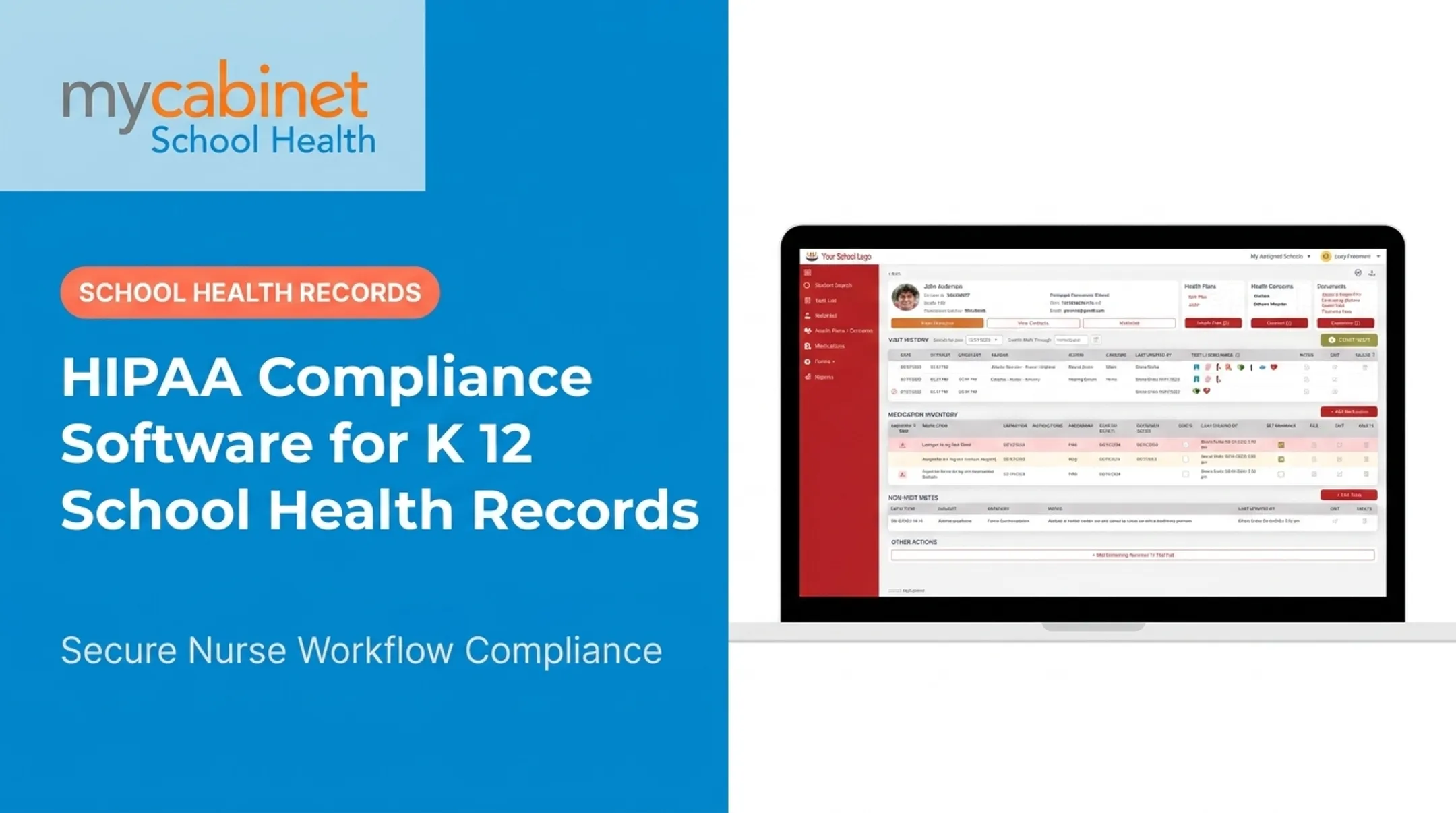
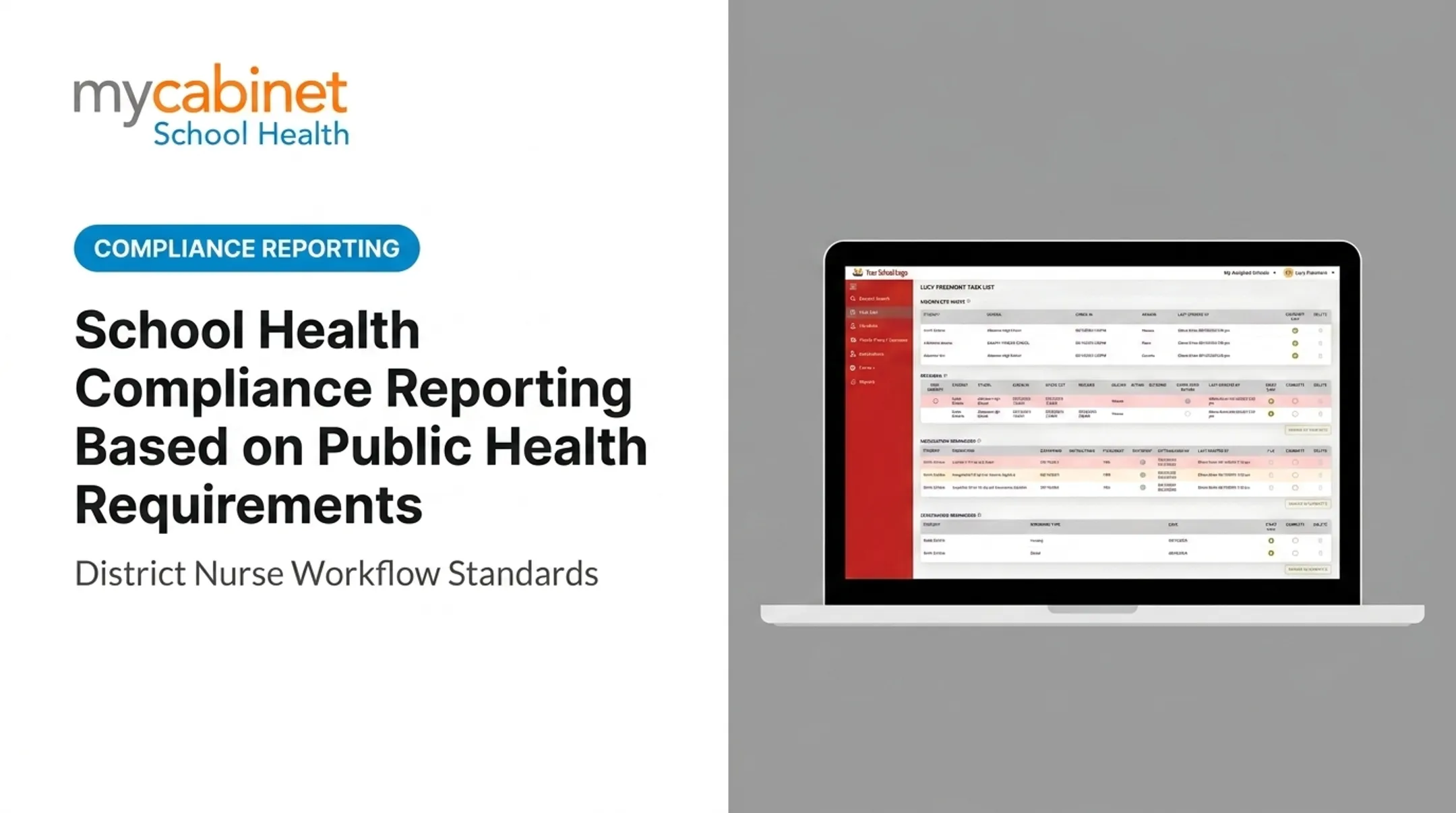
- Intelligent task lists surface incomplete visits, rechecks, medication tasks, and screening deadlines in one dashboard so nurses act before gaps appear
- Digital health-form collection lets parents upload forms through an app or web portal; nurses review and approve in-system, and forms attach to the student record with a consent audit trail
- Role-based access limits each record to appropriate staff and parents, supporting FERPA-aligned reporting without manual gatekeeping
MyCabinet's connected system (Nurse Portal, Parent App, and Parent Web Portal) keeps records centralized so compliance reports can be generated without chasing paper across multiple schools.

Cobb County School District Superintendent Chris Ragsdale put it simply: the platform "digitized and makes documentation easier," giving parents visibility into when their child was seen and given medication. That is "a win for the parents and a win for the district."
Frequently Asked Questions
What should be included in a regulatory compliance report?
Include scope, a review of policies and procedures, a findings summary that highlights gaps, and a corrective action plan. Those four pieces show current status and the next steps required.
What is the best way to create regulatory compliance reports?
Start by understanding the exact requirements for your state and report type, then centralize data collection so you're not pulling from multiple sources. Software that auto-generates audit trails reduces manual errors significantly.
What are examples of regulatory compliance?
In school health, examples include FERPA, HIPAA (in limited contexts), state immunization laws, and IDEA. Each governs a different piece of how student health data is documented and shared.
What are some examples of regulatory compliance reports?
Immunization compliance reports, medication administration audits, and incident/injury reports are the most common in K-12 settings. Screening compliance summaries round out the typical list.
What are the main types of regulatory compliance?
Common types include data privacy, operational, IT/security, and financial compliance. School health programs mainly handle data privacy (FERPA and related rules) and operational clinic workflows, plus state immunization and IDEA requirements.