
The tension is real: districts want to identify at-risk students before a crisis hits, but they can't skip consent, documentation, or privacy safeguards to get there. Rush the process and you risk legal exposure. Move too slowly and a student who needed help doesn't get it.
This guide covers what mental health screening actually involves, the federal and state rules schools must navigate, the tools in common use, and how proper documentation protects students, families, and staff alike.
Key Takeaways
- Screening flags students who may need support — it's not a diagnosis
- FERPA, PPRA, and ESSA impose consent and privacy requirements on school-based screening
- Documentation gaps create legal risk and can delay student support
- Centralized digital records reduce manual tracking errors across screening cycles
What Is Mental Health Screening in Schools?
Mental health screening is a brief questionnaire or checklist, completed by a student, teacher, or parent, designed to flag students who might benefit from a closer look. It is not diagnostic.
A 2022 peer-reviewed school-health study defines screening as identifying students who may need Tier 2 or Tier 3 support, distinct from the follow-up assessment that happens after a referral.
There are two main approaches:
- Universal screening — administered to an entire grade or school population
- Targeted screening — triggered by a specific concern, teacher referral, or behavioral incident
A typical screening asks about mood, worry, sleep, or self-harm thoughts using short, structured questions. The PHQ-9 Modified for Teens, adapted from the adult depression screener, is widely used in schools and pediatric offices.
In its original validation study, a score of 11 or higher showed 89.5% sensitivity and 77.5% specificity for detecting major depression in adolescents ages 13–17.
Common Screening Tools Used in Schools
| Tool | Age Range | Format | Time |
|---|---|---|---|
| BASC-3 BESS | 3-18 | Teacher, parent, or student form (25-30 items) | 5-10 min |
| SRSS | Elementary-secondary | Teacher rates 7 behavior items | 10-15 min per class |
| PHQ-9 Modified for Teens | 13-17 | Self-report symptom checklist | Varies |
| SDQ | 2-17 | Self, parent, or teacher completion | 5-10 min |
| Pediatric Symptom Checklist (PSC-35) | School-age | Parent-report, 35 items | Under 5 min |

None of these tools produce a diagnosis. They produce a signal — one piece of information a school team uses to decide what happens next.
Which Health Screenings Do Schools Typically Provide?
Mental health screening rarely stands alone. Most districts already run vision, hearing, and scoliosis screenings routinely. New York, for example, mandates these three in specified grades unless documented on a health exam.
Mental health screening usually shows up in one of three settings:
- As part of a wellness visit or health education unit
- Through a targeted MTSS (Multi-Tiered System of Supports) referral
- As a standalone district or state-mandated program
Florida's Section 1006.041 requires districts to run mental-health assistance programs built around tiered support, with screenings as one available component.
The key difference: vision and hearing checks carry minimal consent friction. Mental health screening does not. It touches sensitive personal information, which triggers a separate layer of federal and state law that vision charts never will.
Legal and Consent Requirements Schools Must Navigate
This is where things get complicated, and where documentation gaps turn into legal liability.
Federal law sets the floor:
- PPRA requires parental consent before students take surveys covering protected topics, including mental or psychological problems, when tied to federally funded programs
- ESSA (20 USC 7101) requires prior written informed parental consent for mental-health assessments or services connected to a school and funded under the subchapter, with narrow exceptions for emergencies or unaccompanied youth 14 and older
- FERPA protects screening records as confidential education records
- HIPAA may apply on top of FERPA when a school-based health provider (not a school employee) delivers the service
Schools generally can't require a full mental health evaluation without parental involvement. Brief screenings sometimes proceed under state law or IDEA's "child find" provisions, but notice requirements still apply.
State law is a patchwork, and it's shifting fast:
- Illinois passed SB1560 in 2025, requiring annual screening offers for grades 3-12 starting the 2027-28 school year, contingent on the state supplying a free tool
- Utah (effective July 2026) requires prior written parental consent plus annual notice before any screening under its state-approved program
- Florida allows screening within MTSS programs but ties broader health-care consent to a separate statute (Section 1014.06)
The takeaway for administrators: check your state's specific statute before rolling out any program. What's legal in Utah may not match Illinois' rules, and assuming federal law alone covers you is a mistake.
Districts increasingly need a documented, auditable consent trail, not just a signed form in a filing cabinet, to prove compliance if a parent, auditor, or state agency asks questions later.

Best Practices for Documenting Screening and Follow-Up
Good documentation isn't paperwork for its own sake. It's what protects a school when a parent disputes a result, an auditor reviews a program, or a student needs continuity of care across school years.
The National Association of School Nurses holds nurses accountable for records that are timely, accurate, complete, retrievable, and securely protected. A compliant screening record should capture:
- Consent form and date of signature
- Screening tool used and date administered
- Administering staff credentials
- Results or risk category
- Parent notification date
- Referral or follow-up notes and disposition
In practice, tracking this manually is harder. Across a district of several thousand students, paper files or scattered spreadsheets invite missed consent forms, lost follow-up notes, and no clear record of who was notified and when.
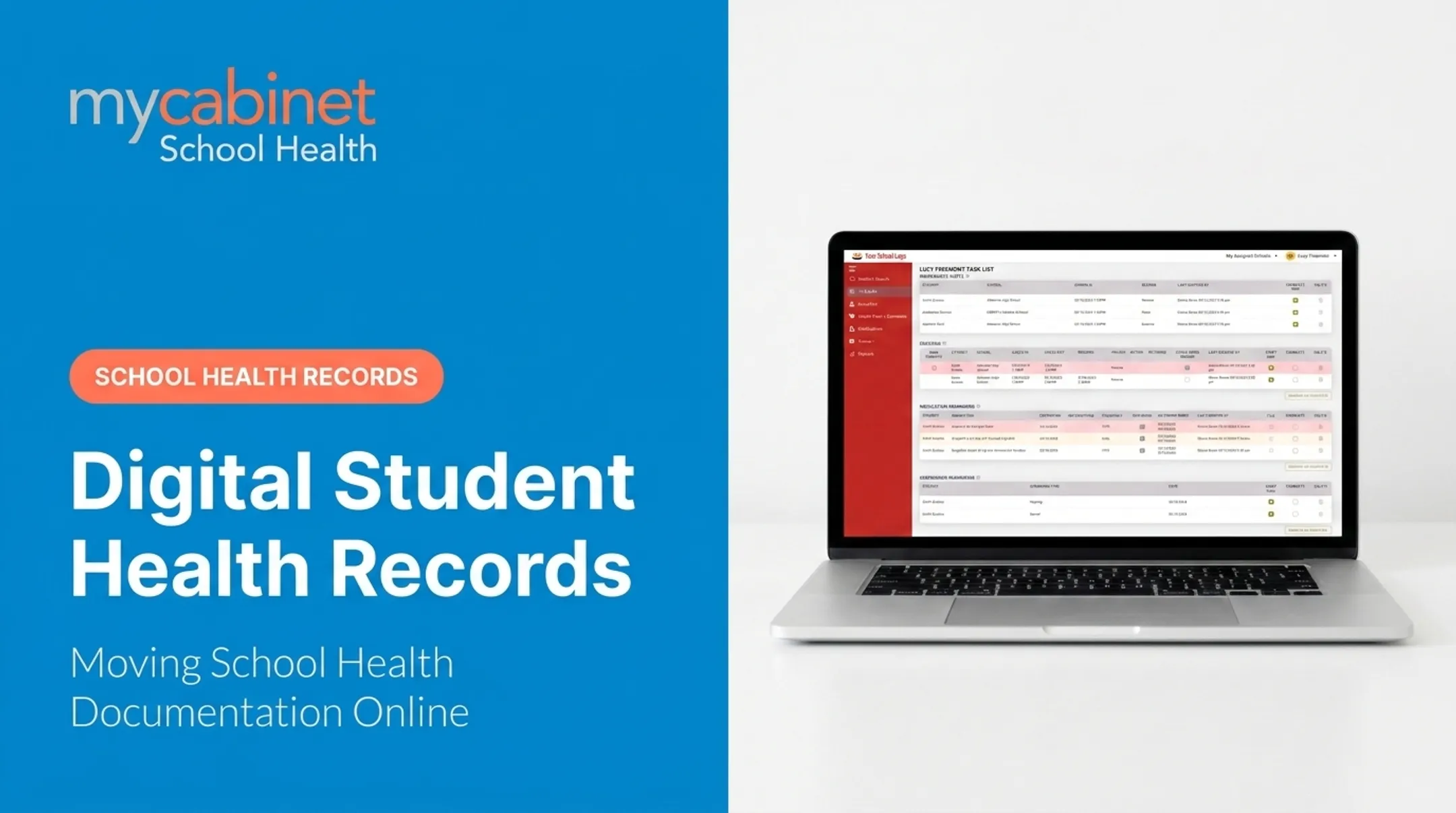
A school health EHR closes that gap. MyCabinet School Health centralizes digital consent forms, structured visit documentation, and audit trails in one place. Nurses can see screening completion, consent status, and pending follow-up tasks in a single dashboard instead of hunting across files.

Access control matters as much as centralization. MyCabinet uses role-based permissions so:
- Nurses and approved staff see only what they need for care
- Parents see only their own child's records
- FERPA-aligned confidentiality applies platform-wide, including sensitive mental health data
That setup keeps screening documentation complete and retrievable without a separate system for mental health records.
Steps for Implementing a Responsible Screening Program
Rolling out a screening program without a plan is how districts end up with compliance headaches six months in. Follow a sequence instead:
- Select a validated tool — Choose one aligned with your district's age range, goals, and state law (for example, PHQ-9 Modified for Teens, SDQ, or SRSS)
- Establish consent procedures first — Notice and consent processes should be locked down before a single questionnaire goes out
- Train staff on administration and response — Scoring a screener is easy; knowing what to do with a flagged result requires training
- Build a referral pathway — Every flagged student needs a documented next step, not an informal hallway conversation
- Track everything centrally — Screenings due, consent received, referrals pending — one system beats scattered notes or a shared spreadsheet

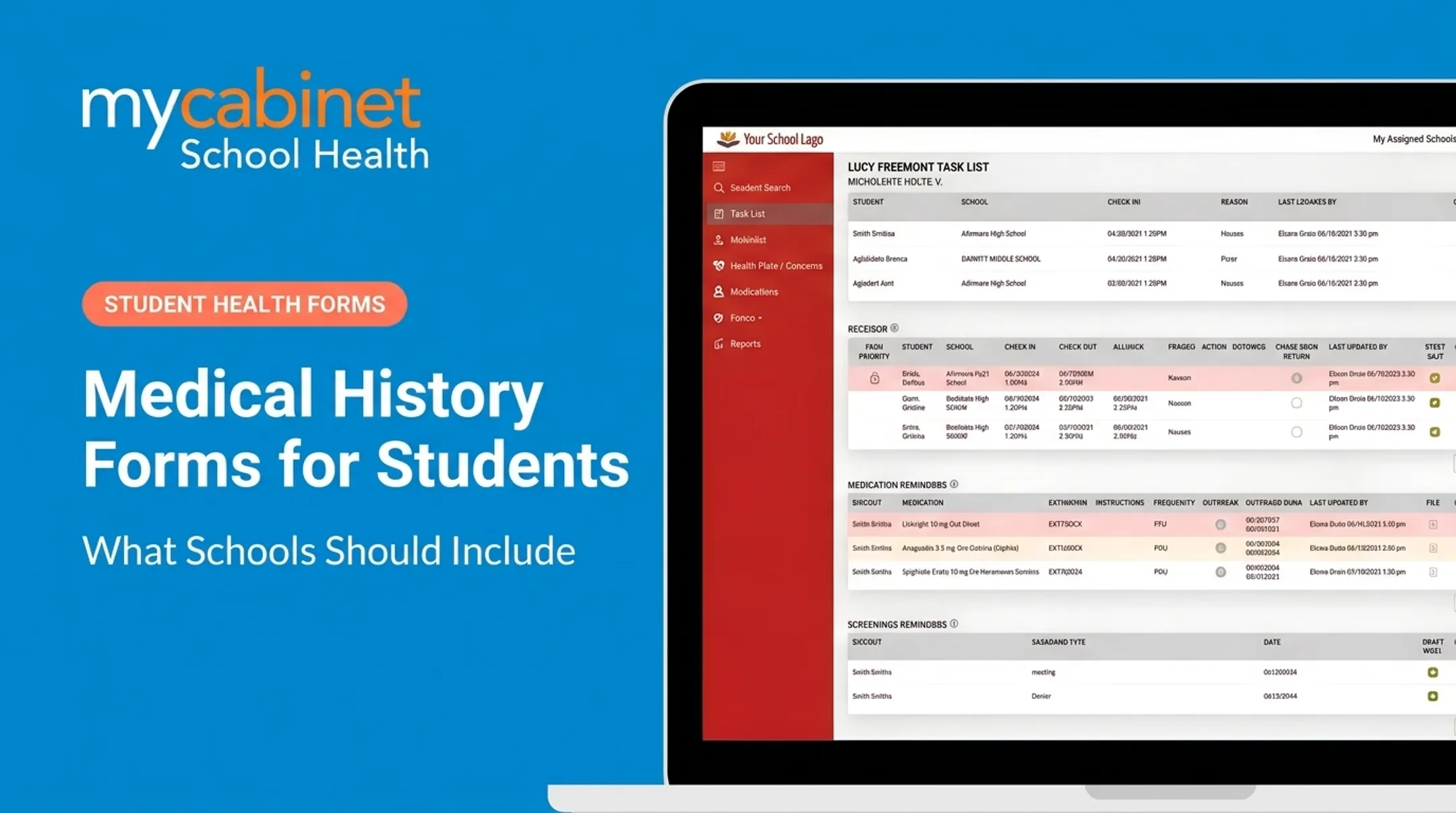
That central tracking is where most programs stall—or stay compliant. The MyCabinet Nurse Portal keeps screening reminders alongside incomplete visits, medication tasks, and rechecks in one prioritized task list, so due items stay visible instead of buried in inboxes.
Frequently Asked Questions
What does a mental health screening consist of?
A short questionnaire on mood, behavior, or risk indicators, completed by the student or an observing adult. The goal is to flag a potential need for further evaluation—not to diagnose.
Can a school require a mental health evaluation?
Generally no, not without parental consent. Brief screenings may occur under specific state laws or IDEA's child find provisions, but proper notice is still required.
Which health screenings are usually provided by schools?
Vision, hearing, and scoliosis screenings are the most common baseline. Mental health screening is increasingly added, depending on state and district policy.
Is there a PHQ-9 for kids?
Yes. The PHQ-9 Modified for Teens is a validated adolescent version widely used in both school and pediatric settings for depression screening.
How do schools protect student privacy during mental health screenings?
FERPA protects screening records as confidential education records, and HIPAA may apply when outside health providers are involved. Role-based access and secure digital records add further protection.
Do parents have to consent before a child is screened?
Federal law requires consent for certain federally funded surveys on sensitive topics like mental health. Many states, including Utah, now require active written parental opt-in before screening begins.