
About 1 in 4 children in the U.S. has a chronic health condition, and many need medication during the school day, according to CDC data cited in research on school medication trends. That includes everything from daily ADHD medications to emergency epinephrine and seizure rescue meds.
A Medication Administration Record (MAR) is the document that tracks what was given, to whom, when, how, and by whom. Requirements vary by state, district, and local policy, so there's no single universal template.
This article covers the essential MAR fields, a practical school workflow, paper versus digital tradeoffs, and implementation tips for districts ready to tighten up their process.
Key Takeaways
- A school MAR consolidates orders, scheduled doses, misses or refusals, observations, and follow-up in one record.
- Complete entries always link the student, authorization, dosage, route, timing, staff member, and outcome.
- MAR documentation supports safety and accountability without replacing provider orders, parental consent, or clinical judgment.
- Digital workflows improve expiration tracking, audit visibility, and communication when paired with training and access controls.
What Is a Medication Administration Record for School Health?
A Medication Administration Record (MAR) is a chronological log of every medication dose given at school. It's different from three other documents schools rely on:
- Medication authorization form — the parent/guardian's written permission and instructions for the school to administer a specific medication.
- Physician order — the prescriber's directive on dosage, route, and timing.
- Student health plan — the broader care plan covering conditions, emergency protocols, and accommodations.
The MAR ties all three together into a record of what actually happened.
Washington State's 2022 guidelines describe it as legal documentation for anyone administering medication, capturing the student's name, prescribed medication, dosage, route, scheduled time, and allergies (OSPI Guidelines for Medication Administration in Schools).
Common School Medication Scenarios
Schools manage several medication categories:
- Daily scheduled medications (ADHD, seizure disorders, chronic conditions)
- As-needed medications (pain relief, allergy symptoms)
- Emergency medications (epinephrine, naloxone, seizure rescue medications)
- Field-trip doses administered off-campus
- Conditional medications given only when specific criteria are met (fever above a threshold, for example)

Why It Matters for Safety and Accountability
A well-maintained MAR reduces reliance on memory, clarifies handoffs between staff, and supports continuity when personnel change mid-year. It also makes follow-up easier when a dose gets missed or a reaction occurs.
The U.S. Government Accountability Office noted in 2020 that inadequate health documentation increases institutional risk and complicates compliance oversight in public systems. Consistent records are what shrink that risk in day-to-day practice.
Important: MAR design and use should follow applicable state requirements, district policy, provider instructions, and your school's approved medication procedures. This article provides general guidance, not legal or clinical direction.
What Information Should a School MAR Include?
A complete MAR connects several categories of information. Missing even one creates gaps that matter during an audit or, worse, during an incident review.
Student Identification and Context
- Full name, plus date of birth or an approved student identifier
- Grade or classroom
- Allergies and relevant precautions
- School year and applicable location or program (classroom, after-school, athletics)
Medication Order and Authorization Details
- Medication name, strength, dosage, form, and route
- Frequency or permitted timing window
- Indication, when relevant
- Start and end dates
- Prescribing provider name
- Parent or guardian authorization
- Supporting health plan, if required
Maryland's 2025 guidance requires order duration and annual renewal of both prescription orders and parental consent (Maryland State Department of Education). Don't assume last year's authorization carries forward.
Administration Log Fields
Every dose entry needs:
- Scheduled date and time
- Actual administration time
- Dose given
- Route
- Administering staff member's name
- Initials or electronic signature
- Space for observations
Documenting Exceptions
Missed, late, refused, held, unavailable, or partially administered doses each need their own clear entry, including:
- The reason (if known)
- Action taken
- Notifications sent
- Follow-up required
New York's guidelines specifically call out missed doses and refusals as required MAR entries (NYSED Guidelines for Medication Management). Skipping this field isn't an option; it's usually where the most important information lives.
Lifecycle and Accountability Fields
Depending on district and state policy, your form may also need:
- Receipt confirmation and quantity (especially for controlled substances)
- Storage checks
- Expiration date
- Discontinued order notations
- Returned medication log
- Documented changes to orders
Verify these specific requirements against your state and district guidance before finalizing a form. What's optional in one state is mandatory in another.
How Should School Staff Use a MAR?
Having the right fields means nothing if staff don't use the form correctly. Here's a practical workflow.
Pre-Administration Check
Before giving any medication:
- Confirm the current authorization and order are still active
- Verify the student's identity
- Review allergies and special instructions
- Check the medication label against the order (name, dose, expiration)
- Confirm the dose and timing match the record

Maryland requires confirming the right patient, drug, route, time, and dose before every administration (per Maryland Administration of Medication guidance). Washington adds that staff must compare the container label with both the medication request and the MAR, and everything must match (OSPI guidelines).
Documenting the Administration
Document the administration immediately after giving the medication, never in advance. Use your school's approved abbreviations and signature method, whether paper initials or electronic entry.
Washington defines "on time" as within 30 minutes before or after the scheduled dose. Staff should only document medication they personally administered, not what a colleague gave.
Handling Missed, Refused, or Incorrect Doses
Documentation errors happen. Here's the right way to fix them:
- Never erase, white-out, or scratch out an original entry
- Draw a single line through the mistaken entry
- Initial and date the correction
- Add an explanation, often on the back of the form or in a designated notes section
This preserves the original record while making the correction transparent. If a dose was missed or refused, document the reason, notify the appropriate parties, and escalate per school policy. If the wrong medication or dose was given, follow your district's medication-error protocol and document the event fully.
Example — Complete entry:
10/14, 12:05 PM. Amoxicillin 250mg PO given. Student tolerated well, no complaints. Initials: JT.
Example — Incomplete entry:
10/14. Gave med.
The second entry tells you nothing useful if a question comes up later. No time, no dose confirmation, no observation.
Post-Administration and Special Situations
After giving medication, staff may need to:
- Observe the student for a specified period
- Document any symptoms or reactions
- Contact school or medical personnel if a reaction or concern appears
- Record parent or guardian notification, when policy requires it
Special situations demand a MAR that stands on its own, without assuming prior context:
- Substitute nurses covering unfamiliar buildings
- Multiple campuses or shared caseloads
- Field trips and after-school programs
- Mid-year order changes
Paper vs. Digital Medication Administration Record Forms
Both formats can work. But they carry different risks and different overhead.
| Factor | Paper MAR | Electronic MAR |
|---|---|---|
| Readability | Handwriting ambiguity possible | Standardized, typed entries |
| Version control | Duplicate versions common | Single source of truth |
| Signatures | Manual initials | Electronic signature, timestamped |
| Audit trails | Difficult to reconstruct | Built-in activity logs |
| Retrieval | Physical search required | Instant search/filter |
| Expiration tracking | Manual calendar checks | Automated alerts |
| Backup | Vulnerable to loss/damage | Cloud redundancy |
Paper-Specific Risks in Schools
Paper forms create specific headaches:
- Lost or misplaced pages
- Outdated orders still in circulation
- Duplicate versions across campuses
- Handwriting that's hard to interpret under pressure
- Delayed review by supervising nurses
- Difficulty tracking expiration dates or open follow-up items
Guidance such as Minnesota's permits either format. Paper entries must use unalterable, legible ink, and electronic records must protect privacy and accuracy (Minnesota Department of Health).
Either way, the record is a legal document and needs to be secured accordingly.
What Digital Platforms Can Add
An electronic school health platform, like MyCabinet School Health, connects medication records with the rest of the health office workflow:
- Digital form collection and nurse review
- Task lists and medication reminders
- Expiration tracking and automated alerts
- Controlled parent notifications
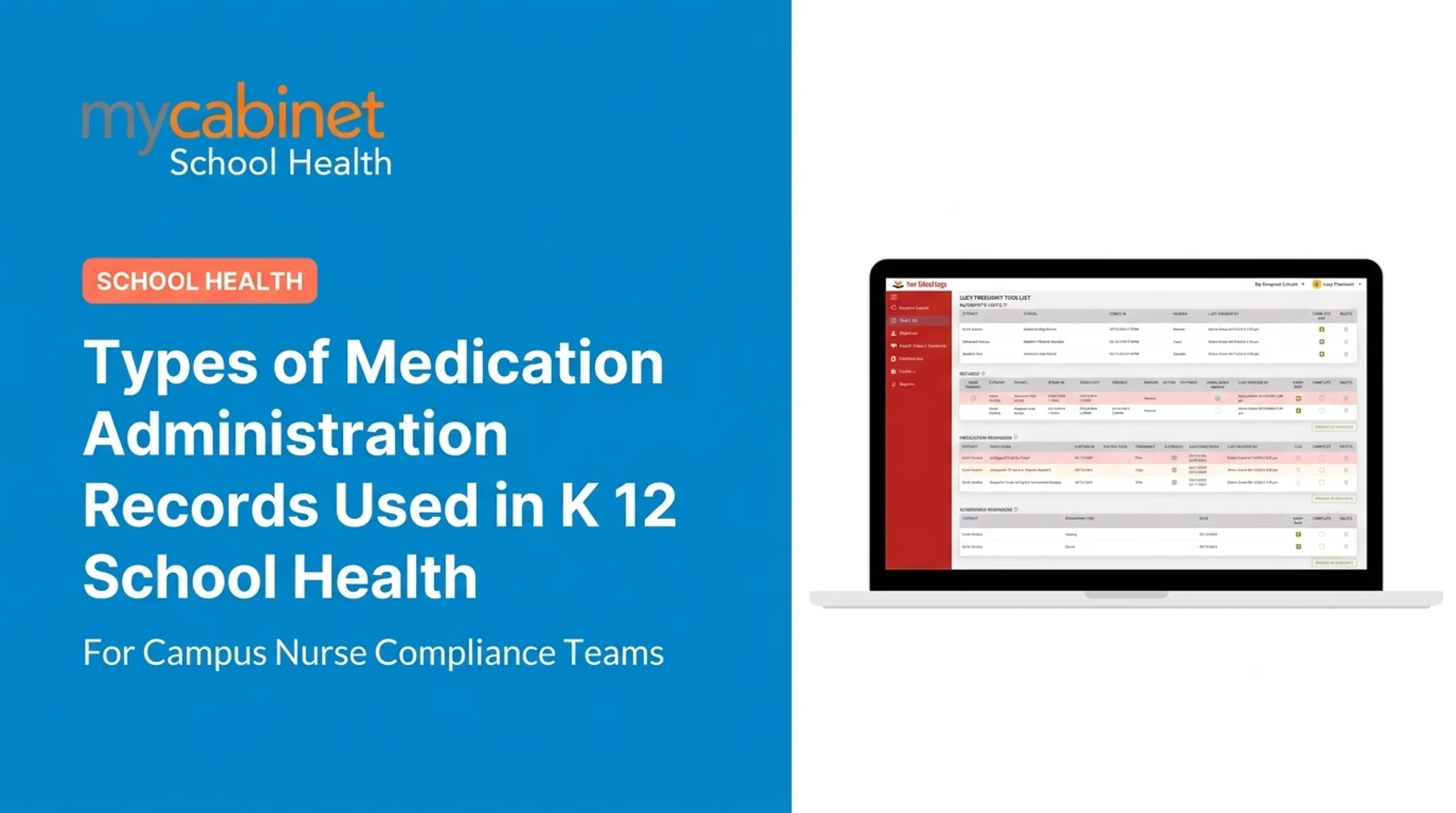
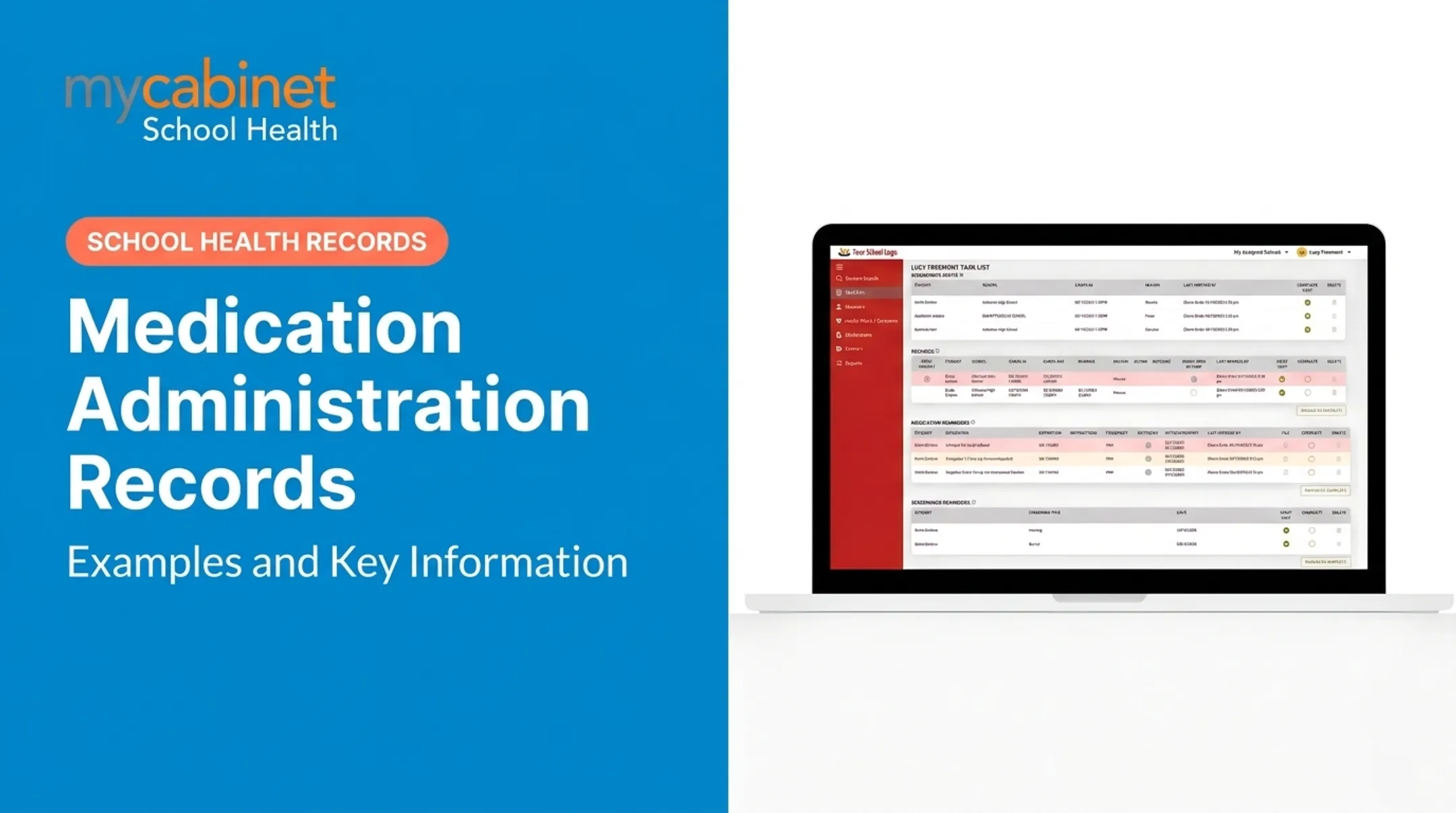
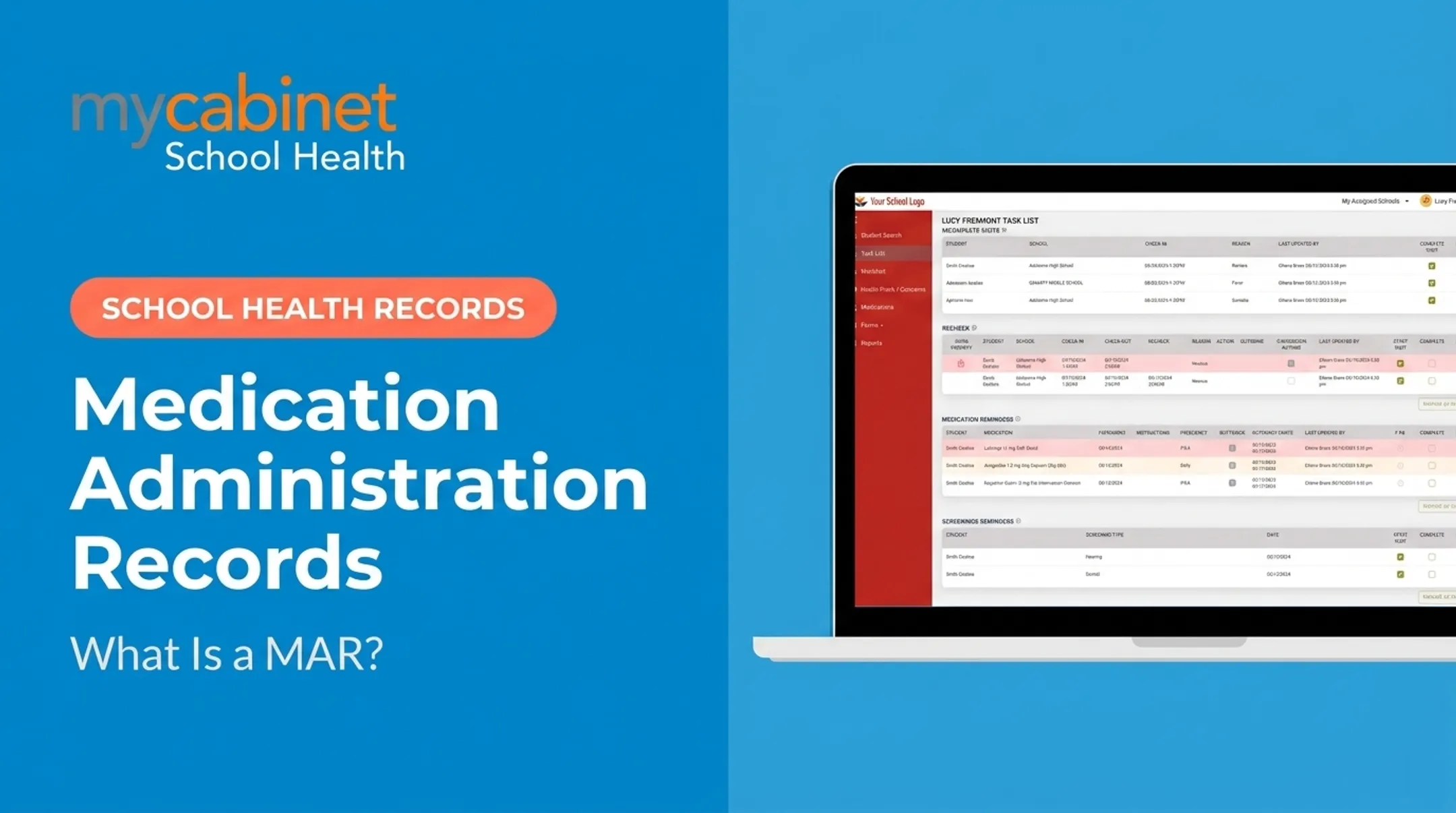
MyCabinet's Nurse Portal organizes incomplete visits, medication reminders, and expiration alerts into one task list rather than separate spreadsheets.

That said, no platform substitutes for trained staff and clearly defined procedures. Published research on school medication management focuses on training, delegation, and emergency protocols. It does not include a direct paper-versus-electronic error-rate comparison for K-12 schools. Treat digital tools as a support system, not a compliance guarantee.
Best Practices for Implementing School MAR Forms
Standardize, But Allow for Variation
Use one consistent MAR format across every campus in the district. Allow approved variations for:
- Different medication types (daily vs. emergency)
- Individualized student needs
- Emergency action plans
- Campus-specific workflows
Implementation Checklist
Before rolling out a new or revised MAR process, confirm:
- Staff roles and who is authorized to administer medication
- Access permissions for viewing and editing records
- Training requirements for new and substitute staff
- Process for updating authorizations and medication changes
- Record review schedule (nurse supervisor sign-off)
- Incident escalation path when a dose is missed, refused, or given in error
- Retention timeline per state requirements
- Periodic quality checks or internal audits
Retention rules vary widely. Washington requires 8 years; New York requires records be kept until the student turns 27; Colorado requires at least 3 years from the log date. Check your state's specific rule before setting a retention policy.
Privacy and Security Controls
Student medication records are sensitive. Protect them with:
- Role-based access — only authorized staff see student health data
- Secure storage or transmission — encrypted, not sitting in an open binder
- Minimum-necessary visibility — staff see only what their role requires
- Audit history — a record of who accessed or edited what, and when
- Correction procedures — a defined process for fixing errors without erasing the original
Under the joint FERPA/HIPAA guidance from the U.S. Department of Education and HHS, student health records maintained by school nurses are generally treated as FERPA education records, not HIPAA records, when the school isn't itself a HIPAA covered entity (U.S. ED/HHS Joint Guidance). That distinction matters for how you handle disclosure requests and parent access.
Where MyCabinet School Health Fits
Districts still running on paper, fax, spreadsheets, and manual email follow-up often struggle to keep MAR data current across campuses.
MyCabinet School Health connects a Nurse Portal, Parent App, and Parent Web Portal so medication workflows stay consistent district-wide. For MAR implementation, that typically includes:
- Medication expiration tracking and dosage/frequency visibility
- Structured documentation with audit trails
- Digital form review and record attachment
- One-way parent notifications for clinic visits and medication expirations
Cobb County School District, a MyCabinet district customer, uses the platform partly for this reason. As Superintendent Chris Ragsdale put it, parents can see when their child was seen and given medication—visibility fragmented paper processes rarely match.

Parent visibility supports accountability. It still depends on training, defined procedures, and clinical judgment to make any MAR system work.
Conclusion
A school MAR is both a safety tool and an accountability record. Its value comes down to accurate fields, timely entries, reliable authorization, and staff who consistently follow the same procedures, whether the form is on paper or on a screen.
If your district's current MAR process feels fragmented, review it against your state's specific requirements, your district policy, and what your nurses actually need day to day. Then decide whether a standardized digital workflow could close the gaps that paper leaves open.
Frequently Asked Questions
What is a medication administration record?
A MAR is a chronological record of medication administrations, including the student, medication, dose, time, route, administering person, and any exceptions or observations. It documents what actually happened, not just what was ordered.
What should be included on a school medication administration record?
A complete MAR includes student ID, the medication order and authorization, the administration schedule, timed administration entries, exceptions, signatures, and follow-up notes. Requirements vary by state and district.
Is a medication administration record the same as a medication authorization form?
No. The authorization form permits or directs school medication administration, while the MAR records each actual administration and its outcome. One grants permission; the other documents what happened.
Who is responsible for completing a school MAR?
The designated nurse or authorized school staff member completes entries according to state law, district policy, staff training, and the student's approved medication instructions. Requirements for who can administer medication vary by state.
Should schools use paper or electronic medication administration records?
Either can work when the records are accurate, secure, accessible, and policy-compliant. Digital systems improve version control, retrieval speed, expiration reminders, and audit visibility.
How should a missed or refused medication dose be documented at school?
Staff should record the actual outcome, the reason if known, actions taken, notifications sent, and any required escalation. The original entry should never be altered, only corrected with a dated, initialed note.