
The pain points are familiar to anyone who has worked in a school clinic: fragmented student health records scattered across binders and shared drives, manual parent phone calls for every medication update, and compliance risk that touches both FERPA and HIPAA-adjacent expectations. This guide covers what EHR integration software actually means for schools, why it differs from hospital-grade systems, what to look for in a vendor, and what districts should expect to pay.
Key Takeaways
- EHR integration software connects health records, parent communication, and nurse workflows into one system instead of siloed tools
- School-specific needs differ from clinical EHRs: FERPA compliance and nurse workflow design matter more than hospital interoperability standards
- NASN notes school nurses maintain records for over 95% of US school-aged children, underscoring integration scale
- Evaluate vendors on FERPA/HIPAA compliance, parent access, and nurse workflow design—not generic data-sharing features alone
What Is EHR Integration Software (and Why School Health Is Different)
EHR integration software connects electronic health records with other systems — forms, communication tools, medication tracking, parent portals — so information flows without manual re-entry. School health integration, though, looks nothing like hospital-to-hospital data exchange.
The National Association of School Nurses defines a school-nursing EHR as software built around the nursing process itself, using standardized nursing data while protecting privacy under both FERPA and HIPAA-adjacent expectations. A student information system with a bolted-on "health module" typically falls short — it lacks the clinical workflow structure and secure exchange a real school-health platform needs.
School nurses manage hundreds of students with little administrative support. That's why workflow-first integration matters more than raw data interoperability. A platform needs to connect three groups, not just two databases:
- Nurses — document visits, medications, and screenings in one clinical workflow
- Students — keep records current and reachable in an emergency
- Parents — see their child's health activity without calling the front office
Those multi-party needs are exactly where hospital-built interoperability models break down.

Why Traditional Interoperability Standards Fall Short for Schools
HL7 and FHIR standards were built for hospital-to-hospital exchange. They say little about digital health form collection, immunization tracking, or parent notification consent — the everyday realities of a school clinic.
Instead, school health vendors need to prioritize:
- FERPA-aligned, need-based access (nurses see only what they need; parents see only their own child's records)
- Controlled parent data sharing, not open data pipes
- Audit trails built for compliance reporting, not just technical logging
Why EHR Integration Matters for Nurses, Districts, and Families in 2026
When digital forms, medication tracking, and visit documentation connect automatically, nurses spend less time on paper folders and more time with students. Task lists that organize incomplete visits, rechecks, medication reminders, and screening follow-ups turn a chaotic day into a manageable one.
Connected records help each group in a practical way:
- Nurses — fewer manual lookups and clearer next-task queues
- Districts — more consistent documentation and less paper chasing
- Families — faster visibility into clinic visits and medication status
Medication safety and fragmented records
In a widely cited survey of school nurses, 48.5% reported a medication error in the prior year, with missed doses accounting for nearly 80% of those errors. That figure is an older benchmark, not a current national rate.
It still shows why expiration tracking, dosage visibility, and outreach logging belong in one connected record instead of scattered spreadsheets. When parents get clinic-visit and medication updates through an app or web portal, phone tag drops and nurses spend less time on status calls.
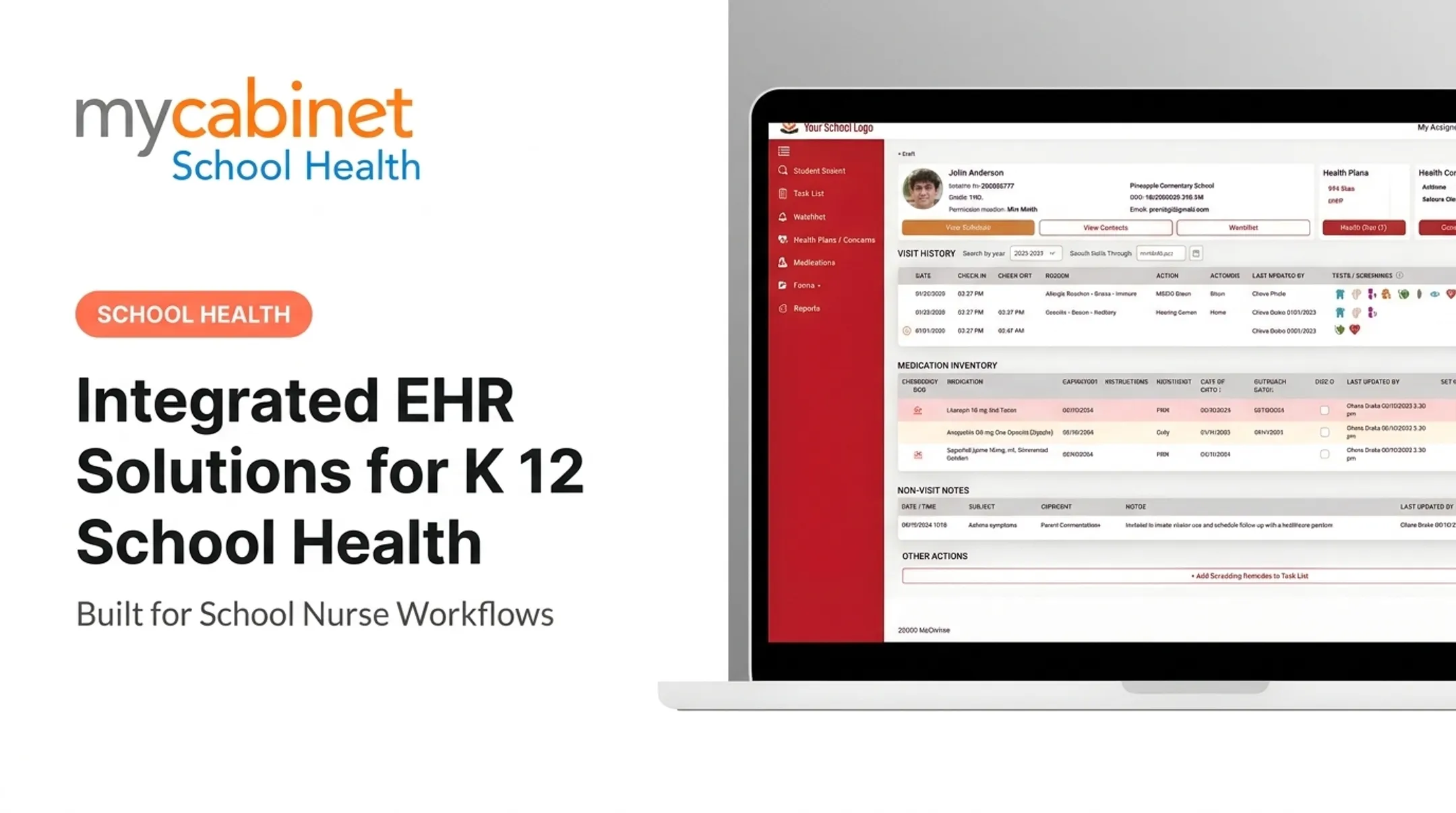
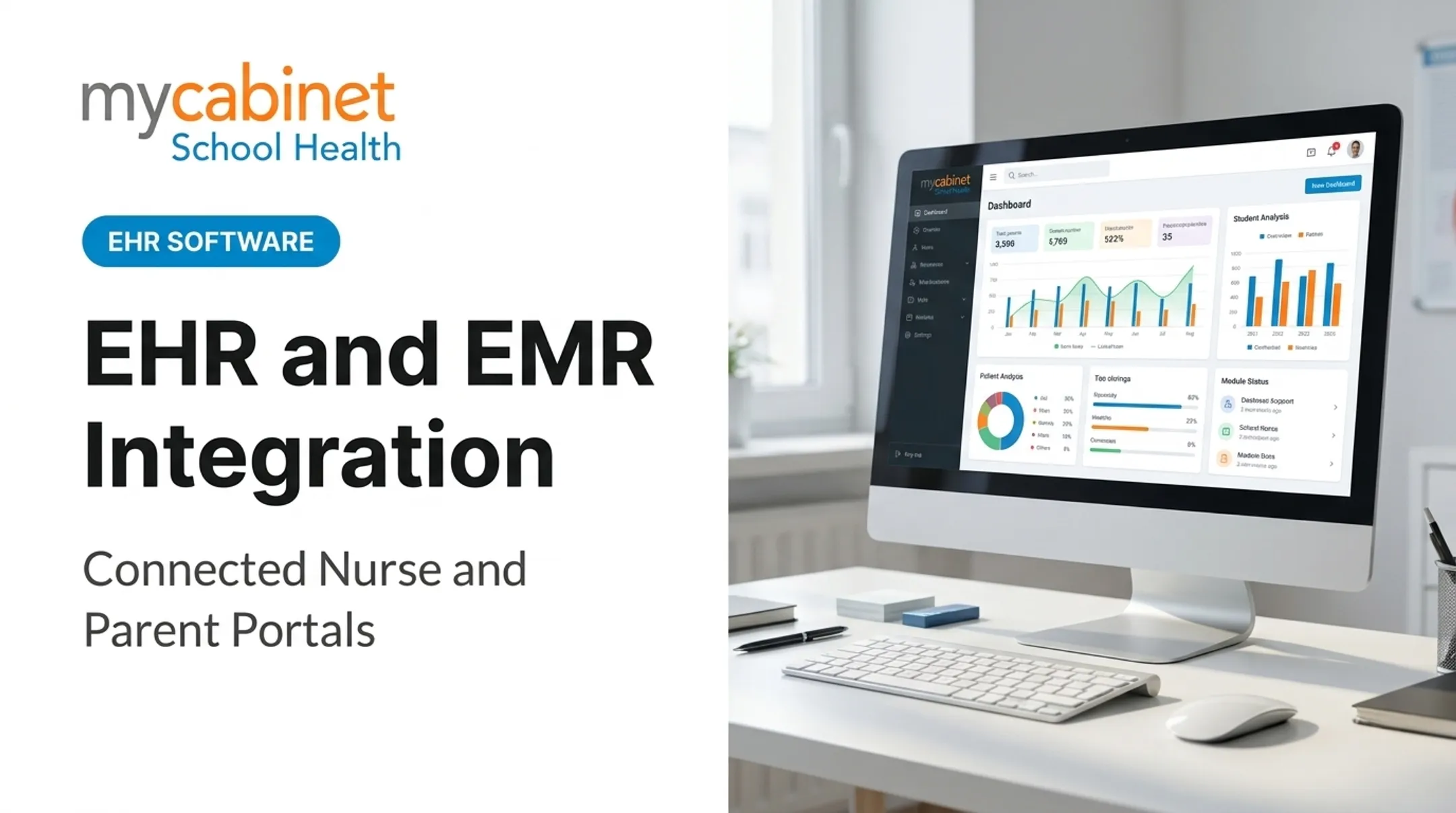
MyCabinet School Health is designed around this model. It combines a Nurse Portal, Parent App, and Parent Web Portal so information moves without manual duplication:
- The Nurse Portal organizes visits, medications, screenings, and task lists in one hub
- The Parent App and Web Portal send one-way visit and medication-expiration notices and let families upload health forms for nurse review

Cobb County School District adopted this approach district-wide. Superintendent Chris Ragsdale described the result at a 2025 school board meeting as letting parents submit paperwork electronically and see when their child was seen and given medication — "a win for the parents and a win for the district."
Types of EHR Integration Approaches for Schools
Districts generally choose from three models:
- Built-in/native integration — Platforms designed from the ground up for school workflows, combining forms, medication tracking, and communication without bolted-on connectors.
- Third-party middleware/interface engines — General healthcare integration tools borrowed from clinical settings. These can technically connect systems but usually require heavy customization for school-specific data like immunization records or parent consent.
- Point-to-point custom integrations — Districts building custom connections between their student information system and health records. Flexible, but often expensive and slow to maintain.
How the models usually compare in practice:
- Native platforms: Fastest to deploy and closest fit for school nurse workflows
- Middleware engines: Broad connectivity, but heavy customization for school data
- Custom point-to-point: Most flexible, yet costly to build and hard to maintain without dedicated IT staff

Most school health offices lack that ongoing IT capacity, so native platforms are the practical default.
Common Challenges in School Health EHR Integration
Privacy and compliance complexity tops the list. School health data touches FERPA and HIPAA at the same time, and confusion about which rules apply creates real friction.
A 2023 qualitative study found that misunderstanding HIPAA hindered collaboration between school nurses and primary care providers, with some providers reluctant to share information at all.
Other recurring challenges:
- Staff adoption resistance: Nurses juggle multiple duties with far less IT support than a hospital department
- Inconsistent data formats: Student information systems, state immunization registries, and health platforms often don't speak the same language, forcing manual re-entry
- Consent confusion: Teams must know when parent authorization is required versus when a school-official exception applies
How to Evaluate an EHR Integration Software Vendor for Schools
Vendor selection should go well beyond a compliance badge on a homepage. Ask about:
- Compliance certifications: FERPA, HIPAA, and SOC 2 specifically, not generic healthcare credentials
- Structured visit documentation: predefined visit types and audit trails, not a blank note field
- Parent-facing capabilities: a mobile app and browser-based portal, not one-directional notifications only
- Role-based access controls: who can see what within the school and district
- Digital health-form collection: in-system parent uploads with nurse approval workflows that cut paper intake each school year
MyCabinet, for example, holds SOC 2 Type II certification, HIPAA compliance, FERPA compliance, and ClassLink Certified Partner status. Those credentials appear as badges that link to a public Trust Center, not as unsupported marketing claims.
A quick vendor comparison checklist:
| Criteria | Ask the vendor |
|---|---|
| Compliance | Do you hold FERPA, HIPAA, and SOC 2 certifications? |
| Parent access | Is there both an app and a web portal? |
| Visit documentation | Are visit types predefined with audit trails? |
| Form collection | Can parents upload forms directly for nurse review? |
| Access control | How are roles segmented between nurses, staff, and admins? |

What Does EHR Integration Software Cost for School Districts?
Pricing models for school health platforms typically scale with district size (enrolled students, number of schools, or overall complexity) rather than per-transaction fees common in clinical healthcare software.
That upfront cost should be weighed against what it replaces:
- Hours spent chasing paper medication logs
- Staff time collecting and filing forms manually at the start of each year
- Repeated parent phone calls for information a portal could deliver instantly
Because pricing varies so much by scope, request a detailed quote that covers implementation, training, and ongoing support rather than generic online price estimates. Confirm what's included:
- SIS integration support
- Onboarding and training materials
- Support response times (some vendors commit to a 24-business-hour turnaround)
Frequently Asked Questions
What is EHR integration?
EHR integration connects electronic health record systems with other software so student data flows automatically. This reduces manual entry and eliminates duplicate work across forms, medication tracking, and communication tools.
What are EHR integration services?
EHR integration services use APIs, middleware, and custom development to connect health record platforms with tools like forms, communication systems, or student information systems. Scope usually includes implementation, field mapping, and staff training.
How much does EHR integration cost?
Costs vary widely by scope and vendor model. School-focused platforms often price by enrollment size or district scale rather than the per-transaction fees common in clinical settings, so a detailed quote is essential.
Why is FERPA compliance important for school health platforms?
FERPA governs student education records, including health information maintained by or for a school. That means school health software must control access and sharing differently than a standard HIPAA-only clinical system would.
Can parents access their child's school health records directly?
Modern school health platforms offer parent apps or web portals for controlled visibility into clinic visits and medication status. Access is typically one-way and limited to the parent's own child, not open messaging or full record access.