
That's a lot of paperwork riding on manila folders and fax machines. Schools and athletic programs commonly struggle with tracking who's submitted a form, whose form is expiring, and whether anything is actually complete before tryouts start.
This guide breaks down what the PPE form covers, how requirements shift state by state, and how schools are moving away from paper chaos toward digital tracking.
Key Takeaways
- Most state high school athletic associations require a PPE before an athlete can practice or compete.
- Every PPE centers on two parts: medical history and the physical exam with clearance.
- Validity periods and required signatures vary by state. Always check your association’s current rules.
- Digital tools like MyCabinet reduce missed forms and manual tracking for nurses and athletic staff.
What Is the Preparticipation Physical Evaluation (PPE) Form?
The Preparticipation Physical Evaluation, often called the "sports physical," is the standardized health check that student-athletes complete before joining a team. Its job is straightforward: to flag cardiovascular, musculoskeletal, or other conditions that could put an athlete at risk during practice or competition.
The NFHS describes the PPE's goal as catching findings that could lead to injury, worsen a controlled condition, or in rare cases, cause death during play. NFHS and most state athletic associations recommend or require it, and the American Academy of Pediatrics' PPE5 monograph, now in its fifth edition, standardizes the form templates used across the country.
Why the Frequency Debate Matters
Here's where things get confusing for schools. PPE5 clinical guidance recommends a full evaluation every 2-3 years, with annual history updates as needed. But most state associations require annual documentation regardless. Schools should follow their state's rule, not the clinical guideline, when it comes to eligibility.
The AAFP's review of PPE5 reports limited evidence that PPEs actually prevent injury or illness. That does not make the form pointless. It remains the standard entry point into a student-athlete's medical eligibility and care, and the document a school must hold on file before a student takes the field.
What Should a Preparticipation Physical Evaluation Include?
The AAP's official templates break the PPE into distinct sections, each targeting a different risk category.
Medical history covers:
- Personal and family cardiac history, including sudden death or inherited heart disease
- Prior injuries, concussions, and heat illness
- Asthma, diabetes, and other chronic conditions
- Vision, weight, and menstrual history questions
Physical examination components include:
- Vital signs (height, weight, blood pressure, pulse)
- Cardiovascular and pulmonary exam
- Musculoskeletal screening from neck to foot
- Neurologic exam and visual acuity testing
Newer Screening Additions
Forms now go beyond the traditional physical checklist. The AAP history form includes PHQ-4 items on anxiety, worry, and depressed mood — answers that often reach a school health office before they reach anyone else.
A 2025 BMJ Open study of PPE forms in all 50 states found wide variation: some states require formal mental-health screening with referral protocols, while others ask no mental-health questions, so what a district actually collects depends entirely on its state's form. Updated state forms also add screening more often for:
- Substance use
- Sleep problems
- Abuse or safety concerns
Clearance Outcomes Schools Should Expect
The AAP form uses specific eligibility categories:
| Clearance Type | What It Means |
|---|---|
| Eligible without restriction | Full play; no limits |
| Eligible with recommendations | Cleared; complete listed follow-up |
| Eligible for certain sports | Approved only for named sports |
| Not eligible pending evaluation | Hold until further evaluation |
| Not eligible for any sports | No sports participation |

Schools may also need the disability supplement for athletes who require adapted clearance. Check state association and local governing-body rules on transgender student-athlete participation before finalizing eligibility files.
Sports Physical Form Names and Sources
The official name is the Preparticipation Physical Evaluation, 5th Edition (PPE5). It was developed jointly by six medical organizations, including the AAP and AAFP, and updated in 2019. The AAP hosts the standard downloadable templates—history form, physical examination form, medical eligibility form, and a disability supplement—directly on its site in English and Spanish. Districts should point families to the current AAP or state version rather than recirculating a copy that may be a season out of date.
State-by-State PPE Requirements Schools Must Track
There's no single national PPE form or validity period. Each state high school athletic association sets its own rules, forms, and timelines, and these can change from year to year.
Athletic directors and school nurses work from different forms depending on their state association. Common examples include:
- Florida: FHSAA
- Texas: UIL
- Ohio: OHSAA
- New Jersey: NJSIAA
A form that was valid last season may not meet this year's requirements — a district-level problem when hundreds of students are cleared off last year's paperwork.
Practical rule: never reuse last year's blank form template. Pull the current version from your state association's website before distributing forms to families each season.

Why PPE Form Collection Is a Compliance Headache for Schools
Ask any athletic director or school nurse what keeps them up before tryouts, and paperwork tops the list.
Common pain points include:
- Chasing paper forms that never make it back from families
- Reading illegible handwriting that delays review
- Hunting down lost documents buried in a filing cabinet or someone's car
- Tracking expiration dates for hundreds of student-athletes across multiple seasons
There's real liability attached to this. Some state associations, like the TSSAA, explicitly prohibit a student from practicing or competing until a signed medical evaluation form is on file with the principal. Letting an athlete slip through without a complete, approved form creates a real compliance risk.
School nurses and athletic directors often end up manually cross-referencing rosters against a stack of submitted forms every season. That's hours of work that could go toward actual student care.

How Digital Health Records Simplify PPE Form Management
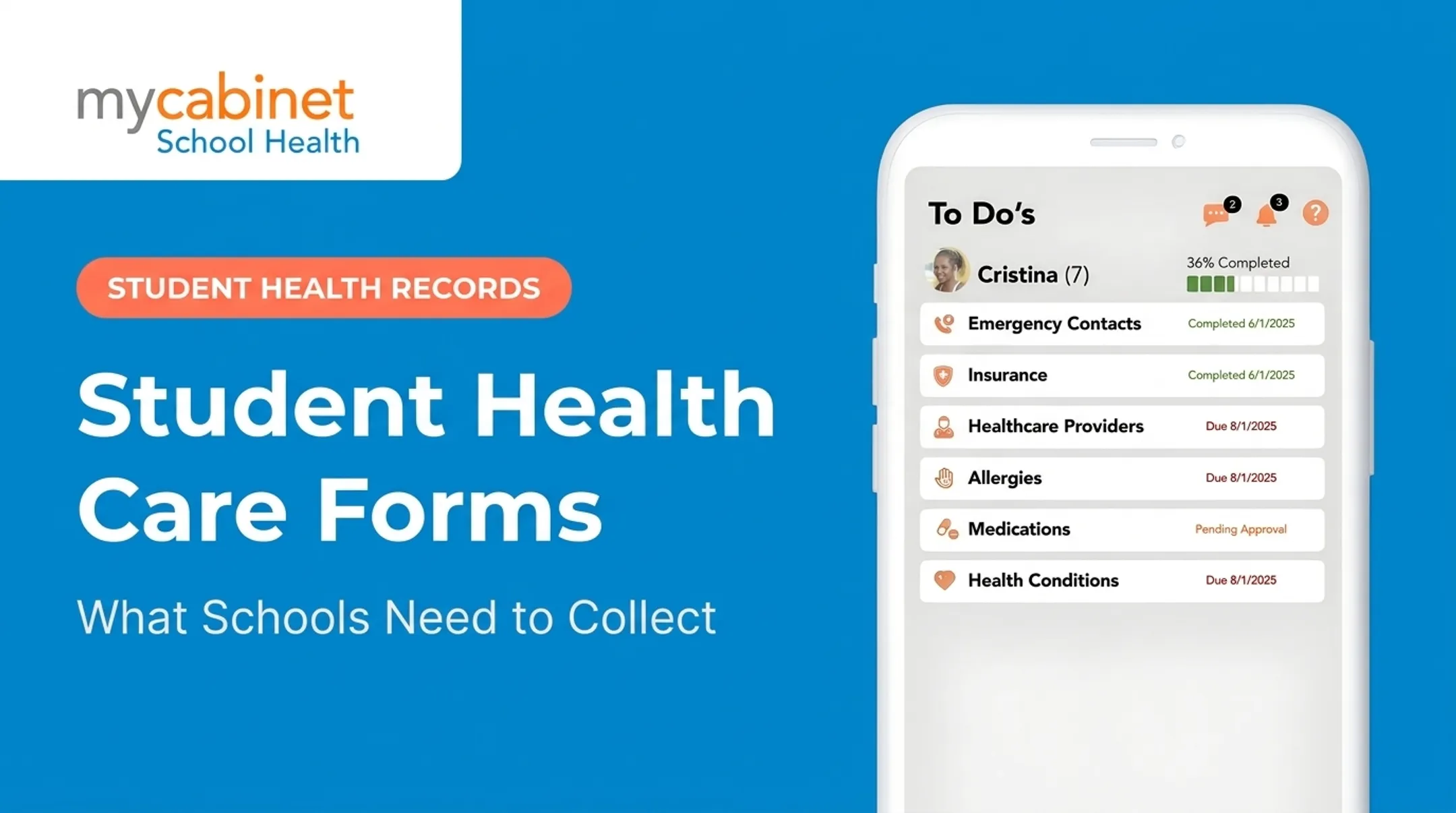
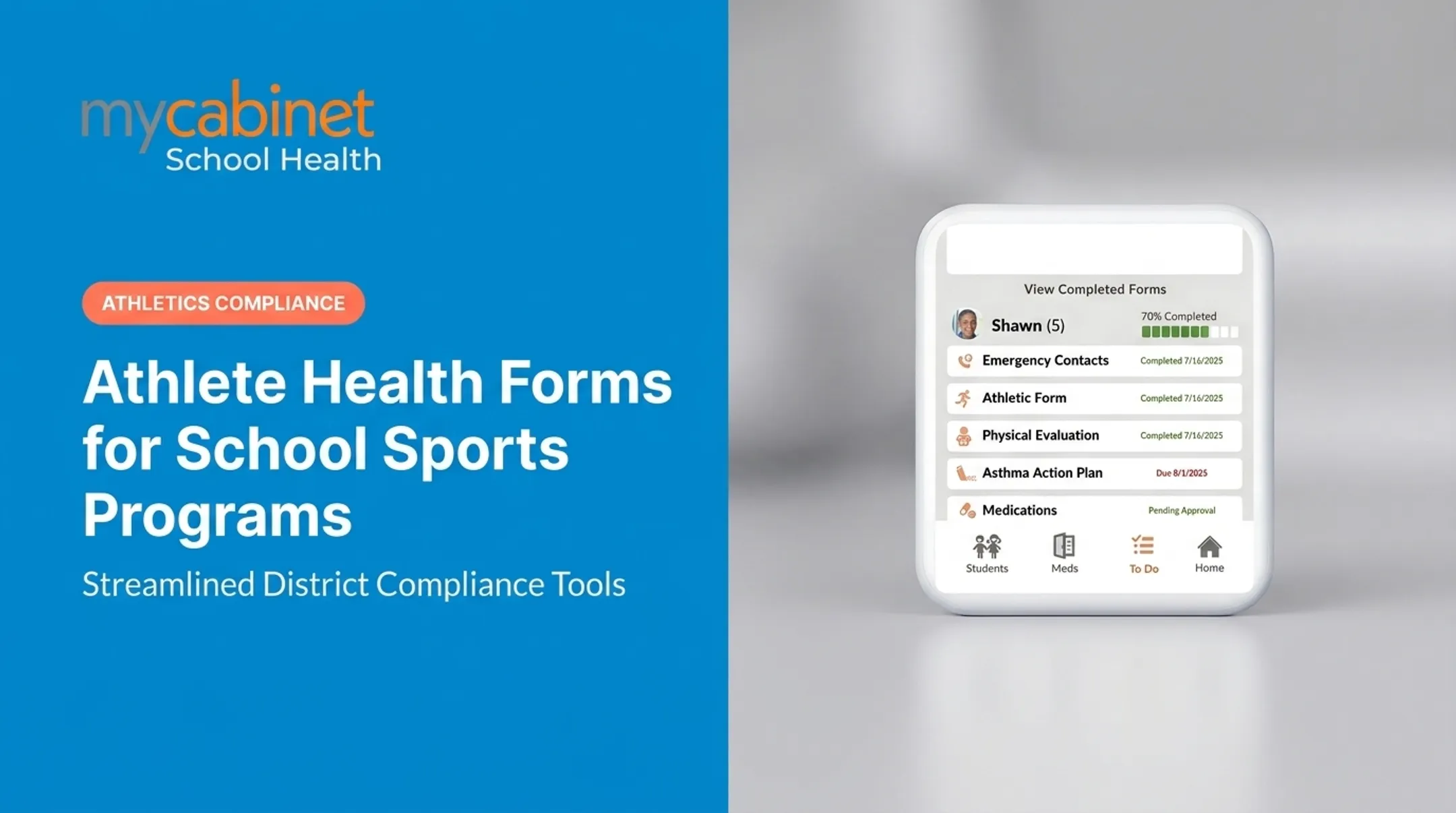
Paper PPE packets and email follow-ups create gaps schools can't afford during sports clearance season. MyCabinet School Health replaces that scramble: parents upload PPE and sports physical forms directly through the MyCabinet Parent App or Parent Web Portal.
Here's how it works in practice:
- Parents sign in through the app (school activation code) or web portal
- They upload the completed PPE or athletic form
- The school nurse reviews the file for completeness
- On approval, the form attaches to the student's electronic health record
On the nurse side, the Nurse Portal task list groups incomplete visits, rechecks, and screening reminders in one color-coded dashboard. Staff can triage outstanding PPE items at a glance instead of flipping through folders.
The platform keeps audit trails and activity logs for FERPA-aligned recordkeeping, so administrators can check compliance status without hunting through paper files.

As Cobb County School District Superintendent Chris Ragsdale noted at a 2025 school board meeting, "MyCabinet digitized and makes documentation easier," with parents submitting paperwork electronically and viewing their child's care history in real time. Nurses spend less time on fax and inbox chase-down—and more time on student care before tryouts and game day.
Best Practices for Schools and Athletic Programs
Whether or not a district uses digital tools, a few habits make PPE season smoother:
- Start early. Collect completed forms at least 4-6 weeks before the season begins, giving time to follow up on flagged conditions or missing signatures.
- Designate one point of contact. A school nurse or athletic trainer should be responsible for verifying form completeness before a student is cleared.
- Keep a master tracking log. Whether it's a spreadsheet or a digital dashboard, someone needs a single source of truth showing which student-athletes have valid, current forms on file.
The NFHS notes that 3-14% of students typically require additional evaluation after their initial PPE—another reason to build in buffer time before the first practice.
Frequently Asked Questions
Where can I find the preparticipation physical evaluation form for my state?
Check your state's high school athletic or activities association website (like FHSAA, UIL, OHSAA, or NJSIAA) for the official current-year form. Generic AAP templates don't always match your state's specific requirements.
What are the state requirements for PPE forms, like Florida's for 2026?
Validity periods, required signatures, and form versions vary by state and often change by school year. Athletic directors should confirm current rules—including any 2025–2026 updates—with their state association before each season.
What should a pre-participation screening include?
Core components are medical and family history, cardiovascular and musculoskeletal exams, and increasingly, mental health and substance use screening questions. The school holds the completed form; the exam itself is done by the student's own provider.
What is the sports physical form called?
Officially, it's the Preparticipation Physical Evaluation (PPE) form. Most people just call it a "sports physical."
How often do student-athletes need to complete a PPE?
Most states require it annually. Clinical PPE5 guidance recommends a full exam every 2-3 years with yearly history updates as needed, but state rules typically take precedence.
Who can perform a preparticipation physical evaluation?
The preferred option is the student's own primary care physician in their medical home, rather than a group or station-based screening at school. That setting gives fuller context on personal and family history.