
For a school nurse, weak medication storage doesn't just mean a messy cabinet. It means delayed treatment when a student needs help fast. It means grabbing the wrong bottle because two students share a last name. It means privacy exposure when health records sit in plain view, and it means hours spent reconstructing what happened after the fact instead of documenting it in real time.
Safer storage isn't about buying a nicer cabinet. It's about combining physical safeguards with repeatable workflows: access control, organization, environmental conditions, ongoing monitoring, and documentation that holds up under review. That's what this guide covers.
Key Takeaways
- Store medications in a secure, access-controlled location with clearly labeled, separated compartments
- Maintain distinct handling procedures for routine, refrigerated, emergency, controlled, expired, and discontinued medications
- Use scheduled checks and reliable documentation to track expiration, custody, administration, and returns
- Align every storage decision with current federal, state, district, and school policy
- Treat digital tracking tools as support for nurse oversight, not a replacement for locked storage
Safety Guidelines for School Nurse Medication Storage
Safe medication storage in a school health office depends on five pillars working every day:
- Controlled access
- Accurate identification
- Correct environmental conditions
- Documented chain of custody
- A clear path from intake to return or disposal
The risks are operational and clinical: student mix-ups, unauthorized access to controlled substances, missed expirations, wrong storage temperatures, privacy breaches, and delays in an emergency. A new cabinet alone will not fix them. Daily checks, scheduled reconciliations, careful handoffs, and regular policy review will.
General Safety Precautions
Start with the basics your district likely already requires, then verify the specifics apply to your building:
- Use a locked cabinet, medication room, or approved secure area, with access limited to authorized personnel. Confirm your district's rules for keys, codes, access logs, and backup access before you assume you know them.
- Organize by student and medication type using legible labels and separated compartments. This single habit cuts down on look-alike, sound-alike selection errors more than almost anything else.
- Keep health records shielded from casual viewing while making sure authorized nurses can still identify the right student, medication, dose, and instructions in seconds.
- Define a clear handoff process that records who delivered, accepted, moved, administered, returned, or disposed of each medication, including any required parent or guardian communication.
Tennessee guidance, for example, requires each student medication in a leakproof container inside a secure or locked area, with cabinet keys limited to staff authorized to administer it. That standard is basic, yet busy weeks are when offices most often skip it.
Storage Setup and Physical Organization
Design storage around how your clinic actually runs, not how a supply catalog shows it. Keep high-use meds easy to reach. Place high-risk or restricted items in extra secured storage when policy requires it.
Give each category its own handling path:
- Routine daily medications
- Emergency medications (epinephrine, rescue inhalers, glucagon)
- Refrigerated medications
- Expired or discontinued items awaiting return
- Medications flagged for parent pickup or disposal
Texas DSHS guidance recommends a locked cabinet or drawer on a secure, solid surface. Limit access to designated health staff and the principal, keep keys on school grounds, and store no more than a one-month supply per student. Refrigerated items belong in a locked box inside the refrigerator, not on an open shelf.
Use bins, dividers, and consistent labels so you verify one student at a time. Loose containers, duplicate stock, and unlabeled packages are how count errors start.
Build a written backup plan for power outages, cabinet failures, lost keys, severe weather, and evacuations. Assign those duties in the medication policy before a crisis hits.
Safety While Retrieving, Administering, and Returning Medication
Every retrieval should follow the same verification sequence, often called the "six rights": right student, right medication, right dosage, right time, right route, and right documentation. State guidance and the American Academy of Pediatrics' 2024 school medication policy both reinforce this framework.

Document immediately after every medication-related action:
- Administration: dose, time, and route given
- Refusal or missed dose: reason and follow-up
- Discrepancy: count mismatch or damaged container
- Parent pickup or transfer: who received it and when
- Disposal: method and witness, where required
Do not wait until end of day to rebuild notes from memory. That gap is how missed-dose errors like those flagged in the North Carolina study take hold.
Controlled substances often carry stricter rules. Washington guidance recommends weekly counts for Schedule II–V medications with a witness confirming the count. Connecticut requires the assigned nurse and a witness to co-sign controlled-medication counts at least weekly. Follow your own state and district rules rather than assuming a national standard.
When something looks wrong, stop. An unreadable label, expired medication, wrong count, damaged container, or instructions that conflict with the student record all mean the same response: pause, secure the medication, notify the right authority, and document what you found and how you resolved it.
Environmental and System Safety Considerations
Physical security is only half the job. Storage conditions matter just as much.
Not every medication can share a cabinet. Some need refrigeration. Some need protection from light. Follow manufacturer and pharmacy instructions, not whatever is easiest that day.
Texas guidance keeps refrigerated medications between 33 and 45°F, with regular temperature checks and documentation. Tennessee is stricter on timing: if storage falls outside manufacturer recommendations for more than a few hours, discard the medication rather than give it. Log temperature checks, cleaning, backup power status, and the steps you take when conditions drift out of range.
Emergency medication readiness needs its own plan. A national review of stock epinephrine laws across all 50 states and D.C. found wide variation: 26 states specified secure storage, 22 specified accessibility, and states split on locked versus unlocked placement. North Carolina, for example, requires at least two epinephrine delivery systems in a location that is secure but unlocked and easy to reach. Confirm your state's rule instead of copying a neighboring district.

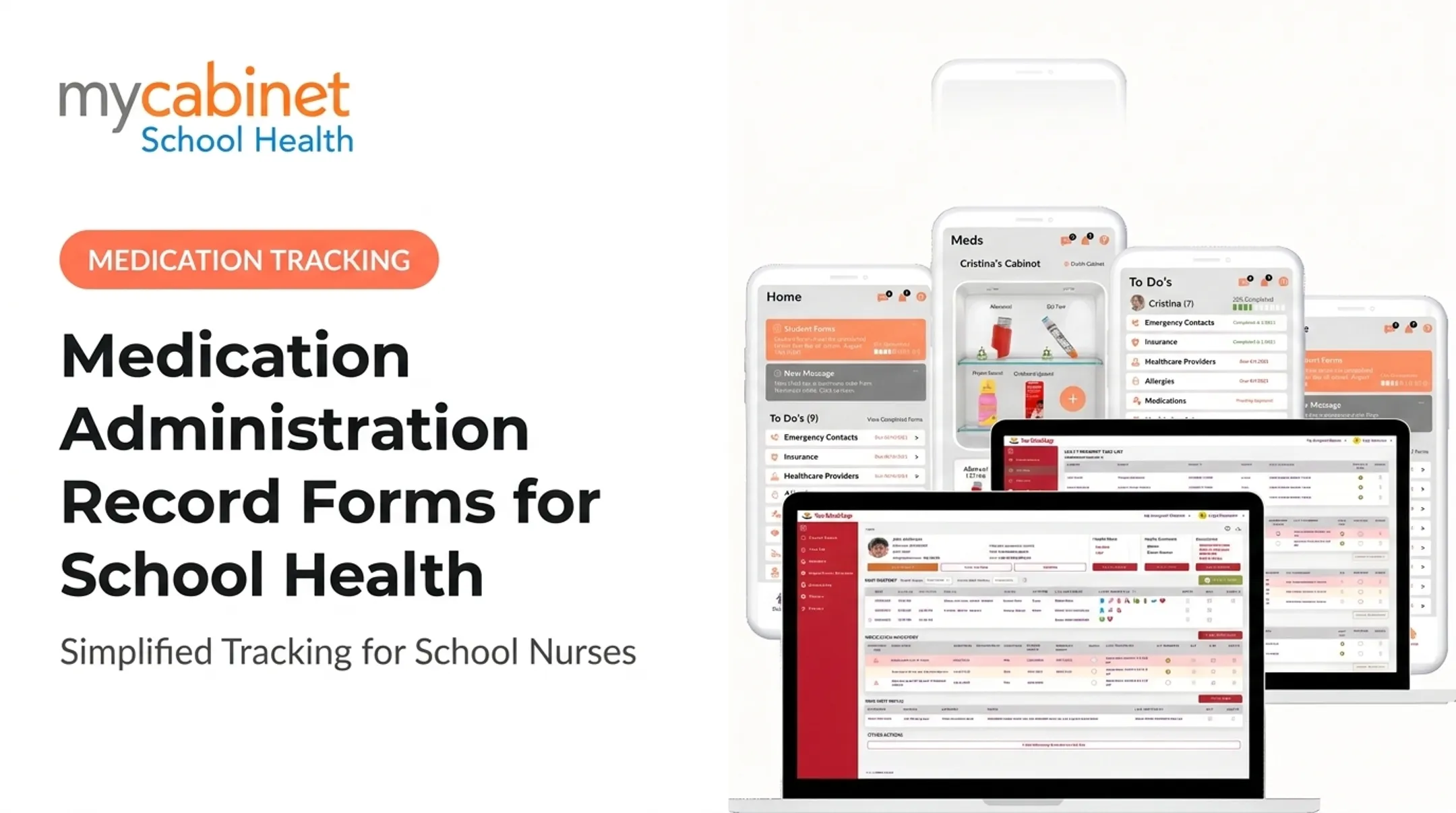
Digital tools support the habits above. MyCabinet School Health tracks expiration dates, shows dosage and frequency at a glance, logs medication-related outreach, and keeps an audit trail on each student profile.
It will not lock a cabinet or read a refrigerator thermometer for you. It will surface expiring medication, overdue counts, and pending outreach before those tasks slip during a busy clinic day.
Common Storage Mistakes to Avoid
Most storage failures trace back to a handful of repeatable mistakes:
- Storing everything together. Mixing students, medication statuses, and storage conditions in one mixed space raises retrieval time and mix-up risk.
- Relying on an unlocked drawer or shared key because "the health office is usually attended." Unauthorized access, privacy exposure, and weak accountability follow.
- Skipping reconciliation after a nurse absence, student transfer, or parent pickup. Physical inventory and digital records drift apart fast without a documented handoff.
- Leaving expired or unlabeled medication in active storage. A spreadsheet and calendar reminder alone are not enough expiration control.
- Focusing on how the cabinet looks. Emergency readiness, temperature logs, controlled-substance procedures, and staff training still have to work.
A tidy cabinet with no working expiration process is still a liability. MyCabinet School Health notifies parents when a school-stored medication is nearing its expiration date and gives nurses a clear window to act before it becomes a compliance gap.

Conclusion
Safer school nurse medication storage depends on several practices working together:
- Secure physical organization
- Condition-appropriate storage
- Restricted access
- Consistent verification
- Documentation completed when each action happens, not reconstructed later
Review the full medication workflow regularly with nursing leadership and administration. Policies shift, staff turnover occurs, and what worked last year may not meet this year's district or state requirements.
Simple, repeatable systems free nurses to spend less time untangling confusion and more time on student care. They also give families clearer visibility into how their child's medications are handled, which matters just as much as getting the storage itself right.
Frequently Asked Questions
How should medication be stored at school?
In a locked, access-controlled area with student-specific labeling and separation by medication type. Maintain appropriate temperature and light conditions, monitor expiration dates, and follow current school and state legal requirements.
Should all student medications be kept in one locked cabinet?
A secure central location often works, but medications still need separation by student, status, and risk level. Refrigerated, emergency, controlled, expired, and discontinued medications each needs its own handling procedure.
How should refrigerated medications be stored at school?
Follow the label, pharmacy, and manufacturer instructions, along with your district's policy. This typically means a locked box inside the refrigerator, regular temperature monitoring, and a documented escalation process for excursions.
How can a school nurse prevent medication expiration?
Schedule regular expiration reviews and inventory reconciliation, and use reminders or task lists to stay ahead of dates. Reach out to families before expiration, then remove or return expired medication promptly according to district policy.
How should emergency medications be stored in a school?
Emergency medications should stay secure but quickly accessible to authorized responders. Keep them clearly identified, current, replenished after use, and included in the school's emergency response procedures.
What documentation should schools maintain for stored medications?
Track receipt, authorization, storage conditions, administration, discrepancies, parent communication, returns, disposal, and staff handoffs. Requirements vary by state and district, so confirm current policy directly with your local guidance.