
K–12 student health data covers a lot of ground: health histories, allergies, current medications, immunization status, clinic visit notes, individualized care plans, screening results, and the health forms and messages parents submit to the school. When that information sits in a digital system, protecting it becomes a full-time responsibility, not a one-time setup task.
This article covers what threatens student health data in schools, which laws actually apply, what safeguards districts should require, and how to put those protections in place without burying school nurses in extra clicks and paperwork.
Key Takeaways
- Protect student health data across its entire lifecycle, from intake through storage, sharing, and disposal.
- Combine least-privilege access, strong authentication, encryption, audit trails, and tested backups.
- Treat FERPA, HIPAA, and state privacy laws as related but separate compliance obligations.
- Build security into nurse workflows so staff never resort to shared logins or personal devices.
- Review access, vendors, and incident readiness on an ongoing basis, not once a year.
What Threatens K–12 Student Health Data?
Student health records sit at the intersection of two high-value data types: personally identifiable information and medical detail. A record that ties a child's name, address, and family contacts to a mental health diagnosis or chronic condition is more sensitive than either piece alone—and a leak can follow that student into adulthood.
Security failures hit three areas at once:
- Confidentiality: unauthorized viewing or disclosure of a student's health information
- Integrity: altered medication dosages, wrong allergy entries, or falsified visit records
- Availability: nurses locked out of records during an actual health event
Common Ways Schools Get Exposed
Most incidents trace back to a short list of recurring problems:
- Phishing emails, stolen credentials, ransomware, and compromised staff accounts
- Lost or stolen laptops, tablets, USB drives, and printed clinic paperwork
- Misdirected emails, screenshots, or informal sharing through personal messaging apps
- Excessive permissions, dormant accounts, shared logins, and incomplete offboarding
- Vulnerable third-party vendors, integrations, and outdated legacy systems
School workflows widen those gaps. Substitute nurses need fast access without shared passwords, students transfer mid-year, and staff move between buildings while keeping access they no longer need. Ordinary handoffs become exposure points.
The scale is well documented. A 2025 CIS/MS-ISAC report analyzing more than 5,000 K-12 organizations found that 82% of reporting schools experienced cyber-threat impacts between July 2023 and December 2024, with over 9,300 confirmed incidents.

Health data is part of that trend. In January 2025, PowerSchool disclosed a breach through its customer-support portal that exposed student and staff data, including limited medical-alert information. Districts nationwide moved to reassess vendor access controls.
The fallout is concrete:
- Investigation costs, legal exposure, and disrupted nurse services during response
- Lost family trust after a child's health details surface
- Stigma or peer discrimination when a condition is exposed
- Patient-safety risk if a medication or allergy record is altered or unavailable
What Compliance Responsibilities Apply to School Health EHRs?
Districts often assume FERPA and HIPAA both cover every student health record. They don't, and treating one framework as enough can leave real gaps.
In most public K–12 settings, HIPAA does not apply. According to the joint guidance from the U.S. Department of Education and HHS, a school isn't a HIPAA-covered entity simply because it employs a nurse or health provider.
Student health information the school maintains is typically a FERPA education record. FERPA's consent rules and disclosure exceptions control who can access it, not HIPAA's Privacy Rule.
That distinction matters for districts working with a vendor. A contractor acting on the school's behalf, like a school health EHR provider, typically holds FERPA education records rather than HIPAA-protected health information. HIPAA only enters the picture if the provider is a covered entity running covered electronic transactions, such as health-plan billing.

FERPA and HIPAA aren't the whole picture, either. Districts also need to check:
- State student privacy laws – New York's Education Law 2-d, for example, treats unauthorized access as a breach and requires reporting to the Chief Privacy Officer
- Breach notification timelines – Under Illinois SOPPA, vendors have 30 days to notify the school; schools then have 30 days to notify parents
- Records retention schedules set by the district or state
- Vendor contract terms covering data ownership, security obligations, and breach response
Whatever the legal classification, the practical safeguards fall into three familiar buckets, following the structure NIST uses in its HIPAA Security Rule guidance:
| Safeguard Type | What It Covers |
|---|---|
| Administrative | Risk analysis, policies, staff training, incident response, vendor oversight |
| Physical | Secured nurse offices, device custody, screen privacy, paper disposal |
| Technical | Authentication, encryption, audit logging, session controls, backups |
Apply all three as baseline requirements in vendor contracts and internal policy, regardless of which law governs a given record.
What Security Safeguards Should Schools Require?
Once you know what's at stake and which rules apply, the next question is concrete: what should actually be in the contract or the system configuration?
Access and Authentication
- Role-based, least-privilege access so nurses, administrators, teachers, IT staff, and parents each see only what their role requires
- Unique accounts for every user: no shared clinic logins, even for quick coverage days
- Multi-factor authentication on accounts with access to health records
- Documented procedures for substitute staff, mid-year transfers, and emergency access requests
- Periodic access reviews to catch dormant accounts and outdated permissions before they become a liability
Data Protection and Visibility
Encryption in transit and at rest is table stakes, but districts should verify the details, not just take a vendor's word for it. Ask about key-management practices, hosting controls, and independent assurance documentation such as a SOC 2 report.
Audit trails matter just as much. A system should log who accessed a record, what they searched for, what they added or edited, and any exports or downloads. Someone at the district needs to actually review those logs, not just collect them.
Visibility into who touched a record is only half the job. Structured documentation protects data integrity in ways a spreadsheet or shared folder can't. Predefined visit types, dosage validation, and change tracking on clinically important updates all reduce the chance of a medication error caused by a typo or an outdated entry.
Vendor Evaluation
Before signing with any school health EHR vendor, check for:
- Independent security certifications (SOC 2 Type II is a common benchmark)
- Clear incident notification terms and timelines
- Defined data ownership, retention, and deletion policies
- Documented disaster recovery and backup testing
- FERPA-aligned contractual language on data use and re-disclosure
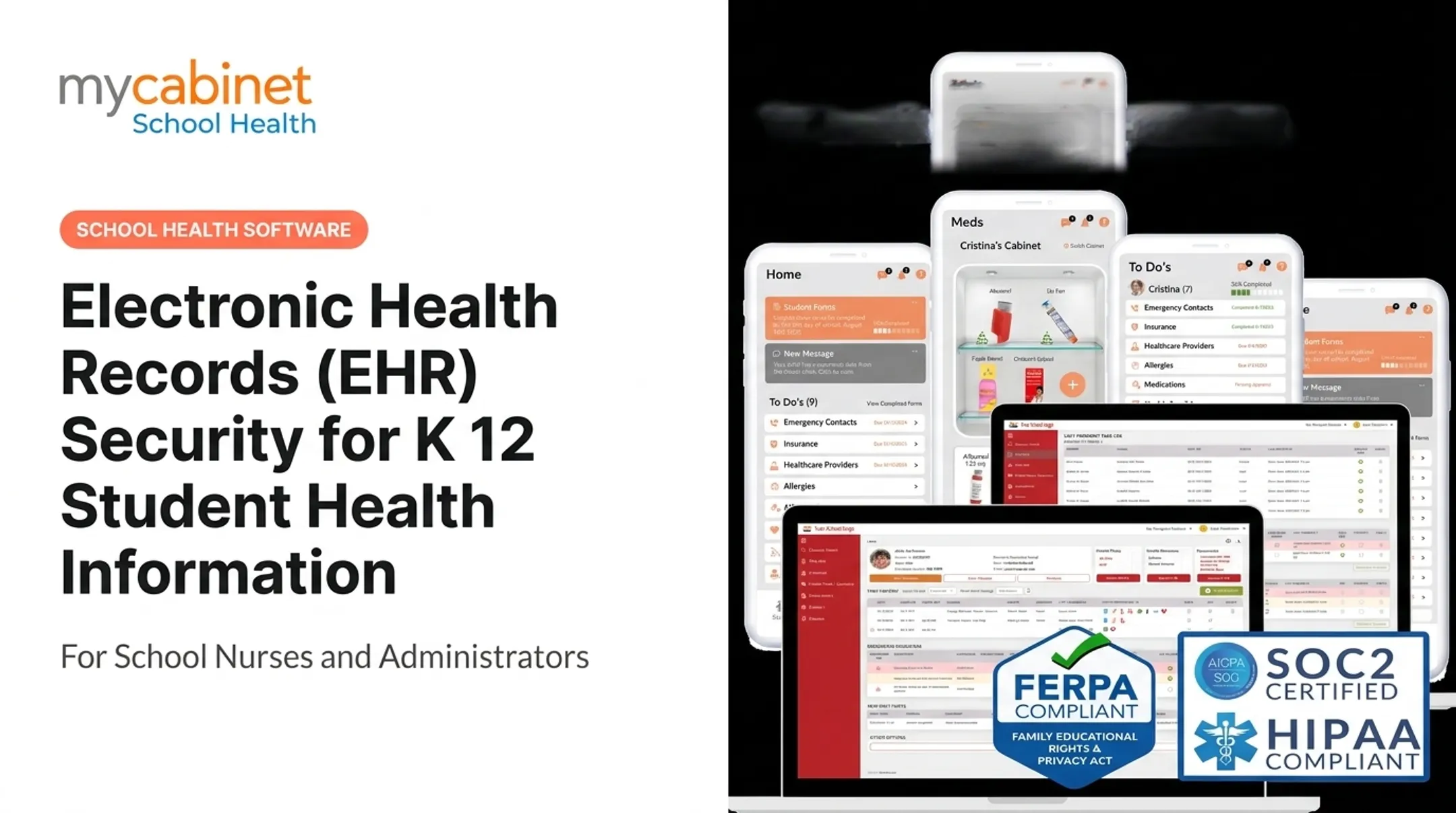
MyCabinet School Health, for example, builds its platform around role-based permissions, audit trails, and encrypted data handling. It holds SOC 2 Type II certification and maintains HIPAA and FERPA compliance commitments. Districts should expect that same level of documentation from any vendor that handles student health data.
How Should Schools Implement EHR Security Without Disrupting Nurse Workflows?
Security policies that ignore how a clinic actually runs tend to get worked around. If logging in takes too long, nurses share a password. If a form process is too rigid, staff go back to paper. Good implementation starts with mapping reality, not writing a policy in a vacuum.
Start With a Data-Flow Assessment
Document where student health information is collected, stored, accessed, transmitted, printed, and eventually deleted, across every school building and every vendor involved. This exposes the gaps nobody thought to ask about, like a screening program that still emails spreadsheets between two office staff.

Match Permissions to Real Roles
Test access with actual users before rolling anything out district-wide:
- School nurses covering daily clinic visits
- Substitutes who need fast, temporary access
- District administrators who need aggregate visibility, not individual chart access
- Parents, who should see only their own child's information
Build Security Into Daily Clinic Work
- Use individual logins with fast, secure session handling on shared clinic devices
- Create clear steps for urgent access during outages, with later reconciliation
- Keep medication administration, expiration tracking, and follow-ups visible inside one workflow instead of scattered across tools
- Replace paper, fax, and manual email with auditable digital processes
This is the gap a purpose-built school health EHR is meant to close. Platforms like MyCabinet School Health align access controls, documentation, and communication with how a nurse's day actually runs. Structured visit types, medication expiration alerts, and digital form review and approval sit inside the workflow rather than bolted onto a generic records system.
Parents get a connected app and web portal for submitting forms and receiving updates, while nurses retain control over what gets shared and when.
Train and Test, Don't Just Publish a Policy
- Run role-specific training on phishing, password hygiene, screen privacy, and approved communication channels
- Test readiness with tabletop exercises and simulated phishing, not just a signed acknowledgment form
- Get feedback from nurses and IT after each test. Workflow friction is a security risk, too
How Should Schools Govern Security and Respond to Incidents?
Security isn't a project with an end date. It needs an owner, a review cycle, and a plan for the day something goes wrong.
Assign Ownership Clearly
District leadership, nursing leadership, IT/security, legal counsel, vendors, and school-site administrators should each have a defined role. Document escalation paths and after-hours contacts so that when an incident hits at 6 a.m. on a Saturday, nobody is guessing who to call.
Keep a Governance Cycle Running
- Review access after every role change, transfer, or staff departure
- Monitor audit logs for unusual access, bulk downloads, or repeated failed logins
- Reassess vendors and integrations after any system change
- Track remediation deadlines for identified weaknesses until they're closed
Have an Incident Response Plan Before You Need One
- Contain the event while preserving logs and evidence
- Notify district leadership, IT, the vendor, legal counsel, and families as required
- Assess whether health data was viewed, altered, lost, or exfiltrated
- Restore services, validate record integrity, and document every decision
A quick self-check for district leaders:
- Data inventory and risk assessment on file
- Access review completed recently
- MFA enabled on all health record accounts
- Encryption and backup restore tested
- Vendor contracts checked for security terms
- Incident response exercise run in the last year
- Family communication plan drafted before you need it
Those checklist items only hold if day-to-day controls match the plan. Controlled, one-way parent notifications and medication oversight tools, such as those in MyCabinet School Health, support accountability with auditable communication and tightly scoped access.
Software alone still doesn't guarantee compliance or stop every breach. Secure student health records depend on continuous governance, workable processes, trained staff, and controls you test regularly—not a certificate filed away after go-live.
Frequently Asked Questions
What are the safety and security measures required for electronic health records?
School EHR security combines administrative, physical, and technical safeguards. Core measures include role-based access, strong authentication, encryption, audit trails, staff training, secure communication, tested backups, and a documented incident response plan.
What are the risks of electronic health records?
Key risks include unauthorized access, phishing and ransomware, insider misuse, lost or stolen devices, and third-party vendor exposure. Schools also face altered records, service outages, and errors when staff bypass awkward workflows.
What are the ethical concerns surrounding electronic health records?
Core concerns include confidentiality, minimum-necessary access, data accuracy, and transparency with families. Student dignity should sit alongside operational efficiency, and equity should guide access and information-sharing decisions.
What are the five C's of confidentiality?
A common ethics framework lists Consent, Court Order, Continued Treatment, Comply with the Law, and Communicate a Threat. These are circumstances where disclosing confidential health information may be appropriate. In schools, they guide when student health data can be shared beyond the care team.